
Compliance & Accreditation · November 16, 2026
Apheresis in Blood Centres: Types, Donor Rules and Licence Requirements in India
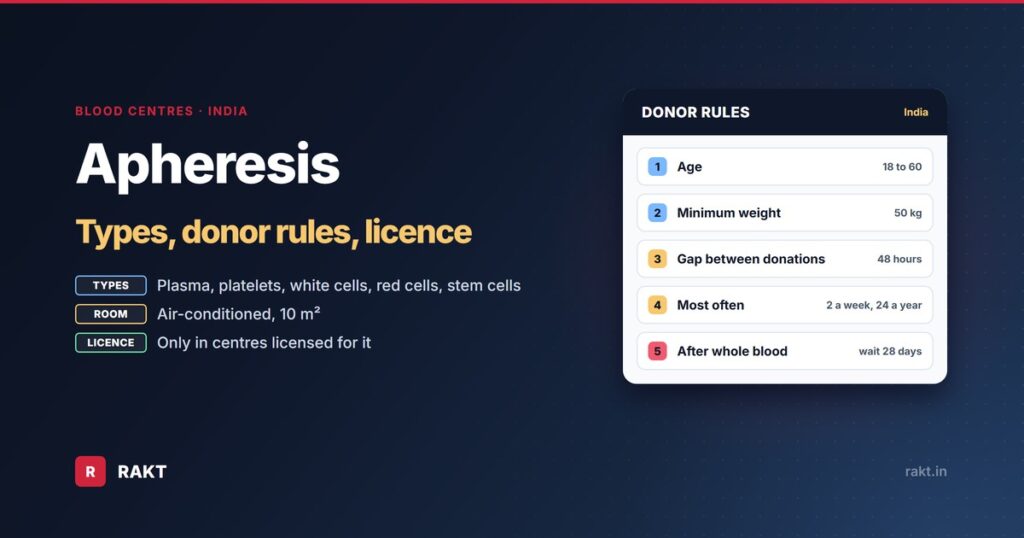
A man who gives whole blood can donate about four times a year. A platelet or plasma donor, giving by apheresis, can donate up to 24 times a year.1
That difference is why apheresis matters to blood centres. One donor, on one machine, can give a whole bag of platelets or a large volume of plasma, and come back within days. But the rules for apheresis are stricter than for whole blood, for the donor, the room, the staff and the licence.1, 2
This guide explains what apheresis is, its types, the donor rules in India, and what a blood centre needs before it can offer it.
What is Apheresis?
Apheresis is a procedure in which blood is drawn from a donor, one part such as plasma, platelets or white cells is separated by a machine, and the rest of the blood is returned to the same donor. The machine is called a cell separator.1, 2
| At a glance | Apheresis |
|---|---|
| What it does | Collects one part of the blood and returns the rest to the donor |
| Machine | Cell separator |
| Types | Plasma, platelets, white cells, double red cells, stem cells, plus therapeutic apheresis |
| Donor age | 18 to 60 years |
| Minimum weight | 50 kg |
| Gap between donations | At least 48 hours, no more than twice a week, 24 times a year |
| Where | Only in a blood centre licensed for apheresis |
| Room | Air-conditioned, 10 square metres |
The figures come from the Drugs and Cosmetics Rules and the national standards for blood centres, cited in the sections below.1, 2
Types of Apheresis
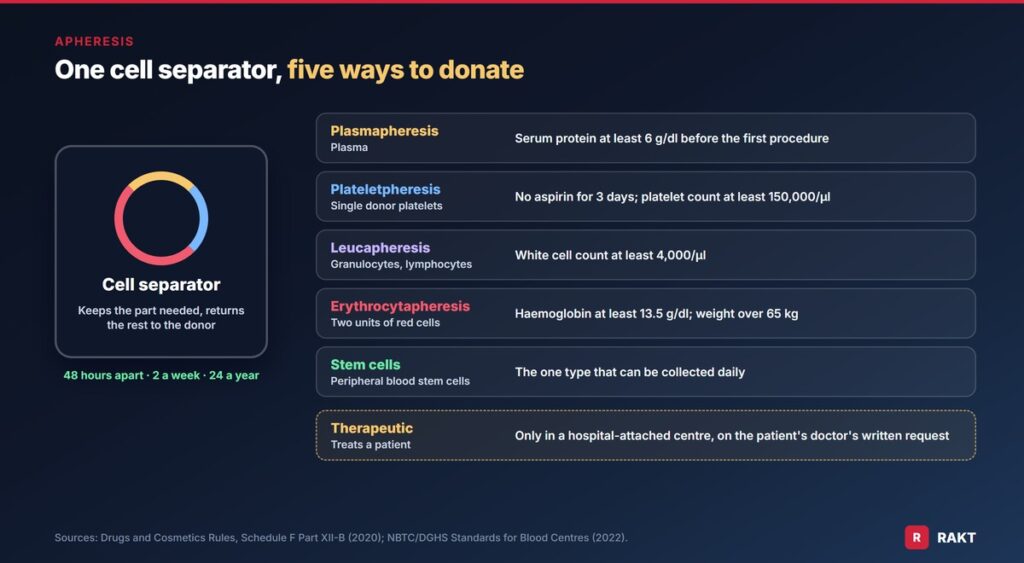
The Drugs and Cosmetics Rules list five types of donor apheresis. The key rules in the table come from the rules and the national standards:1, 2
| Type | What is collected | A key rule |
|---|---|---|
| Plasmapheresis | Plasma | Total serum protein of at least 6 g/dl before the first procedure |
| Plateletpheresis | Single donor platelets (SDP) | No aspirin in the 3 days before; platelet count of at least 150,000/µl |
| Leucapheresis | Granulocytes, lymphocytes or mononuclear cells | White cell count of at least 4,000/µl with a normal differential |
| Erythrocytapheresis | Two units of red cells from one donor | Haemoglobin of at least 13.5 g/dl and weight over 65 kg |
| Stem cell apheresis | Peripheral blood stem cells | Can be done daily, unlike other types |
The National Standards group these into plasmapheresis and cytapheresis, which covers every type that collects cells.2 A sixth use, therapeutic apheresis, treats a patient rather than collecting from a donor. It has its own rules, covered further down.
For platelets in more detail, our guide to SDP vs RDP platelets compares apheresis platelets with platelets made from whole blood.
Apheresis vs Whole Blood Donation
| Whole blood | Apheresis | |
|---|---|---|
| What is collected | The whole unit, separated into components later | Only the part needed; the rest goes back to the donor |
| Age | 18 to 65 (first-time donors up to 60) | 18 to 60 |
| Minimum weight | 45 kg for a 350 ml bag; over 55 kg for 450 ml | 50 kg |
| Haemoglobin | At least 12.5 g/dl | At least 12.5 g/dl |
| Gap between donations | 90 days for men, 120 days for women | At least 48 hours |
| Most in a year | About 4 for men, 3 for women | 24, and no more than twice a week |
The table follows the 2020 donor selection criteria in the Drugs and Cosmetics Rules.1
The two kinds of donation also limit each other. After giving whole blood, a donor must wait 28 days before giving platelets or plasma by apheresis. After giving platelets, a donor must wait 28 days before giving whole blood, or 90 days if their red cells could not all be returned during the procedure.1, 2
Donor Rules For Apheresis in India
An apheresis donor must meet the normal donor criteria, plus these extra rules.1, 2
Who can donate
- Age 18 to 60, and at least 50 kg.1
- No donation of any type within 12 months of a bone marrow harvest, or 6 months of a peripheral stem cell harvest.1
- For platelets: no aspirin in the 3 days before, and no personal or family history of bleeding problems.1, 2
How often
- At least 48 hours between procedures, no more than twice a week, and no more than 24 times a year. Stem cell collection is the exception and can be daily.1, 2
- Donors who give plasma no more than once every 12 weeks, or cells no more than once every 4 weeks, are treated like ordinary whole blood donors.2
Tests before the procedure
- Haemoglobin of at least 12.5 g/dl, as for any donor.1 Donors who give more often than once every 12 weeks are tested before every procedure, and need haemoglobin of at least 12.5 g/dl and/or a haematocrit of at least 38%.2
- For plasma: total serum protein of at least 6 g/dl before the first procedure, and again before the third if all three fall within four weeks.1, 2
- For platelets: a platelet count of at least 150,000/µl. A donor below that is deferred until a later count reaches it.2
- For white cells: a total count of at least 4,000/µl with a normal differential.2
How much can be taken?
- The Drugs and Cosmetics Rules allow no more than 500 ml of plasma per sitting and once a fortnight, or 1,000 ml a month.1
- The national standards put it as no more than 500 ml per procedure, 1,000 ml a month and 12 litres a year, for a donor of at least 55 kg.2
- The blood outside the body at any time must not exceed 15% of the donor’s estimated blood volume, and red cell loss in cell collections must be no more than 25 ml a week.2
Consent and care
- The donor signs an informed consent in a language they understand, after the procedure and its risks are explained.2
- Staff watch closely for reactions such as headache, fainting, a fast heartbeat, twitching or breathlessness.2 Our guide to transfusion reactions covers what to do on the recipient’s side.
Licence and Facility Requirements
Apheresis can be carried out only in a blood centre licensed for that purpose.2 Before a centre adds it, it needs four things in place.
1. The licence
A centre that already holds a blood centre licence applies to the licensing authority to add apheresis items. The rules set a fee of ₹300 for each item added to a licence.1 Our guides to the Form 28-C licence and licence renewal explain the process.
2. The room
An air-conditioned area of 10 square metres for apheresis and therapeutic procedures.1 The national standards add that the air-conditioned blood collection area may be used for apheresis.2
3. The equipment
- A cell separator.
- A dielectric tube sealer.
- Emergency items: an oxygen cylinder with mask, gauge and regulator; 5% glucose or normal saline; sterile disposable syringes, needles and IV sets; and the emergency injections listed in the rules.
The list comes from the 2020 amendment to the Drugs and Cosmetics Rules.1
4. The people
- A medical officer trained in apheresis is responsible for every procedure.2
- Staff who run the machine are trained in apheresis and work under the medical officer’s direct supervision.2
- Emergency medical care must be available if a donor has a reaction.2
Apheresis Products and Quality Control
Single donor platelets (SDP)
- At least 3 × 10¹¹ platelets per unit, in at least 75% of units tested. Test 1% of monthly production or 4 units a month, whichever is higher.1, 2
- pH of 6 or above at the end of storage,1, 2 and a volume of at least 200 ml.2
- Stored for up to 5 days at 20 to 24 °C with continuous agitation.1, 2
- To be called leucoreduced, a unit must contain fewer than 5 × 10⁶ white cells.2
Granulocytes
- At least 1 × 10¹⁰ cells per unit.2
- Stored at 20 to 24 °C for up to 24 hours, without agitation, and transfused as soon as possible, preferably within 6 hours.2
- Irradiated, crossmatched if they contain more than 2 ml of red cells, and never given through a micro-aggregate filter.2
Every apheresis product’s label must say it was collected by apheresis and show its approximate volume.2 Our guides to quality control in a blood bank and blood bank labels cover both in full.
Therapeutic Apheresis in a Blood Centre
Therapeutic apheresis removes something harmful from a patient’s blood. Therapeutic plasma exchange, often just called plasmapheresis in hospitals, is the best-known example. It is not the same as donating plasma: the patient’s plasma is removed and replaced, rather than collected for someone else.
Indian rules allow it only under these conditions:1, 2
- The blood centre is attached to a hospital with apheresis facilities.
- A registered medical practitioner is responsible for the procedure.
- The patient’s own doctor has asked for it in writing.
- The patient gives informed consent, in a language they understand.
- The patient’s doctor provides any emergency care. The national standards say it is done in the blood centre or, preferably, in the ward, depending on the patient’s condition.
The record must show the patient’s identity, diagnosis, the procedure and method, the blood volume removed and returned, the time taken, the type and volume of replacement fluid, any reaction and any medication given. It is signed by the medical practitioner and the blood centre’s medical officer.1, 2
Records to Keep for Donor Apheresis
For every apheresis donor, the national standards expect:2
- Periodic examinations and laboratory tests.
- The signed consent.
- The date of the last apheresis.
- The attending physician’s certificate.
- Procedure details and the volume of product separated.
- Any drugs used, any adverse reaction and its treatment.
The date of the last apheresis is the record that matters most day to day. It is how staff prove the 48-hour gap, the twice-a-week limit and the 24-a-year limit were respected.
Every Apheresis Unit, with its Own Expiry
An SDP lasts 5 days. Granulocytes last a day. Each apheresis product has its own storage temperature and its own clock, and they sit in the same stock as components made from whole blood. RAKT keeps them in one record:
- Component preparation covers apheresis products as well as components from whole blood, each with its own volume, storage temperature and expiry.
- SDP is recorded as its own component type, alongside PRBC, FFP, RDP and cryoprecipitate.
See how RAKT tracks component preparation, or book a demo on WhatsApp.
Frequently asked questions
What is apheresis in simple words?
Apheresis is a way of donating only one part of your blood. A machine draws blood, keeps the plasma, platelets or other part needed, and returns the rest to you during the same sitting.
What are the types of apheresis?
Indian rules list five: plasmapheresis (plasma), plateletpheresis (platelets), leucapheresis (white cells), erythrocytapheresis (two units of red cells) and stem cell apheresis. Therapeutic apheresis, used to treat patients, is a separate category.
What is the difference between apheresis and whole blood donation?
Whole blood donation takes a full unit, which is separated later. Apheresis takes only the part needed and returns the rest, so donors can give more often: as often as every 48 hours, up to 24 times a year.
How often can you donate by apheresis in India?
At least 48 hours apart, no more than twice a week and no more than 24 times a year. Stem cell collection is the exception and can be done daily.
What is the age and weight limit for apheresis donors?
Apheresis donors must be 18 to 60 years old and weigh at least 50 kg. The national standards’ plasma volume limits are set for donors of at least 55 kg.
How long after platelet donation can I donate whole blood?
28 days, if all your red cells were returned during the platelet donation. If they could not all be returned, you must wait 90 days.
Is plasmapheresis the same as plasma exchange?
Not quite. Donor plasmapheresis collects plasma from a healthy donor for others. Therapeutic plasma exchange removes a patient’s plasma and replaces it. Hospitals often call both plasmapheresis.
What is the difference between apheresis platelets and platelet concentrate?
Apheresis platelets (SDP) come from one donor on a cell separator, with at least 3 × 10¹¹ platelets in a unit. Platelet concentrate (RDP) is separated from one whole blood donation, so an adult usually needs several units from different donors.
How much space does an apheresis room need?
The Drugs and Cosmetics Rules require an air-conditioned area of 10 square metres for apheresis and therapeutic procedures.
Does a blood centre need a separate licence for apheresis?
Apheresis must be done in a blood centre licensed for it. A centre that already holds a licence applies to add apheresis items, with a fee of ₹300 for each item added.
Sources
- Drugs and Cosmetics Rules, 1945: rule 122-EA, and Schedule F, Part XII-B, as amended by G.S.R. 166(E), 11 March 2020 cdsco.gov.in
- National Blood Transfusion Council and Directorate General of Health Services, Ministry of Health and Family Welfare. Standards for Blood Centres and Blood Transfusion Services. 2nd edition, 2022 clinicalestablishments.mohfw.gov.in