
Blood Bank Software · November 6, 2026 · Updated November 10, 2026
Blood Transfusion Reactions: Types, Signs, What to Do and How to Report Them in India
Forty minutes into a unit of packed red cells, the patient starts to shiver. The nurse has to decide quickly: is this a mild fever, or the start of something that can kill?
Indian blood centres reported 8,169 transfusion reactions to the national haemovigilance programme in 2018 and 2019. That is about 8.6 reactions for every 10,000 blood products transfused, and those are only the ones that got reported.1
The good news is that most reactions are mild, and about 98% of patients recovered.1 What helps most is a fixed routine: stop, check, inform, test and report. This guide covers the types of transfusion reaction, the signs of each, what to do at the bedside, and how to report a reaction in India. It is written for nurses, doctors and blood centre staff.
What is a Blood Transfusion Reaction?
A blood transfusion reaction happens when a person’s body reacts badly to blood or blood products received from another person during a blood transfusion.
In simple words: When someone receives blood from a donor, their body may sometimes recognize something in that blood as harmful or foreign and react to it. This reaction is called a Blood Transfusion Reaction.
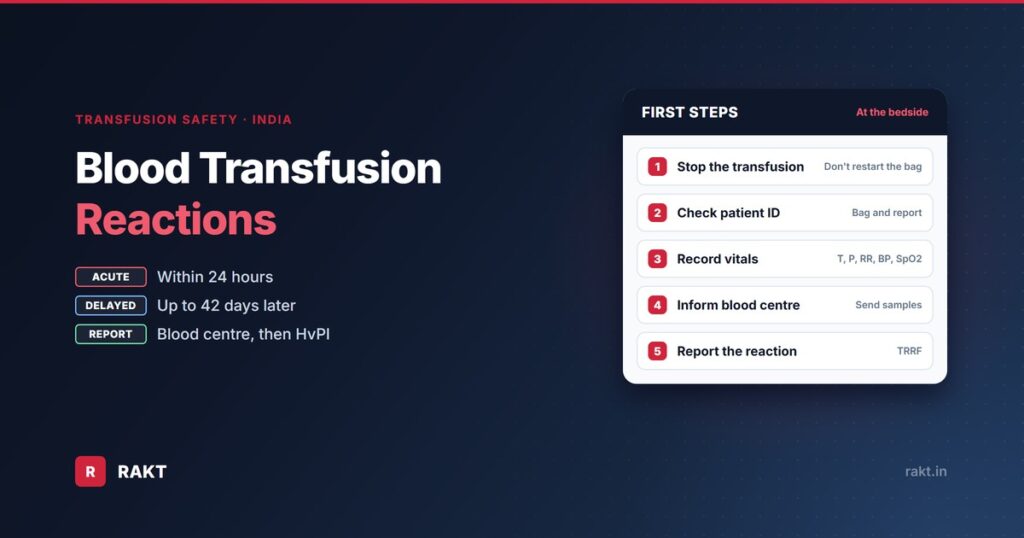
Acute reactions start during the transfusion or within 24 hours. Delayed reactions start after 24 hours, sometimes weeks later. They range from mild fever and itching to life-threatening haemolysis, TRALI and TACO.2
India’s Haemovigilance Programme uses the international (ISBT) definitions, and so does national guidance from the National Institute of Biologicals (NIB).2 Using the same names matters. A reaction called “fever” on one ward and “FNHTR” on another is hard to count or compare.
Types of Transfusion Reactions
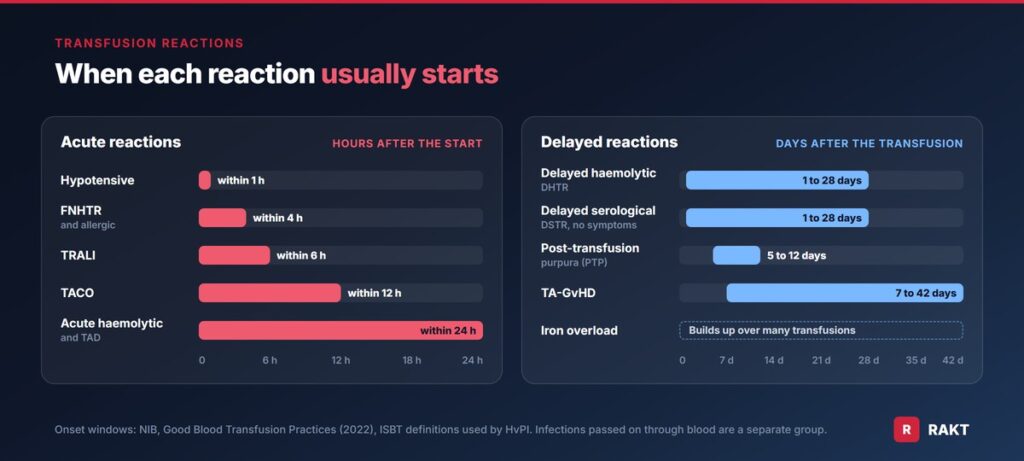
Reactions are sorted two ways: by when they start (acute or delayed) and by cause (immune or non-immune). Infections passed on through blood form a separate group.2
| Reaction | Type | Usually starts | Main signs |
|---|---|---|---|
| Hypotensive reaction | Acute, non-immune | Within 1 hour | Systolic BP falls by 30 mmHg or more, to 80 mmHg or below |
| Febrile non-haemolytic reaction (FNHTR) | Acute, immune | Within 4 hours | Fever of 38 °C or more with a rise of at least 1 °C, or chills and rigors |
| Allergic reaction, up to anaphylaxis | Acute, immune | Within 4 hours | Itching, hives, rash, swelling of the lips, tongue or eyes |
| TRALI (transfusion-related acute lung injury) | Acute, immune | Within 6 hours | Sudden breathlessness, low oxygen, fluid in both lungs on imaging |
| TACO (transfusion-associated circulatory overload) | Acute, non-immune | Within 12 hours | Breathlessness, raised BP, signs of fluid overload |
| Acute haemolytic reaction (AHTR) | Acute, immune or non-immune | Within 24 hours | Fever, back or flank pain, low BP, dark urine, bleeding |
| Transfusion-associated dyspnoea (TAD) | Acute, immune | Within 24 hours | Breathlessness that does not fit TRALI, TACO or allergy |
| Delayed haemolytic reaction (DHTR) | Delayed, immune | 24 hours to 28 days | Haemoglobin falls or fails to rise; milder signs of red cell breakdown |
| Delayed serological reaction (DSTR) | Delayed, immune | 24 hours to 28 days | No symptoms; a new red cell antibody is found on testing |
| Post-transfusion purpura (PTP) | Delayed, immune | 5 to 12 days | Low platelet count |
| TA-GvHD (graft versus host disease) | Delayed, immune | 7 to 42 days | Fever, rash, liver problems, diarrhoea, low blood counts |
The onset windows and signs above come from national guidance.2 The list also includes hyperkalaemia (acute, non-immune) and iron overload (delayed, non-immune), which builds up over many transfusions. Anything that fits none of the definitions is reported as an unclassifiable reaction.2
Acute haemolytic transfusion reaction
This is the most feared reaction. In 2019, haemolysis from ABO-incompatible blood caused both deaths that HvPI definitely linked to a transfusion.1 Transfused red cells are destroyed in the patient’s body. It is called immune when tests show a cause such as ABO-incompatible blood, an incompatible crossmatch or a positive direct antiglobulin test (DAT). It is non-immune when the tests are negative and a physical cause has damaged the cells.2 India’s national reaction form lists three such causes: freezing the red cells, warming them the wrong way, and running another fluid through the same set.3
Signs include fever, chills, chest pain, flushing, abdominal or back pain, nausea, low blood pressure, jaundice, little or no urine, diffuse bleeding and dark, cola-coloured urine. Not every patient shows every sign.2 One rare immune cause is the Bombay blood group: these patients look like group O on routine grouping but react to group O blood.
Febrile and allergic reactions
These are the most common reactions in India. Between 2013 and April 2016, febrile non-haemolytic reactions made up 40.84% of reactions reported nationally. Mild allergic reactions made up another 27.26%, and anaphylactic or hypersensitivity reactions 12.68%.4 National guidance treats urticarial allergic reactions and FNHTR as the two types that are not potentially fatal. Every other type can be.2
Infections passed on through blood
Bacteria, viruses and parasites such as malaria and babesia can also pass on through blood. A bacterial infection may cause anything from no symptoms to fever, sepsis, low blood pressure and death.2 Our guide to TTI testing records covers the tests blood centres must run on donated blood.
Signs and Symptoms of a Transfusion Reaction
Many reactions share the same early signs, so one sign alone rarely tells you which reaction it is. This table, based on the national guidance, shows which reactions to think of for each sign.2
| Sign | Think of |
|---|---|
| Fever | Acute haemolysis, FNHTR, TRALI, bacterial sepsis |
| Low blood pressure | Acute haemolysis, anaphylaxis, TRALI, sepsis, hypotensive reaction; sometimes allergic |
| Hives or itchy rash | Allergic reaction, anaphylaxis |
| Breathing difficulty | Acute haemolysis, anaphylaxis, TACO, TRALI, sepsis |
| Red or dark urine (haemoglobin in urine) | Acute haemolysis |
| Change in urine output | Acute haemolysis, TACO; sometimes TRALI or sepsis |
Two groups need extra care. In children, irritability, agitation or crying that a parent cannot settle may be the only sign of a reaction.2 Patients under anaesthesia cannot tell you how they feel, and the national reaction form records whether the patient was anaesthetised.3
What To Do when a Transfusion Reaction Starts
Act first, diagnose second. National guidance sets out these steps for any acute reaction.2
- Stop the transfusion straight away. Do not restart it from the same bag.
- Keep the vein open with normal saline, at another site.
- Check the patient’s identity against the bag label and the compatibility report, to rule out the wrong blood going to the wrong patient.
- Record the vitals: temperature, pulse, breathing rate, blood pressure and oxygen saturation. If the patient is on a ventilator, note the settings before and after the transfusion.
- Inform the blood centre at once.
- Treat the symptoms as per your hospital protocol. In a life-threatening reaction, that means the airway, high-flow oxygen and saline to support blood pressure, plus treatment for anaphylaxis or overload as needed. NIB’s guidance gives the drugs and doses.
- Check a fresh urine sample for haemoglobin, and start a fluid balance chart.
- Send samples: a clotted sample and an EDTA sample from the patient, with the bag and the transfusion set, to the blood centre.
- Fill in the reaction form: the signs, how long after the start the reaction began, and the unit number and volume transfused.
Stopping comes first for a reason. The more blood goes in, the more severe a reaction usually is.2
What the blood centre tests
The blood centre’s job is to rule out haemolysis and find the cause. These are the tests national guidance lists.2
| Reaction | Tests |
|---|---|
| Every reaction | Repeat blood grouping, direct antiglobulin (Coombs) test, complete blood count |
| Fever, or suspected bacterial infection | Blood culture of the bag and of the patient |
| Suspected haemolysis | Plasma and urine haemoglobin, kidney and liver function, clotting tests |
| Breathing problems | Chest X-ray, B-type natriuretic peptide (BNP) |
The national form also asks for clerical checks, a repeat crossmatch and an antibody screen on samples taken before and after the transfusion.3 Our guide to the crossmatch test explains how compatibility is checked in the first place.
TRALI vs TACO: How to Tell Them Apart
Both cause sudden breathlessness during or soon after a transfusion. They are treated differently, so it pays to tell them apart. For example, national guidance gives a diuretic when a breathless patient has raised blood pressure (TACO).2
| TRALI | TACO | |
|---|---|---|
| What it is | Acute lung injury caused by the transfusion | More fluid than the heart and circulation can handle |
| Starts | During or within 6 hours | During or within 12 hours |
| Fever | Can be present | Not a usual sign |
| Blood pressure | Often low | Often raised, with a fast pulse and swollen neck veins |
| Oxygen | Low: SpO2 below 90% on room air, or P/F ratio of 300 or less | Falling oxygen saturation |
| Chest imaging | Fluid in both lungs, not mainly due to heart pressure | Signs of overload, such as pleural effusion or a larger heart shadow |
| Fluid balance and BNP | Not part of the definition | Positive fluid balance; BNP more than 1.5 times the pre-transfusion level |
To call a reaction TACO, at least three of the listed criteria must be present. A normal BNP after the transfusion argues against TACO.2 Both are rare in India’s reports. In 2018, TACO made up 1.03% of all reported reactions and TRALI 0.28%.1 Rare does not mean unimportant: both are potentially fatal.2
How Serious is it? Severity and Cause
Every reported reaction gets two ratings: how severe it was and how sure you are that the transfusion caused it.2
| Grade | Meaning |
|---|---|
| 1. Non-severe | Treatment may have been needed, but without it there would be no lasting harm |
| 2. Severe | Led to admission or a longer stay, lasting disability, or treatment to prevent lasting harm |
| 3. Life-threatening | Needed major help to prevent death, such as vasopressors, intubation or intensive care |
| 4. Death | The patient died, and the death is possibly, probably or definitely linked to the transfusion |
The link to the transfusion (imputability) is graded once the investigation is complete: definite, probable, possible, unlikely or excluded.2 The national form adds “not assessed”.3
How to Report a Transfusion Reaction in India
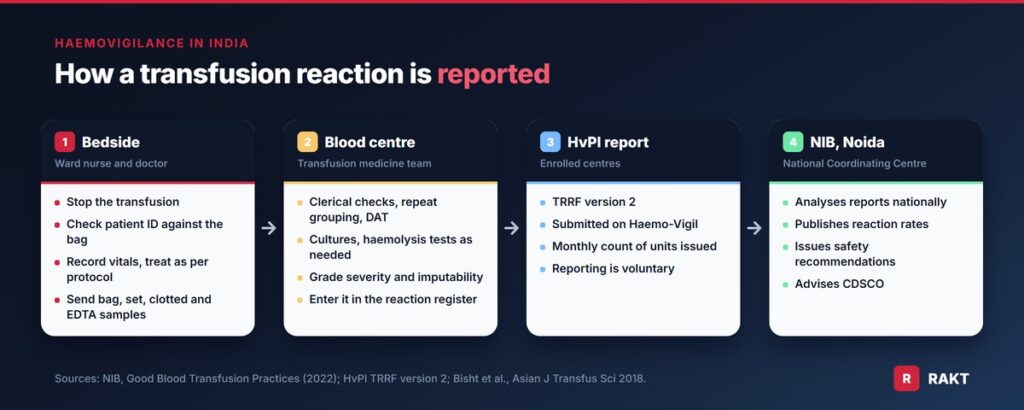
India’s system is the Haemovigilance Programme of India (HvPI). It was launched on 10 December 2012, and the National Institute of Biologicals in Noida runs it as the National Coordinating Centre.4, 5 Reporting runs in two stages.
Stage 1: the ward reports to the blood centre
Every reaction should go to the blood centre, even a mild one. The blood centre needs it to rule out haemolysis. A complete report also lets it give the patient modified blood components next time, so the reaction does not come back.2
Stage 2: the blood centre reports to HvPI
Enrolled centres report on the Transfusion Reaction Reporting Form (TRRF), now in version 2, through NIB’s Haemo-Vigil software.3, 6 The form has six parts:3
- Patient details: initials, hospital number, age, gender, blood group and diagnosis.
- Reaction details: date and time of issue and of onset, vitals before the transfusion and at the reaction, and a tick-list of signs.
- Product details: unit number, component, volume transfused, expiry, and the bag’s manufacturer and batch number.
- Investigations: clerical checks, repeat grouping and crossmatch, DAT, antibody screen, cultures, and the cause of any ABO mismatch.
- Nature of the reaction and its outcome.
- Imputability assessment.
Centres also send a monthly count of units issued, by component, so that reaction rates can be worked out.3 You can see the full TRRF on NIB’s website. Our guide to blood bag types covers the bag records the rules require.
How a blood centre enrols
- The head or in-charge of the transfusion medicine department or blood centre sends the enrolment form to the National Coordinating Centre by post or email.
- NIB checks the details.
- NIB issues a user ID and password for Haemo-Vigil (patient reactions) and Donor-Vigil (donor reactions).6
For help, HvPI’s toll-free number is 1800-180-2588, Monday to Friday, 9:00 AM to 5:30 PM. The email address is haemovigilance@nib.gov.in.5
Is reporting mandatory?
Reporting to HvPI is voluntary.1 Keeping the record is not. The Drugs and Cosmetics Rules list “transfusion adverse reaction records” among the records a blood centre must keep for five years. Its SOPs must also cover how reactions in donors and patients are managed.7 Our guide to Schedule F Part XII-B records lists the rest.
Still keeping the reaction register on paper? In RAKT, a transfusion reaction is recorded against the unit that was issued, in a Transfusion Reaction Register that sits with your other registers. See how RAKT links a reaction back to the issued unit.
What India’s Haemovigilance Data Shows
The latest national summary covers 2018 and 2019.1 It shows where the risks are, and how much is still not reported.
- Reaction rate: 8.25 per 10,000 products in 2018 and 8.94 in 2019.1 The rate was 8.4 between May 2016 and December 2017.8
- Most common reactions: febrile and allergic reactions, as in every earlier report.1, 8
- Components: packed red cells were involved most often, because they are transfused most often. But apheresis platelets had the highest rate, at 1.48 and 1.67 reactions per 1,000 units, against 1.08 and 1.11 for packed red cells.1 Our guide to SDP vs RDP platelets explains the difference between platelet types.
- Outcomes: 97.76% of patients in 2018 and 98.47% in 2019 recovered, most within 6 hours.1
- Deaths: 22 deaths were reported over the two years. In 2 of them, the transfusion was the definite cause. Both were haemolysis from ABO-incompatible blood.1
- Bedside errors: haemolysis from ABO mismatch and from non-immune causes was put down to errors at the bedside, and the report calls for staff training.1 An earlier analysis named the errors: the wrong patient’s blood in the sample tube, grouping errors, labelling errors and giving the wrong unit.4
- Under-reporting: by 2019, 959 centres had enrolled, but only 474 of them were active that year, counting nil reports as reporting.1
How to Prevent Transfusion Reactions
Not every reaction can be prevented. But HvPI traced haemolysis from ABO mismatch to bedside errors, and those can be.1 National guidance and HvPI’s findings point to these steps.
- Identify the patient twice: when the sample is taken and at the bedside before the transfusion. National guidance, citing UK data, notes that patient identification errors are the most common cause of serious reactions.2 In India, wrong blood in the tube was among the causes of ABO-mismatched transfusions.4
- Start slowly and watch. For a stable patient, start each unit slowly, at about 1 ml a minute, for the first 15 minutes.2 Record vitals before the start, at 15 minutes, every 30 to 60 minutes after that, and at the end.2
- Keep to the time limits. Red cells and thawed plasma should be transfused within 30 minutes of issue, and platelets immediately. A unit of red cells should be finished within 4 hours.2
- Match the volume to the patient. Children under 20 kg should be prescribed blood in millilitres, not units, to avoid overload.2
- Use modified components when needed: leucodepleted packed red cells (fewer than 5 × 10⁸ white cells) to prevent febrile reactions, washed red cells for some patients with allergic or anaphylactic reactions, and red cells irradiated at 25 Gy to prevent TA-GvHD.2 National analysts have called for more resources for leucofiltered components.4
- Train the staff who watch transfusions to recognise a reaction and act early.2
- Report every reaction, so the blood centre can protect the patient next time.2
Track Reactions and Your Reaction Rate without a Second Register
Reporting a reaction means bringing together the issue record, the crossmatch, the bag details and the investigation results. On paper, that can mean searching several registers. Centres preparing for NABH also track a transfusion reaction rate as a quality indicator.
RAKT keeps it in one place:
- The issue workflow covers the request, allotment against a named patient, the crossmatch result before issue, the issue itself, and the reaction report that may come back afterwards.
- Each reaction is recorded against the unit that was issued, so it traces back to the bag and the donor.
- The Transfusion Reaction Register sits with the stock, crossmatch, issue and other registers.
- Performance indicators, including adverse transfusion reactions, are worked out continuously from the records you already enter.
Our guides to quality indicator records and transfusion inquiry records show how these records are used. See how RAKT computes NABH indicators, or book a demo on WhatsApp.
Frequently asked questions
What is the most common blood transfusion reaction?
Febrile non-haemolytic reactions and allergic reactions are the most common in India. Between 2013 and April 2016, febrile reactions made up about 41% of reactions reported nationally, and mild allergic reactions about 27%.
How soon can a transfusion reaction start?
Some start within minutes. A hypotensive reaction starts within 1 hour, febrile and allergic reactions within 4 hours, TRALI within 6 hours and TACO within 12 hours. Delayed reactions can start from a day to six weeks later.
What are the types of transfusion reaction?
Reactions are acute (within 24 hours) or delayed (after 24 hours), and immune or non-immune. Acute reactions include haemolytic, febrile, allergic, TRALI, TACO, dyspnoea and hypotensive reactions. Delayed reactions include delayed haemolytic and serological reactions, post-transfusion purpura and TA-GvHD. Infections passed on through blood form a separate group.
What is the difference between TRALI and TACO?
TRALI is lung injury caused by the transfusion. It starts within 6 hours and often comes with low blood pressure and sometimes fever. TACO is fluid overload. It starts within 12 hours and usually comes with raised blood pressure, a positive fluid balance and a raised BNP.
What is the 30-minute rule in blood transfusion?
Indian national guidance, following WHO, says red cells and thawed plasma should be transfused within 30 minutes of being issued by the blood centre, and platelets immediately. A unit of red cells should then be completed within 4 hours.
Why is there blood in the urine after a transfusion?
Red or dark, cola-coloured urine can mean haemoglobin from destroyed red cells, a sign of a haemolytic reaction. Stop the transfusion, check a fresh urine sample and inform the blood centre at once.
Is it mandatory to report transfusion reactions in India?
Reporting to the Haemovigilance Programme of India is voluntary. But blood centres must keep transfusion adverse reaction records for five years under the Drugs and Cosmetics Rules, and every reaction should be reported to the blood centre.
How do I report a transfusion reaction to HvPI?
Report it to your blood centre first. If the centre is enrolled with HvPI, it fills in the Transfusion Reaction Reporting Form (version 2) on the Haemo-Vigil software. To enrol, the head of the blood centre sends the enrolment form to NIB, which issues a login.
Sources
- Haemovigilance Programme of India, National Institute of Biologicals. Summary of Transfusion Reactions Reported for Year 2018-2019 and Key Recommendations for Blood Safety. July 2024 nib.gov.in
- National Institute of Biologicals, Ministry of Health and Family Welfare. Good Blood Transfusion Practices: Guidance for Rational Use of Blood. 2022 nib.gov.in
- Haemovigilance Programme of India. Transfusion Reaction Reporting Form (TRRF) for Blood and Blood Components and Plasma Products, Version 2 nib.gov.in
- Bisht A, Marwaha N, Kaur R, Gupta D, Singh S. Haemovigilance Programme of India: analysis of transfusion reactions reported from January 2013 to April 2016 and key recommendations for blood safety. Asian J Transfus Sci. 2018;12(1):1-7 nib.gov.in
- National Institute of Biologicals. Haemovigilance Programme of India. Accessed 6 November 2026 nib.gov.in
- National Institute of Biologicals. Enrol your centre under HvPI. Accessed 6 November 2026 nib.gov.in
- Drugs and Cosmetics Rules, 1945, Schedule F, Part XII-B, as amended by G.S.R. 166(E), 11 March 2020 cdsco.gov.in
- Bisht A, Marwaha N, Kaur R, Gupta D, Chhabra R. Haemovigilance Programme of India: comparative analysis of transfusion reactions reported over a 5-year period through two reporting formats and key recommendations for blood safety. Asian J Transfus Sci. 2020;14(2):103-16 nib.gov.in