
The numbers your management actually asks for
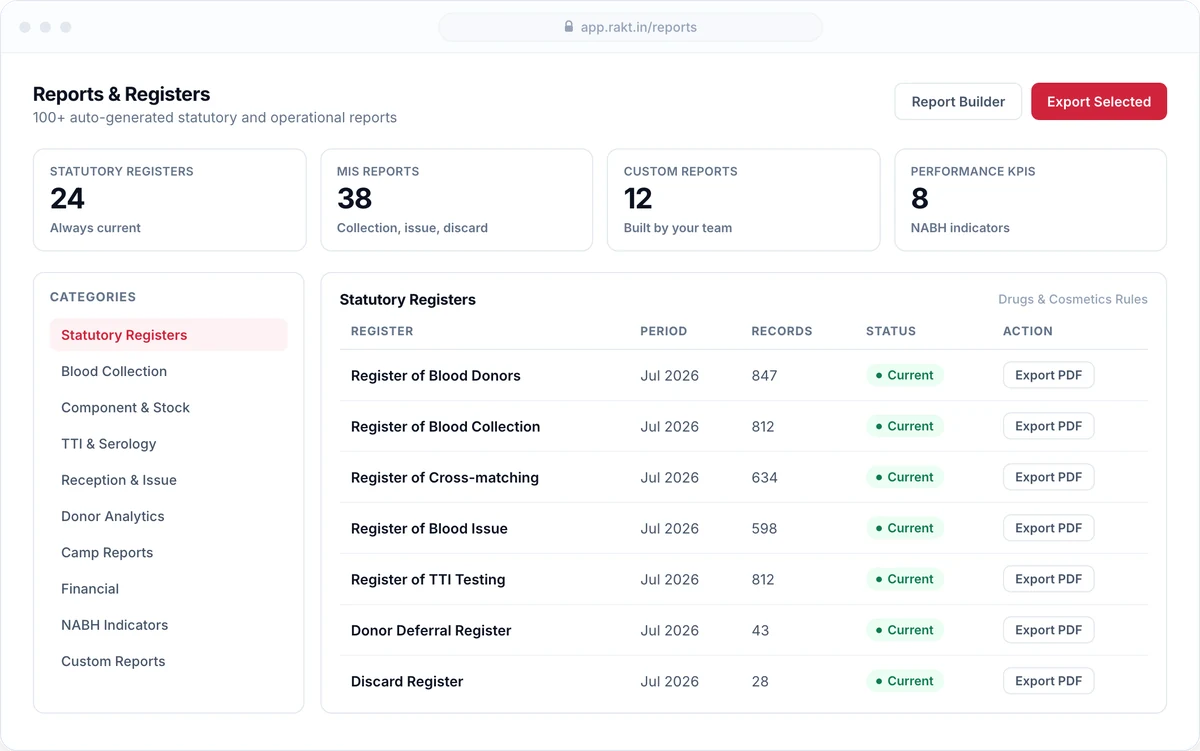
Stock position, collection trends, issue patterns, discard analysis and utilisation — available on demand rather than compiled by hand at the end of the month.
WhatsApp + email
Sections you toggle
Including state formats
Custom reports you keep
Reporting that reflects reality
Built from operational records, so the report and the register agree.
Tested and untested stock
What you hold by blood group, component and expiry — separated by whether it has been shifted to tested stock.
Collection and issue trends
Where units come from and where they go, over any period you choose.
Discard and near-expiry
The Discarded Components and Expiring Components registers, broken down by reason and component, while there is still time to act.
Financial summaries
Processing charges, concessions, refunds and outstanding amounts, reconciled to units issued.
Hospital Wise Consumption
Which requesting hospitals consume what, what comes back as Return To Stock, and the credit outstanding against each.
Export anything
Every report exports in formats your finance and quality teams can work with.
Reports that leave the building without a login
Masters switch the daily summary on
Addon-gated. A scheduled job builds the PDF from Live stock, handover, collection and the sections you chose in Daily Report Settings.
WhatsApp and email, every morning
Contact numbers on the organisation get the Cloud API message; masters get email. Management sees the position without opening RAKT.
Registers and MIS on demand
The reports app covers the statutory set plus state-specific MIS. Custom reports are saved, not one-off exports.
Donor reports the same pipe
Blood-report WhatsApp to donors is a separate addon flag — same messaging stack, different audience.
The daily PDF that leaves the building
Masters can switch on a scheduled daily summary. The PDF is built from live stock and the sections you chose, then sent on WhatsApp and email — management sees the position without opening RAKT.
- Addon-gated Daily Report Settings: pick which sections run each morning
- WhatsApp Cloud API to contact numbers on the organisation; email to masters
- On-demand MIS includes state-specific formats and a report builder you keep
- Same messaging stack can send blood reports to donors when that addon is on
A report and a register that disagree is the actual problem
The reason blood centres distrust their own MIS is almost never the report. It is that the report and the register were built from different things. Where the stock position is maintained as its own record, updated by a person when they remember, it drifts from the issue and collection records within days, and then the monthly report says one thing, the Stock Register says another, and whichever one is quoted upward becomes the number that gets defended. A centre in that position learns to recompute by hand before any meeting, which means the reporting system has negative value: it costs money and produces work.
Deriving everything from one record per bag removes the class of problem rather than reconciling it. Tested and untested stock by group, component and expiry is a view of the bags, not a separate ledger. Collection and issue trends over any period are the same records grouped differently. Discard analysis by cause and the expiring-components list are queries against the same data, which is why they can be run while there is still time to act rather than reported after the fact. Hospital-wise consumption, returns to stock and outstanding credit per requesting hospital come out of the issue records that already exist.
What this changes in practice is who can answer a question. When every report is a view, a question that arrives at 4pm is a report to run rather than a project to schedule: how much O negative went to which hospital last quarter, or what the discard rate by cause looks like against last year. The report builder exists for the same reason: the report your state council or your management asks for and nobody else does is the one that will never ship in a fixed list, and it is the one that determines whether the month closes on time.
Questions about reports & mis
Can we build our own reports?
Yes, that is what the report builder is for. A fixed list of reports covers the common cases and then fails on the one your state council, your trust board or your quality manager asks for and nobody else does, which is reliably the report that determines whether the month closes on time. Anything built exports in formats your finance and quality teams can actually work with.
Does RAKT show live stock position?
Yes, by blood group, component and expiry, and separated by whether a unit has been shifted to tested stock, which is the distinction that matters at the counter and the one most commonly collapsed in reporting. Because the position is derived from the bag records rather than maintained as a separate ledger, it cannot drift away from the Stock Register the way a manually updated stock figure does.
Can we see which hospitals consume the most blood?
Yes. Hospital-wise consumption shows what each requesting hospital takes, by component and group, what comes back as return to stock, and the credit outstanding against each. It is usually the first report a centre inside a hospital group runs, because it turns an argument about utilisation into a table.
How do we track discards and wastage?
Every discard carries a reason and a medical officer approval, so wastage can be explained rather than only counted, and the discard and expiring-components views are available for any period. The expiring list is the operationally useful one: a discard report tells you what you lost, and an expiry list run weekly tells you what you are about to lose while there is still time to move it.
More of what RAKT does
See this running on your own floor
Tell us how your centre works today and we will show you the parts that would change.