
Results from the analyser, not from a notepad
Connect your TTI and serology analysers so results land against the right unit automatically. Transcription comes out of the critical path, and so do transcription errors.
TTI analyser path
Grouping / crossmatch
Results land on bag ID
Untested stock cannot issue
From sample to released unit
The laboratory workflow, with the manual copying removed.
Analyser integration
HIV, HBsAg, HCV, VDRL, MP and NAT results captured from the instrument against the sample, instead of read off a printout.
Component preparation tracked
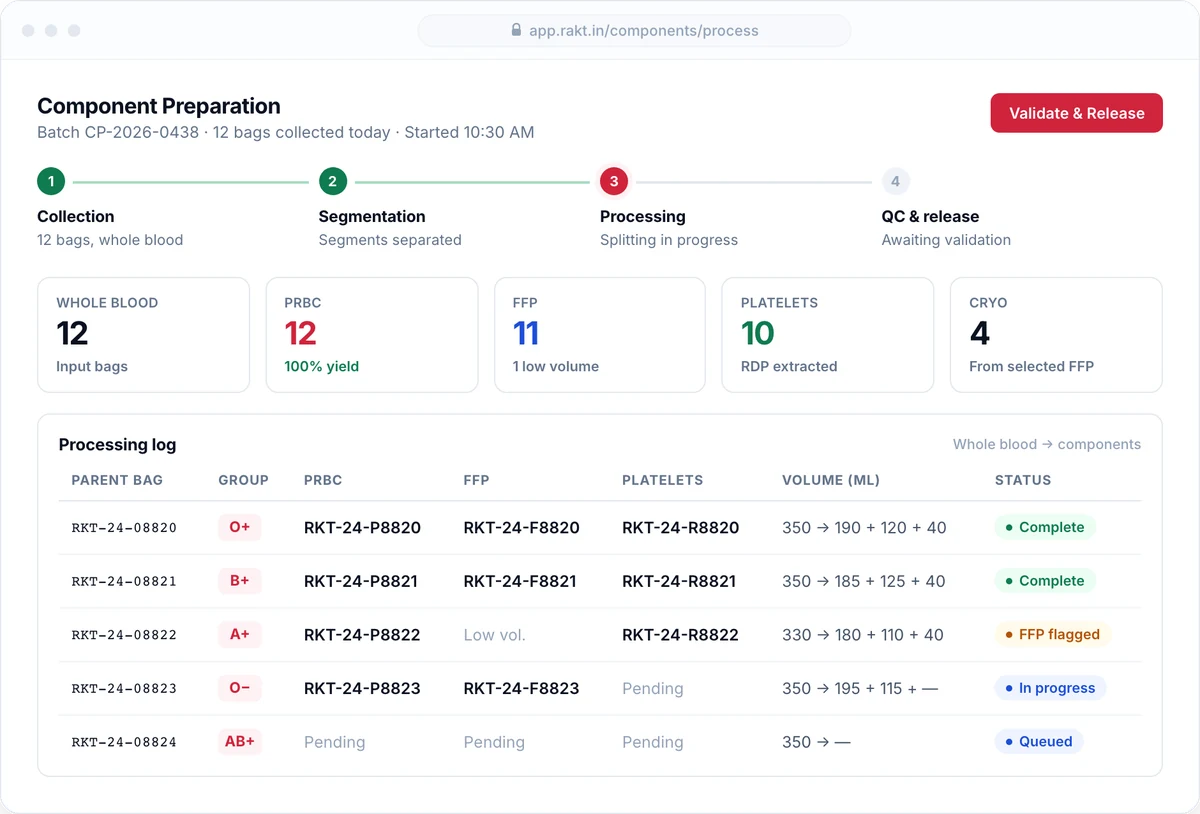
Blood Processing and Component Volume record what each bag yielded as PRBC, PRBC-LR, SWRC, FFP, CPP, PLC, RDP, SDP or CRYO.
QC registers per component
PRBC/WB, FFP/CPP, PLC/PRP and CRYO quality control captured in the register your assessor opens.
Automatic stock movement
A validated component becomes issuable at Shift To Tested Stock. A reactive TTI result moves the bag to Lab on its own.
Grouping and crossmatch
Forward and Reverse Grouping, phenotyping, irregular antibodies and Crossmatch Compatibility, each recorded against the bag and the request.
Traceable in both directions
From any component back to its parent bag and donor, or from a donor forward to every component their bag produced.
From the analyser printout to tested stock
Machine posts the result
Tulip Electra (TTI) and Matrix AutoMax-80 (grouping / crossmatch) push through a webhook. The payload is stored, then matched to the bag ID.
Screening already waiting
A TTI screening row is created when the bag is saved. Staff review autofilled values, attach kit lots, and move the bag through the validation states.
Validation, then shift
Only after the state machine allows it does the unit move to tested stock — or to quarantine / discard if reactive.
Issue refuses the wrong bag
Untested, reactive or not-yet-shifted units cannot be allotted. The refusal is in the allotment logic, not a training reminder.
What the sequence looks like
- Untested unitRefused
- TTI reactiveRefused
- Not shifted to tested stockRefused
- Already issuedRefused
- Cleared, crossmatch recordedIssued
- Emergency release, flaggedIssued, exception recorded
The system will not let an untested bag be issued
These are refusals, not warnings. A component that has not cleared grouping and TTI Screening and been shifted to tested stock cannot be allotted, and there is no override at the counter.
- “TTI testing not completed” — the bag cannot be allotted at all
- “Component is reactive in TTI testing” — and the reactive tests are named
- “Not shifted to tested stock” — validated is not the same as releasable
- A discard cannot be completed until your MO or MD approves it
The error class software can eliminate outright
Most classes of error in a blood centre can only be reduced. Transcription is the exception: a result read from an analyser and written onto a worksheet, then typed from the worksheet into a register, passes through two copying steps that can be removed entirely. This is worth being specific about because it is the one place where automation is not a productivity argument but a safety one. A mistyped TTI result is a reactive unit in tested stock, and no amount of downstream discipline recovers from it, the crossmatch will not catch it, because the crossmatch is testing compatibility rather than infection status.
Reading results from the instrument also changes what the audit trail can say. A typed result has one author and no provenance: the register records that a person entered a value, not where the value came from. A captured result is attributable to a run on a named instrument at a recorded time, which is what an assessor is actually asking for when they ask how you know a result is correct. The same applies to component preparation, where each product is derived from its parent bag with its own volume, storage temperature and expiry, so separation arithmetic cannot exceed collection and every component traces back to one donor in one direction and forward to every product in the other.
The part worth testing in a demo is the release rule rather than the capture. In RAKT a component cannot be allotted until grouping and TTI screening are complete and the unit has been shifted to tested stock, and a reactive result moves the bag out of issuable stock on its own rather than raising a message somebody has to act on. Those are refusals, not warnings, and nobody at the counter can wave them through. The one documented exception is emergency release before crossmatch, which is flagged on the request, and where a centre turns on the post-issue setting the crossmatch stays mandatory and outstanding until it is done. Ask any vendor, us included, to demonstrate the refusal rather than describe it. A control a supervisor can quietly wave through is a control an assessor will treat as absent, and quite rightly.
Questions about lab automation
Which analysers can RAKT connect to?
TTI and serology instruments covering HIV, HBsAg, HCV, VDRL, malaria and NAT are the common cases, and the practical answer depends on your specific models and their output interface. Name your instruments at the demo rather than asking whether integration is possible in general: "we can integrate that" and "that is integrated" are usually a quarter apart, and the difference should be established before contract rather than after.
Can RAKT stop a reactive unit being issued?
Yes, and it is enforced rather than advisory. A component cannot be allotted until grouping and TTI screening are complete and it has been shifted to tested stock, a reactive result moves the bag out of issuable stock on its own, and nobody at the counter can override either. A discard also cannot be completed without medical officer or medical director approval. Ask us to issue an untested bag during the demo and watch it refuse. Emergency release before crossmatch is deliberately possible, because clinically it has to be, and it is recorded on the request rather than being an invisible bypass.
Does RAKT track component preparation and quality control?
Yes. Blood processing and component volume record what each bag yielded across PRBC, PRBC-LR, SWRC, FFP, CPP, PLC, RDP, SDP and CRYO, each with its own volume, storage condition and expiry derived from the parent bag. Quality control registers are kept per component group, covering PRBC and whole blood, FFP and CPP, platelet products and cryoprecipitate, in the form an assessor opens them.
What if we do not have analysers that can be interfaced?
Results are entered manually against the sample, and the release rules, registers and traceability all work identically. You lose the elimination of transcription error, which is the main prize, so it is worth knowing that interfacing is usually a smaller project than centres expect and can be added later without re-implementing. It is not a reason to defer the rest of the system.
More of what RAKT does
See this running on your own floor
Tell us how your centre works today and we will show you the parts that would change.