
Patient data, handled like patient data
RAKT holds donor and recipient records. Access control, encryption and auditability are properties of the product rather than options you configure later.
Full register + sign-in
Name and revoke
PASSKEYS_ENABLED env
Periodic check for staff
How access is protected
Shared passwords are the most common weakness in a blood centre. RAKT is built to remove them.
Passkey sign-in
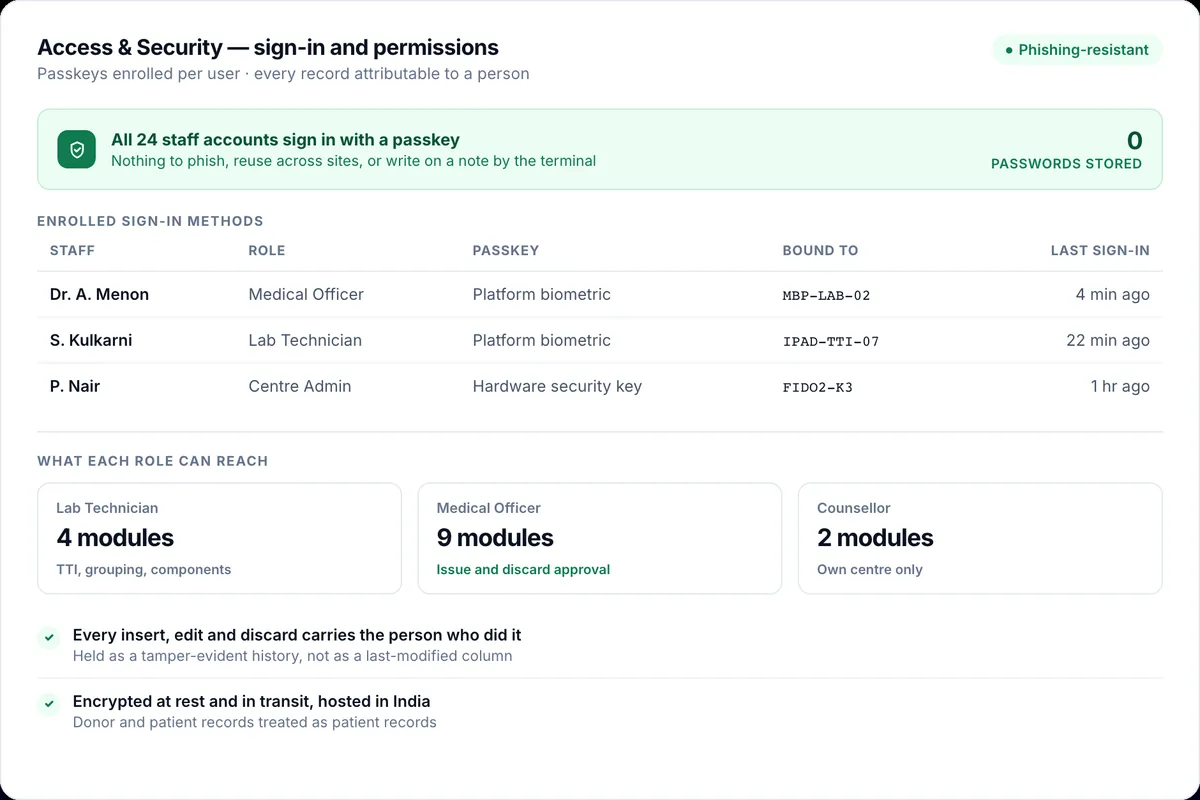
Phishing-resistant WebAuthn passkeys — staff sign in with a device, not a password on a sticky note.
Role-based access control
Granular permissions per role and per centre, reviewed and changed centrally.
Encrypted in transit and at rest
Traffic protected end to end, data encrypted at rest, hosted in India.
Audit log on every record
Retained and searchable, for inspection and for internal review.
Least privilege by default
New staff start with the minimum their role needs rather than a shared administrator account.
Backups you can rely on
Regular backups with restoration tested, so a bad day does not become a lost year.
How passkey sign-in actually works here
Offer on the login page
When passkeys are enabled, Log In shows “Sign in with passkey” beside password. No separate product SKU — it is the same account.
Enroll on the Security page
/passkeys/security/ runs the WebAuthn ceremony. Staff name the device and can delete it when a laptop leaves the centre.
RP ID and origin from env
Credentials are stored per user. The relying-party config is environment-driven so staging and production do not share keys.
Hardening beyond the passkey
Orgs can require periodic credential re-auth for ordinary users. Role permissions still decide what that person can touch after they are in.
Passkeys are a real ceremony, not a checkbox
When PASSKEYS_ENABLED is on, staff enroll and sign in with WebAuthn. Devices are named and revocable on the Security page — the shared sticky-note password is the failure mode this removes.
- Sign in with passkey on the login page beside password
- Enroll, rename and delete devices under /passkeys/security/
- Relying-party ID and origin from environment — staging keys stay out of production
- Orgs can still require periodic credential re-auth for ordinary users
The password on the monitor is the vulnerability
Security conversations about health software tend to be about infrastructure, and infrastructure is the part least likely to fail. Encryption in transit and at rest, hosting in India, patched systems and automated daily backups are table stakes and RAKT has them. The breach that actually happens at a blood centre is more mundane: one login shared by a shift because accounts were rationed, a password written on a note by the counter machine because it has to be typed forty times a day, or a departed employee’s credentials still working three months later. None of those are defeated by better encryption, and all of them defeat the audit trail completely.
Passkeys address the mechanism rather than the symptom. WebAuthn sign-in binds authentication to a device the person has instead of a string they can write down, share or be phished out of, which removes the shared-password problem at the root rather than policing it with rotation rules that make it worse. It is also faster at the counter, which matters more than it sounds: a security control that slows down a busy technician is a control that gets circumvented within a fortnight, and most password policies in clinical settings are examples of exactly that.
Access control is the other half. Permissions by role and by centre, least privilege on new accounts rather than a shared administrator, central review and revocation, and an audit log on every record. It is worth stating what we do not claim: RAKT does not hold ISO or HIPAA certifications and does not describe itself as certified against them, and we would encourage you to ask any vendor who does for the certificate, its scope and its expiry date. In this category those claims are asserted a great deal more often than they are held, and a purchase committee is entitled to the document rather than the adjective.
Questions about security & passkeys
What is passkey sign-in and why does a blood bank need it?
A passkey is a WebAuthn credential bound to a device rather than a password that can be written down, shared or phished. Blood centres need it because the realistic security failure in a blood bank is a shared login or a password on a sticky note by the counter machine, not an attack on a data centre, and a shared credential also destroys attribution, so it is a compliance failure as much as a security one.
Where is RAKT data hosted?
On managed database infrastructure in India, encrypted in transit and at rest, with automated daily backups and point-in-time recovery. There is no server at your centre to patch, back up or replace, which removes the most common cause of unrecoverable data loss at a blood centre: a local machine with a backup routine that nobody has verified in two years.
Does RAKT hold formal security or health-privacy certification?
No, and we will not imply otherwise or display a badge we have not earned. What we have are the controls a certification would audit: encryption in transit and at rest, role and centre based access control, least privilege on new accounts, phishing-resistant passkey sign-in, an audit log on every operational record, and automated daily backups with point-in-time recovery. If a named certification is a procurement requirement for your tender, tell us and we will answer honestly about scope and timing.
What happens when a staff member leaves?
Their access is revoked centrally and immediately, and their historical actions remain attributed to them in the audit trail, which is the correct behaviour, since removing a person’s account should not remove the record of what they did. Dormant credentials that still work months after someone has left are one of the most common findings we see when migrating a centre off an older system.
More of what RAKT does
See this running on your own floor
Tell us how your centre works today and we will show you the parts that would change.