
Run a camp with the discipline of your main centre
Plan the camp, register donors on a tablet with RAKT Pass, print labels on site, and reconcile every collection back to your inventory the same day.
NBTC-style checklist
Tablet donor desk
Cold-chain temps logged
Bags into centre stock
Camps, end to end
5,883 camps have been run on RAKT to date.
Plan and schedule
Organiser, venue, expected turnout, staff and kit assigned before the van leaves.
Register on a tablet
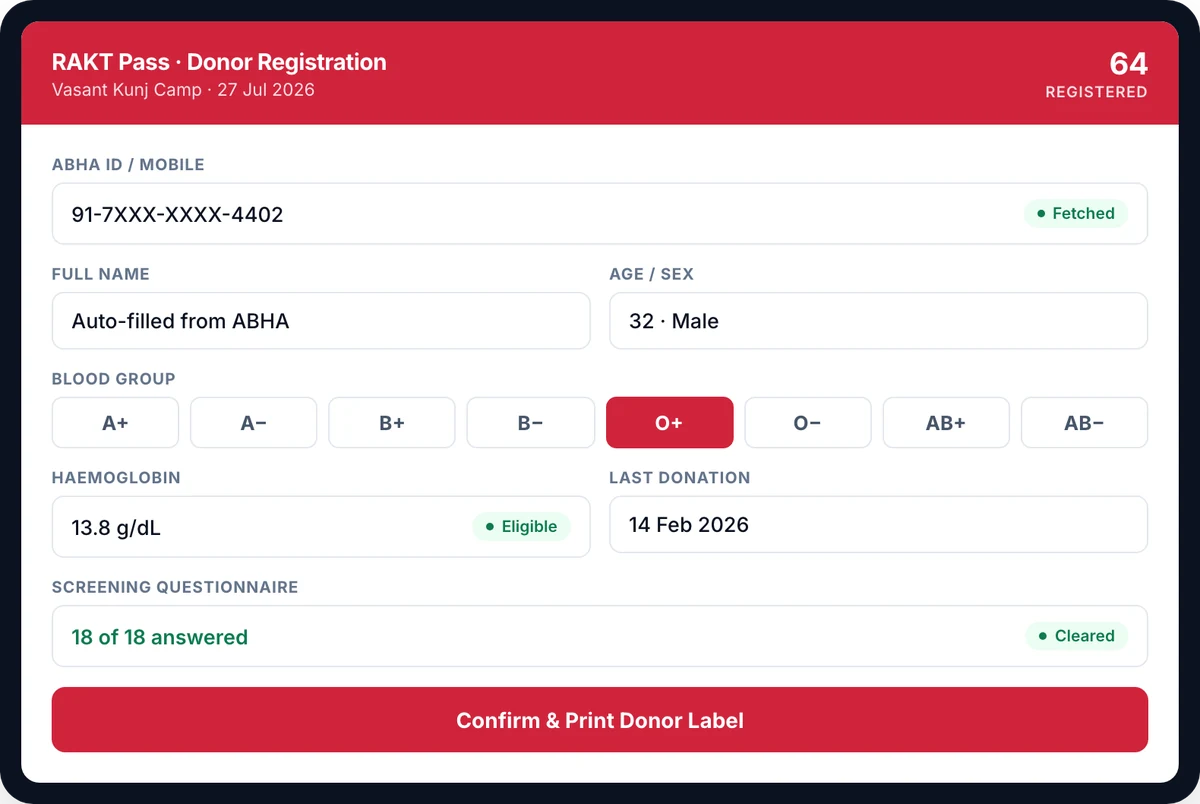
RAKT Pass replaces the paper register. Weight, pulse, blood pressure and haemoglobin recorded at the desk, with the medical officer signing off there.
Labels printed on site
Bags are identified from the first minute rather than labelled back at the centre from memory.
Deferrals applied on the spot
The Annexure questionnaire and its defer reasons run at the desk, and a donor who gave blood too recently is flagged before the needle.
Reconciled the same day
Bags come back into Bag Entry at the centre, matched against what the camp recorded, not keyed in three days later.
Follow-up handled
Thank-you messages, certificates and next-eligibility reminders go out without anyone maintaining a list.
How a camp day runs on RAKT
Create the camp, inspect the site
Camp create auto-opens Site Inspection, Duty and Post-Camp Report. The checklist covers power, lighting, waste, counselling space — the things an auditor asks about.
Register donors on a tablet
RAKT Pass (when the addon is on) runs the desk flow with QR / status AJAX. Shareable WhatsApp text sits on the camp record for organisers.
Bag entry linked to the camp
Units collected that day are ordinary bags with a camp foreign key — not a parallel spreadsheet that gets typed in two days later.
Close the day with temperatures
Post-camp captures send/receive times and cold-chain temperatures, deferrals and transport. The centre and the camp share one donor history.
The people who bring you donors get looked after too
Camp organisers are the reason a camp fills. RAKT keeps a record of every organisation you have worked with and what each camp produced.
- Organiser history with turnout and collection figures per camp
- Certificates and acknowledgements generated for organisers and donors
- Repeat camps set up from a previous one rather than from scratch
The two days between the camp and the keyboard
For a large number of Indian blood centres, outdoor camps are the single biggest source of collections and the weakest part of the record. The mechanism is always the same. Donors are registered on paper at the camp because that is what works in a school hall with no reliable connection, bags are labelled by hand or labelled later, and the whole day is entered back at the centre one to three days afterwards by somebody who was not there. Everything that goes wrong in a camp record goes wrong in that gap: bags matched to the wrong donor, questionnaires that cannot be reconciled to a name, deferral decisions nobody can reconstruct, and consent for contact that was given verbally and recorded nowhere.
Closing the gap means the record has to be created at the camp, not transcribed from it. RAKT Pass registers the donor on a tablet at the desk: the Annexure questionnaire and its deferral reasons, weight, pulse, blood pressure and haemoglobin, with the medical officer signing off there. It prints the donor label on site, so the bag is identified from the first minute rather than from memory. The day then reconciles into Bag Entry at the centre against what the camp recorded, which turns a data-entry session into a check.
The part most systems ignore is the organiser. A camp fills because an organisation filled it, and the same organisations run camps annually. Keep a record of every organiser and what each of their camps produced: turnout against expectation, collections, deferral rate. That is what lets you plan next year from evidence, set a repeat camp up from the previous one, and give the organiser something back the same evening. Corporate organisers in particular expect a count and certificates on the day, and a centre that can only respond a week later tends to get one camp rather than a series.
Questions about camp management & rakt pass
Can donors be registered at a camp without an internet connection?
RAKT Pass runs at the camp desk on a tablet or laptop: registration, the questionnaire, screening vitals, deferral decisions and on-site label printing, with the day reconciling into centre stock the same evening rather than being typed up two days later. Being straight about the requirement, because a school hall on a Sunday is a real constraint: it is a browser-based system and it needs a connection at the desk. Most centres run a phone hotspot, which is enough at camp volumes. It will not work in a venue with no signal at all, and you should tell us about those venues at the demo rather than discover it on the day.
How does a camp collection get into blood bank inventory?
Bags come back into Bag Entry at the centre and are matched against what the camp recorded, so the step at the centre is a reconciliation rather than a fresh entry. That is the whole point: when the record is created at the camp, nothing has to be reconstructed afterwards, and the bag-to-donor link is not being inferred from a paper sheet and a batch of unlabelled bags.
Does RAKT handle donor follow-up after a camp?
Yes. Thank-you messages, donor certificates and next-eligibility reminders go out without anybody maintaining a list, and organiser acknowledgements and certificates are generated for the organisation that hosted the camp. Repeat donation is largely a function of whether the donor hears from you at the right interval, and that interval is computable from the donation record rather than something to track by hand.
How many camps has RAKT been used for?
5,883 camps to date across the centres running on RAKT. The useful thing to ask about is not the total but whether we can show a camp of your shape being planned, run and reconciled: a college drive, a corporate campus, a rural block camp. Those three differ considerably in venue conditions, turnout pattern and what the organiser expects back.
More of what RAKT does
See this running on your own floor
Tell us how your centre works today and we will show you the parts that would change.