Now live: RAKT AI assistant for compliance queries. Learn more →
Blood bank software that runs the floor from Bag Entry to Issue
RAKT is a cloud blood bank management system running the floor at 200+ blood centres across India. The Donor, TTI, Grouping, Crossmatch and Issue registers write themselves while your staff work.
Cloud-hosted in India · Passkey sign-in
Standalone licences, hospital blood banks, charitable trusts and multi-licence networks, in daily use across 24 states
Blood centres run on RAKT
Donors on record
Components prepared
Camps run to date
States covered
Registers generated
The portals your centre reports into, and the standards it is inspected against
Built from the bags you already entered
Demographics fetched from the health account
Computed over real periods, from your own record
Schedule F Part XII-B registers, filled as you work
What an inspector asks for already exists. How compliance works.
The same screens your staff already move through
Not a diagram of the blood lifecycle, the actual sequence in RAKT, and every step writes to the register it belongs to.
Technician and lab
Reception and serology
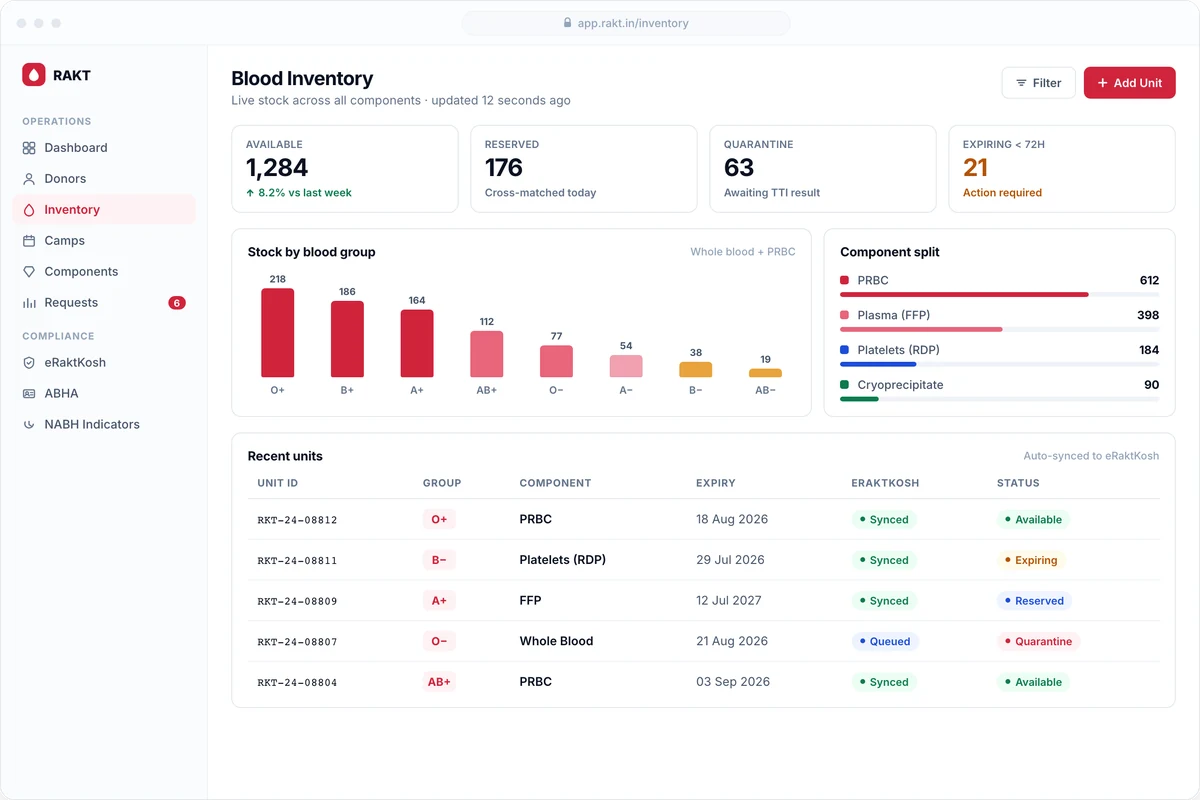
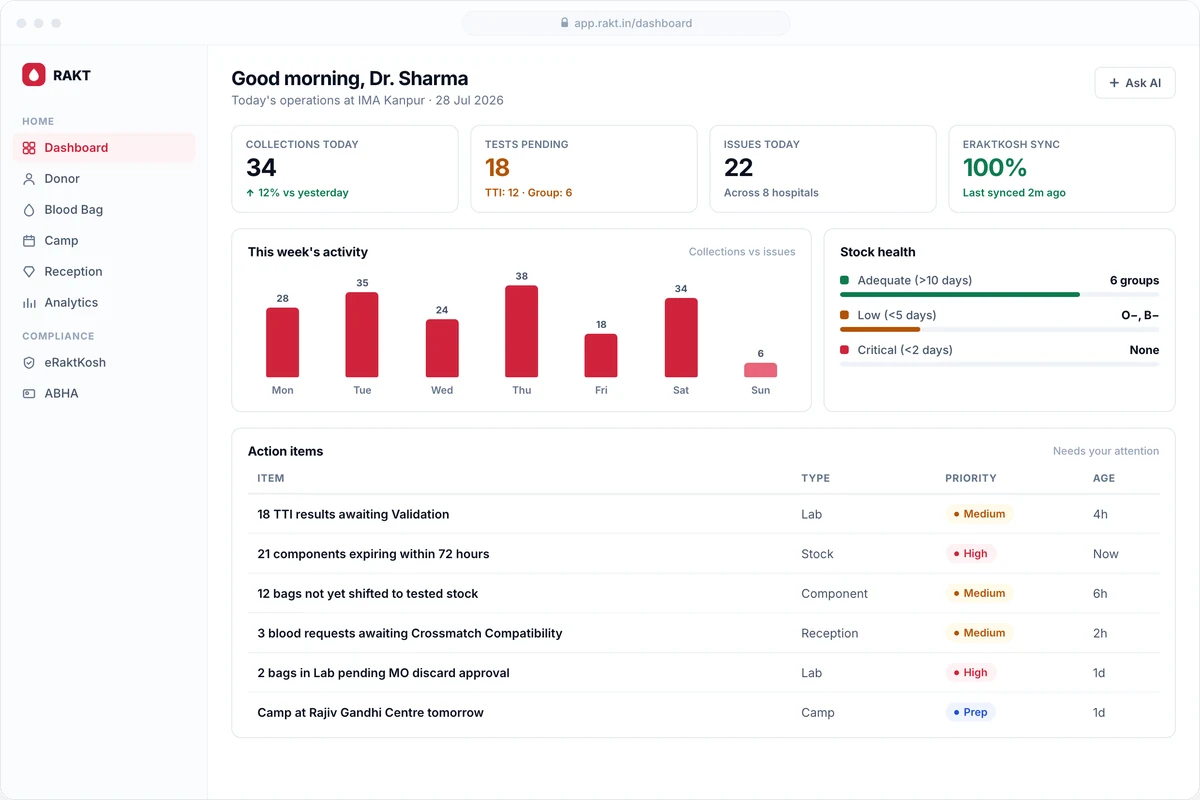
Open RAKT and see where the day stands
Bags collected today, components awaiting Validation, TTI results pending, near-expiry stock and eRaktKosh sync status, on one screen, before the first hospital call comes in.
- Tested and untested stock by blood group and component
- Near-expiry components flagged while there is still time to use them
- Bags held in Lab, waiting to be released or discarded
- eRaktKosh submission status, so a rejection is never a surprise
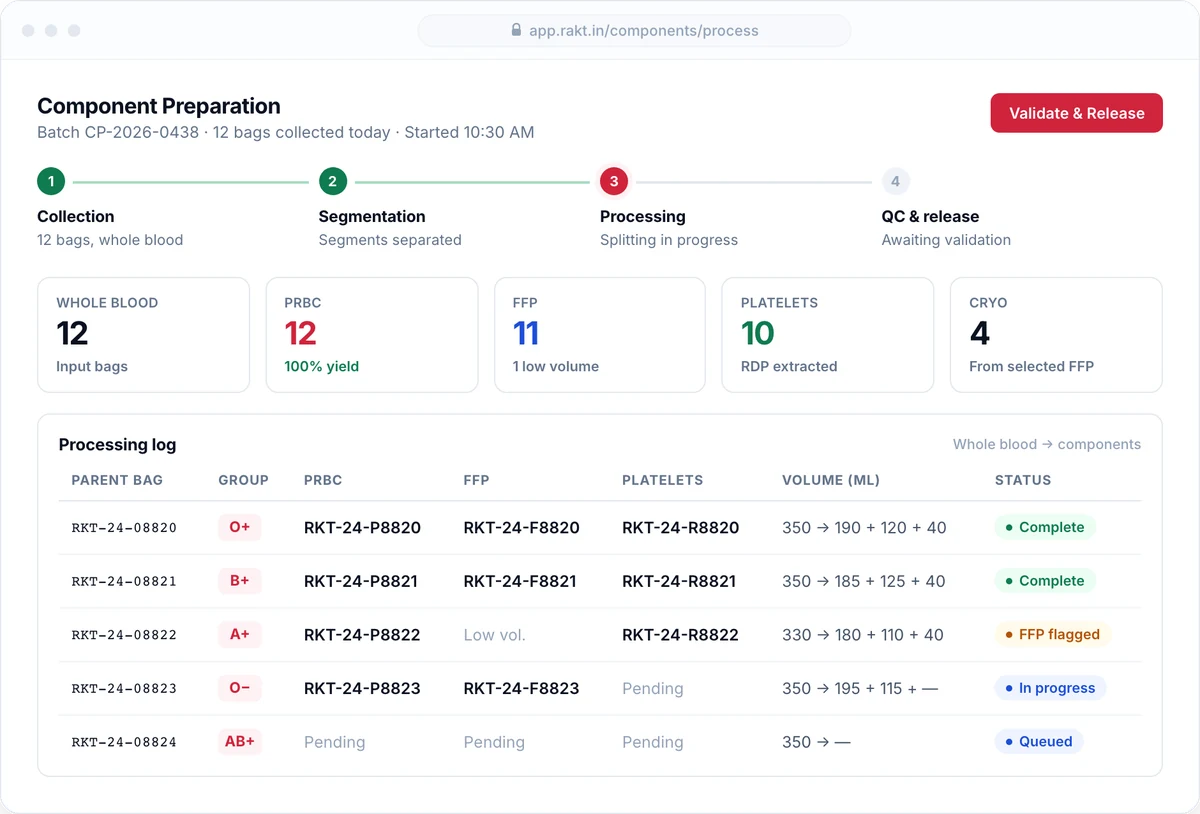
One bag in, four components out, each with its own expiry
Blood Processing records the centrifuge settings, Component Volume records what each bag yielded, and Validation signs it off. Every component carries its parent bag number, so a unit issued next month still traces back to the donor who gave it.
Components
PRBC and PRBC-LR, SWRC, FFP, CPP, PLC, RDP, SDP, CRYO and whole blood.
TTI Screening
HIV, HBsAg, HCV, VDRL, MP and NAT, read off the analyser or keyed in.
Forward / Reverse Grouping
Both directions recorded separately, with phenotyping and irregular antibodies.
Lab
A reactive TTI result moves the bag to Lab on its own. Discard needs MO approval.
The checks RAKT runs, and will not let you skip
Every one of these is a refusal your staff will actually see, not a warning that can be clicked past.
A reactive HIV, HBsAg, HCV, VDRL, MP or NAT result moves the bag to Lab and names the test.
Validated is not releasable. Until it is shifted, a blood request cannot reach it.
Tests outstanding means no allotment, however busy the counter is.
Forward and reverse grouping are recorded before a patient can be matched.
Expiry is checked at allotment, not found later in the register.
A quarantined bag must be released before it can re-enter stock.
Checked against the patient’s own grouping before crossmatch, not after.
Each component leaves once. Double-allotment to two requests is refused.
Where your centre sets that policy, RAKT holds it at the counter.
RAKT also warns at registration when a donor has given blood in the past 90 days, and a discard cannot be completed until your MO or MD approves it.
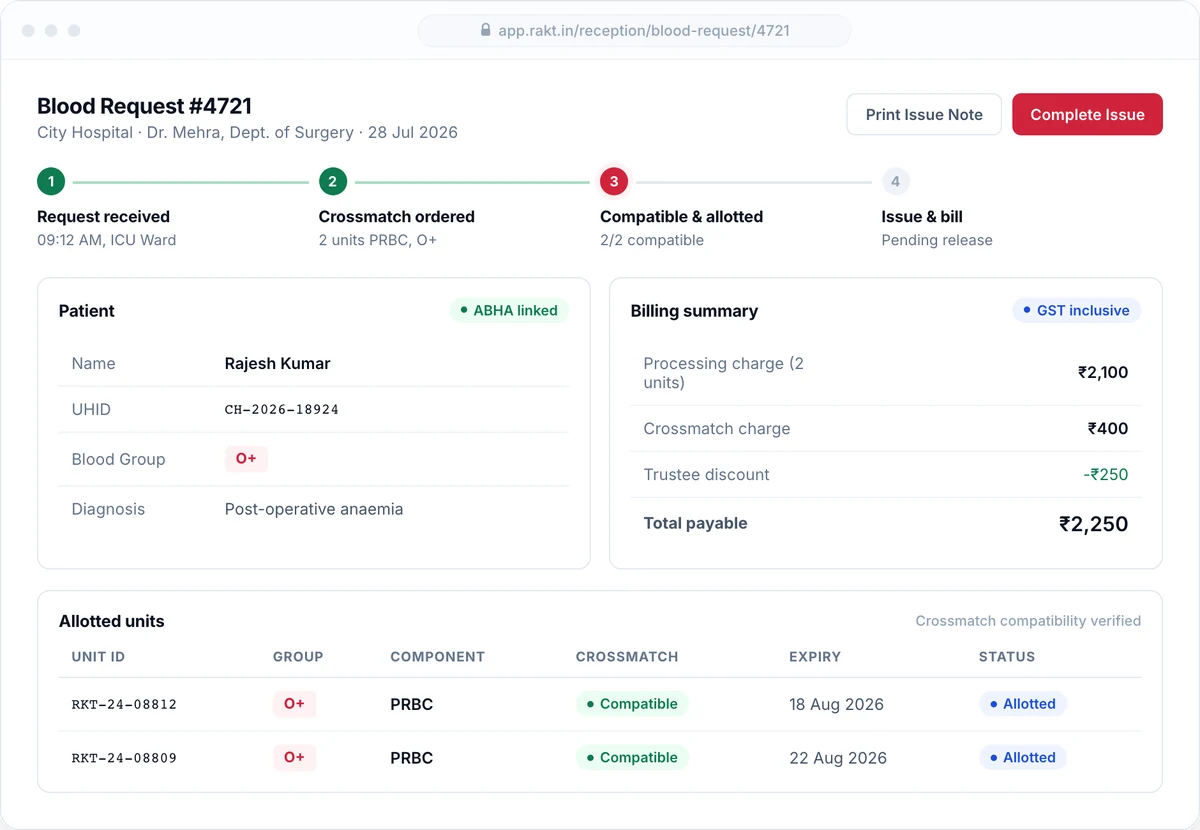
Blood Request, Allot Unit, Crossmatch, Issue
A hospital or a patient’s relative raises a Blood Request. Reception bills it, serology allots units against it, crossmatch compatibility is recorded per unit, and Issue prints the invoice and the compatibility report together.
- Allot Unit will not open until the billing is finalised
- Crossmatch Compatibility recorded per unit, not per request
- Bulk Request for hospitals, Fractionation and Inward Stock alongside it
- Return To Stock for a unit that comes back, with the charges handled
- Adverse transfusion reactions recorded against the unit that was issued
The register the inspector asks for is already written
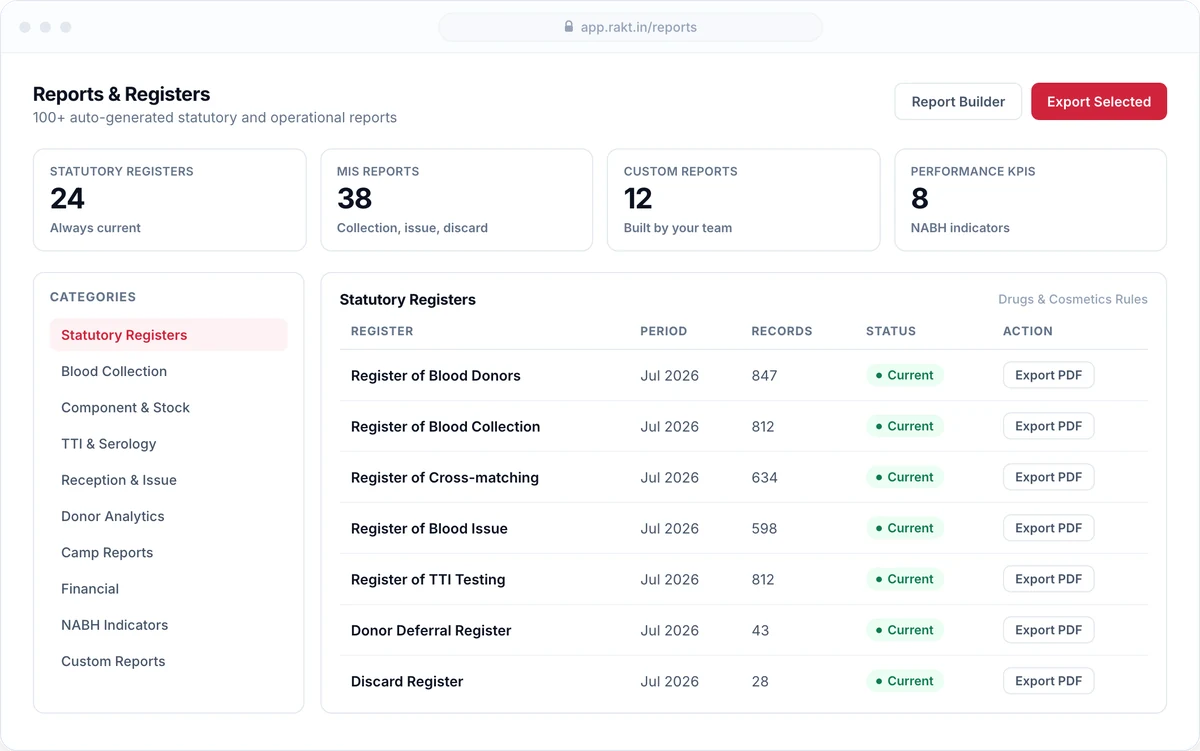
Every entry lands in the register it belongs to, in your assessor’s format, so nobody compiles anything the weekend before.
Twelve of about a hundred. The rest, and the report builder for the register only your state asks for, are on the compliance page.
eRaktKosh submission
The Monthly Collection Summary and Data export, built from what you already recorded. Validation runs first, so a rejection reaches your queue, not your inbox weeks later.
NABH Performance Indicators
TTI reactive rate, adverse reactions, issue turnaround, voluntary share, deferrals, outdated units and QNS, all recalculated as the work is recorded.
SBTC and MIS reports
SBTC Report, hospital-wise consumption, turnaround time, daily summary and cash reports, plus a builder for the register only your state asks for.
What stops happening when you move from paper to blood bank software
Most blood banks we onboard are running paper registers, an Excel stock sheet, or desktop software from the 2000s.
Donor Register written by hand, then copied out again at month end
Donor Register fills itself at registration and prints for any date range
Someone re-types the month into the eRaktKosh portal
Monthly Collection Summary built from the bags you already entered
Stock counted off an Excel sheet that is stale by afternoon
Tested and untested stock live, by group and component, with expiry flagged
Camp forms come back in a bag and get keyed in three days later
RAKT Pass registers donors at the camp; bags reconcile the same day
TTI results read off a printout and copied into the register
TTI Screening reads results from the analyser into the TTI Register
Register camp donors on a tablet, not a paper register
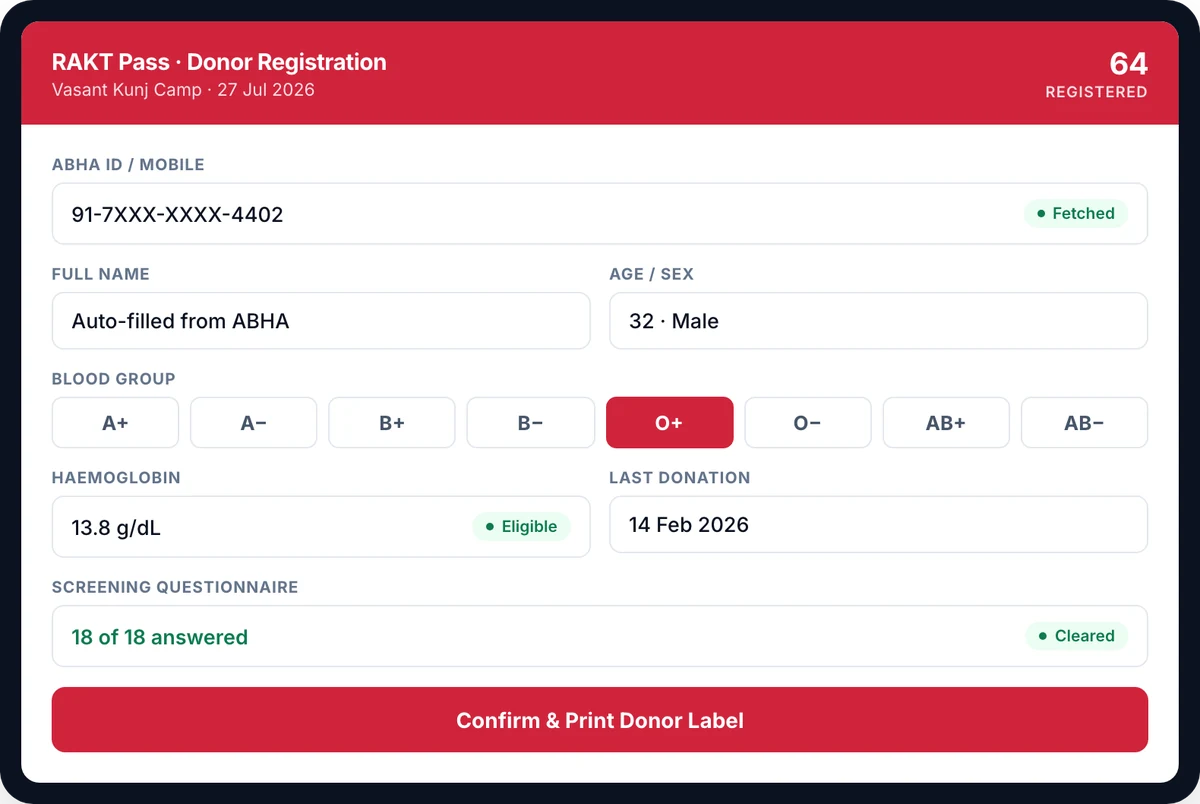
RAKT Pass runs the same registration, questionnaire and screening as your main counter, on a tablet at the camp. Weight, pulse, BP and haemoglobin are recorded on the spot, deferrals are applied there and then, and the donor label prints before the bag is filled.
- Annexure deferral reasons applied at the camp, not reviewed afterwards
- Donor labels printed on site, so every bag is identified from the first minute
- A donor who gave blood too recently is flagged before the needle
- Bags reconcile back to Bag Entry at the centre the same day
- 5,883 camps have been run on RAKT to date
One donor identity that follows them between centres
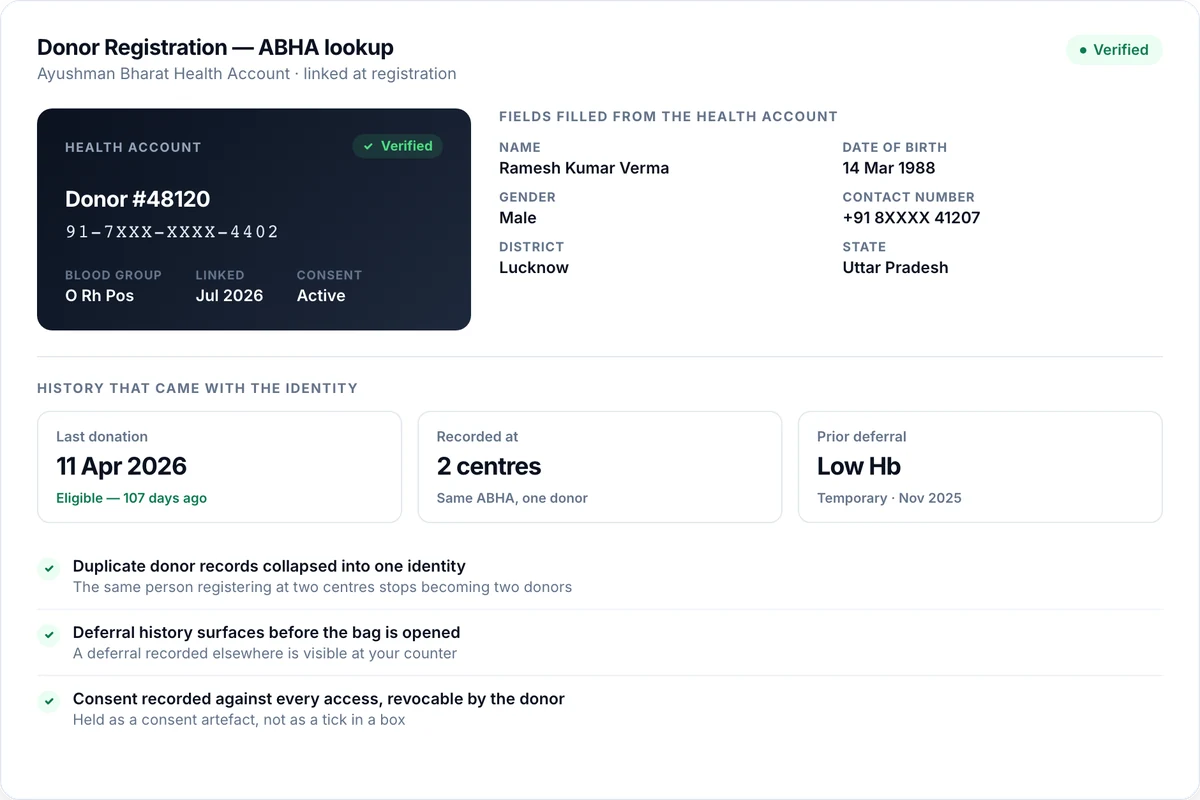
Link a donor’s ABHA number at registration and their demographics arrive with it, instead of being read off a card and typed at the desk. If they gave blood at another centre on your network, their last donation date and deferral history come too.
- ABHA ID and ABHA Number recorded on the donor, verified against the health account
- Demographics fetched rather than re-keyed, so spellings stop drifting
- Duplicate donor records collapse into one identity
- Consent recorded against every access, and revocable by the donor
Three places RAKT does the typing for you
Not a chatbot bolted on. Each of these removes a specific job your staff currently do by hand.
Fill with AI
Photograph a filled-in donor form and the fields populate themselves. Built for camp registrations, where a queue of donors and a paper form do not wait for typing.
RAKT AI assistant
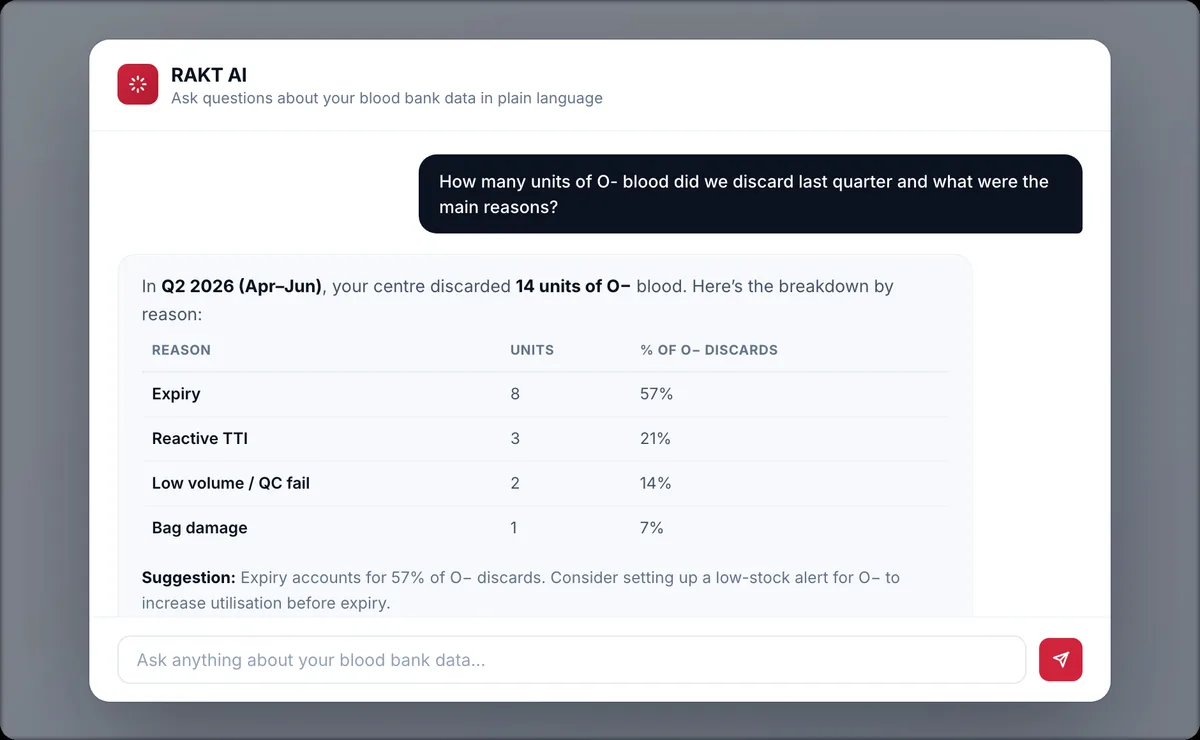
Ask in plain language, as in “how many O Rh Neg units did we discard last quarter?”, and get the answer from your own records, with the units behind it listed.
Compliance audit AI
Checks your records against NABH, NBTC and Drugs & Cosmetics Act requirements and lists what is missing, while there is still time to fix it before the assessor arrives.
Connects to what your centre already runs on
The portals you report to, the analysers in your lab and the ways you reach donors, joined up rather than keyed across by hand.
Submission built from your own records
Donor identity verified against the health account
TTI results read from the instrument
Reminders, invitations and confirmations
Cards, UPI and net banking, reconciled
Webhooks and HIS or LIMS integration
Also: barcode and label printing to Zebra-class printers, a Chrome extension for barcode tools, and bulk import and export as CSV whenever you want your data out. See the integrations page.
Donor and patient records, handled like patient records
You are handing us five lakh donor identities and your recipients’ transfusion history. Access control and audit are part of the product, not an add-on.
Passkey sign-in
Staff sign in with their device, not a password shared around the counter.
Role and centre permissions
A phlebotomist, a technician and a medical officer see different screens.
Encrypted, hosted in India
Encrypted in transit and at rest, on infrastructure inside the country.
Audit log on every record
Who changed a TTI result, who approved a discard, and when.
Most centres go live in two to three days
You keep your current system running alongside for as long as you want to. Nobody is asked to turn anything off on day three.
Questions we get asked most
Is it a blood bank or a blood centre?
Legally it is a blood centre. The Drugs and Cosmetics (Second Amendment) Rules, 2020, notified as G.S.R. 166(E) on 11 March 2020, replaced “Blood Bank” with “Blood Centre” throughout Part X B of the Drugs and Cosmetics Rules, 1945. In practice both words are current: licences and inspection notes increasingly say centre, while staff, hospitals, most tenders and nearly everybody searching for software still say bank. We use both here because our customers do. The reference page sets out what changed.
Is RAKT cloud-hosted or on-premise?
RAKT is a cloud-hosted service running on infrastructure in India. There is no server to install at your centre and nothing for your staff to back up. You reach it through a browser on any device.
Does RAKT submit data to eRaktKosh automatically?
Yes. The bags, test results and issues your staff record during the normal day are mapped to the eRaktKosh schema and submitted to the MOHFW API in one action, so nothing is keyed into the portal twice. Validation runs before it is sent, and the portal’s reply comes back on the same screen, so a rejection shows up while you can still fix it. Tested stock is exposed separately on an endpoint eRaktKosh polls, which is what keeps public availability current between returns.
What is ABHA and do I need it?
ABHA (Ayushman Bharat Health Account) is the national health identity. At registration RAKT can verify an existing ABHA, or create one, by Aadhaar or mobile OTP, and fill the donor’s demographics from the profile ABDM returns rather than having them typed at the desk. RAKT Innovation is registered on ABDM’s Health Facility Registry (ID IN0710008026) and the feature is built to ABDM’s Milestone 1 APIs. It is optional for the donor, and increasingly expected. It does not reach into other providers’ records, so a deferral recorded at a centre unrelated to yours will not appear at your counter.
Can I migrate from my current blood bank software?
Yes. We import donor records, donation history, deferrals and your existing back stock, and we match your register formats before go-live. Most single-centre migrations finish in two to three days, including the back stock, with staff training in the same window.
How does RAKT handle camps?
RAKT Pass registers donors on a tablet at the camp: questionnaire, screening vitals, deferrals and donor label printed on site. Bags reconcile back to Bag Entry at the centre the same day. 5,883 camps have been run on RAKT so far.
Can it stop an untested bag being issued?
That is enforced, not advisory. A component cannot be allotted until grouping and TTI Screening are complete and it has been shifted to tested stock, a reactive result moves the bag out of issuable stock on its own, and nobody at the counter can override either. Emergency release before crossmatch is the one documented exception and is marked on the request.
Which registers does RAKT generate?
Over a hundred, including the Donor Register, TTI Register, Grouping Register, Issue Register, Crossmatch Register, Sample Receiving Register, Component Preparation Record, Patient-Recipient Register, Disposition Register and Discard Register, plus NABH Performance Indicators and the SBTC Report. There is also a report builder for the register your state asks for and nobody else does.

What security measures protect our data?
WebAuthn passkey sign-in rather than shared passwords, permissions per role and per centre, encryption in transit and at rest, and an audit log on every record. Hosting is inside India.
Is there a free trial?
We set up a guided pilot rather than a self-service trial, because blood bank software has to be configured to your licence, your components, your roles and your register formats before it means anything. Book a demo and we will run it on your own workflow.
What happens to my data if I leave?
It is yours. Full export of every record in standard formats, CSV and PDF registers, whenever you ask. There is no lock-in beyond the system being useful.
Do I need special hardware?
No. RAKT runs in a browser on the machines you already have, and RAKT Pass runs on any Android tablet or iPad. Label printers connect over USB or Bluetooth.
How does pricing work?
It depends on the number of licences, centres and modules. See the pricing page for the broad tiers, or ask us for a quote.
See RAKT running your centre’s workflow
Tell us how your centre works today: how many bags a month, which components you prepare, what your registers look like. We will show you the parts that would change. Demos are run by people who have implemented RAKT at blood centres, not from a script.
Or call us directly: +91 7042721037