
Assistance where it removes typing, not judgement
AI in a blood centre should reduce data entry and surface what needs attention. Clinical and release decisions stay with your staff, with the audit trail intact.
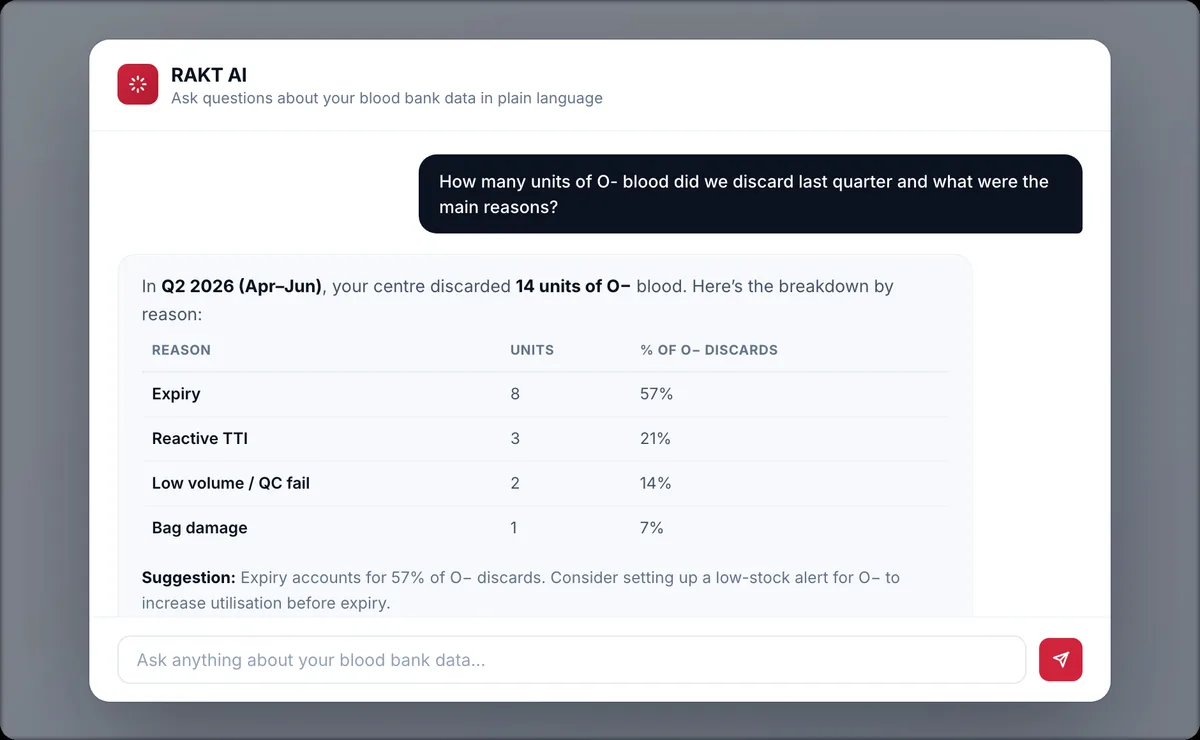
Ask RAKT AI tools
Streaming answers
Vision on donor forms
Golden-set regressions
Where AI is applied
Narrow, checkable tasks — not a black box over your inventory.
Fill with AI
Long forms populated from a document or a photograph, then reviewed by the person responsible before saving.
Ask your data
Question your own records in plain language instead of building a report to answer one question.
Demand signals
Historical collection and issue patterns surfaced so planning is informed by more than last month.
Anomaly surfacing
Entries that look unlike your normal pattern are flagged for a human to look at.
Faster registration
Identity documents read once and checked, rather than typed twice and checked once.
Always attributable
Anything AI drafts is saved by a named user, so accountability does not move.
Two different AIs, on purpose
Ask RAKT AI from the dashboard
Natural-language questions over stock, compliance and registers. Tools are org-scoped and explicitly read-only — nothing releases a unit.
Stream, cancel, export
Answers arrive over SSE. Long results can export to Excel. A WhatsApp webhook serves recognised staff numbers on the same tool surface.
Fill with AI is separate
Donor desk: photograph a form, Vision extracts fields, staff review, then save. Gated by its own addon — write-assist, not judgement.
Eval suite before it ships
Golden datasets include permission-denial cases. If a tool would answer across orgs, the eval fails the build conversation.
Ask RAKT AI is read-only; Fill with AI writes after review
They share a brand name and almost nothing else in the code path. Confusing them is how demos oversell release decisions the product will not make.
- Ask RAKT AI: org-scoped tools, streaming answers, Excel export — nothing releases a unit
- Fill with AI: Vision on a donor form photograph, staff review, then save — separate addon
- WhatsApp webhook serves recognised staff numbers on the same Ask tool surface
- Golden-set evals include permission-denial cases before behaviour ships
Where AI belongs in a blood centre, and where it does not
The useful boundary is not about how capable the model is. It is about who is accountable for the outcome. A blood centre makes two kinds of decision: clinical and release decisions, where a named person is answerable and the audit trail has to show who decided; and data-handling work, where the only thing at stake is time and accuracy. AI belongs entirely in the second category. Reading a donor’s identity document and populating a form, answering a question over your own records in plain language, surfacing an entry that looks unlike your normal pattern, each is checkable by the person responsible before it becomes a record, and each removes typing rather than judgement.
What follows is a hard rule about attribution: anything AI drafts is saved by a named user, and the record shows that person as its author. This matters more than it appears. If a system could write to a register on its own, the audit trail would contain entries with no accountable human behind them, which is unusable in an investigation and indefensible in an assessment. Keeping a person on every write is what keeps the trail meaningful, and it is also the reason the assistance is deliberately narrow: a suggestion a person must check is safe, and an action taken autonomously is not.
So there are things we will not build, and it is worth being explicit rather than leaving the door open. Nothing in RAKT will decide whether a donor is fit to donate, override a deferral, release a unit to tested stock, or approve a discard. Those are refusals of scope, not features we have not got round to. Anyone offering a blood bank an AI that makes release decisions is offering to move accountability away from the medical officer, and there is no version of that a licensed centre should accept.
Questions about rakt ai
Does AI make any clinical or release decisions in RAKT?
No, and that is a boundary rather than a current limitation. Donor eligibility, deferral, release to tested stock and discard approval stay with your staff, and nothing AI drafts becomes a record without a named user saving it. Autonomous writes would put entries in the audit trail with no accountable person behind them, which is unusable in an investigation and indefensible in an assessment.
What can RAKT AI actually do?
Three narrow, checkable things. Fill with AI populates long forms from a scanned document or photograph for the responsible person to review before saving. Asking your data lets you question your own records in plain language instead of building a report to answer one question. And anomaly surfacing flags entries that look unlike your normal pattern for a human to look at. It also surfaces demand signals from historical collection and issue patterns for planning.
Is our data used to train models?
Your donor, patient and operational records are yours, and the point of the assistance is to work over your own data for you rather than to accumulate a training corpus from it. If this is a procurement question for your trust or committee, ask us for the answer in the contract rather than on a web page. That is where it belongs and where you can hold us to it.
Can AI predict how much blood we will need?
It can surface signals from your own history, meaning collection and issue patterns over comparable periods, so planning is informed by more than last month. We are careful about the word predict: a forecast presented with more confidence than the underlying data supports is worse than no forecast, because it gets planned against. The output is a pattern for a person to weigh, not a number to act on unexamined.
More of what RAKT does
See this running on your own floor
Tell us how your centre works today and we will show you the parts that would change.