
Blood Bank Software · November 10, 2026
Coombs Test (DAT and IAT): Direct vs Indirect, Results, Pregnancy and Blood Bank Uses
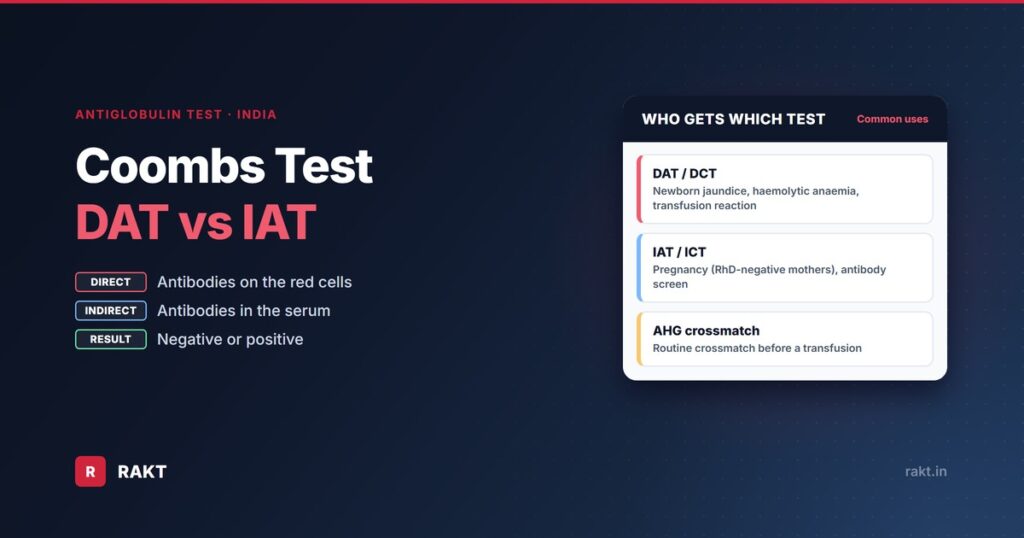
One report says “DCT positive”. Another says “ICT negative”. A third, from the blood centre, says “AHG crossmatch compatible”. All three are versions of the same test, and they are easy to mix up.
The stakes are real. In a Delhi study of pregnant women who had been pregnant before, about 1 in 10 of those who were RhD negative had antibodies against red cells, compared with about 1 in 800 of those who were RhD positive.1. Those antibodies are exactly what the Coombs test is designed to find.
This guide explains the Coombs test in plain words: the difference between the direct and indirect tests, how they work, what a positive result means, why the test matters in pregnancy and for newborns, and how blood centres use it every day.
What is the Coombs test?
The Coombs test, also called the antiglobulin test, is a blood test that finds antibodies against red blood cells. The direct Coombs test (DAT or DCT) looks for antibodies already stuck to a person’s red cells. The indirect Coombs test (IAT or ICT) looks for antibodies floating in the serum.2, 3
It is named after Robin Coombs, who first described the method with Arthur Mourant and Robert Race in 1945.3, 4 The test needs no fasting or other preparation, and results are usually ready within 24 hours.2
| At a glance | Coombs test |
|---|---|
| Also called | Antiglobulin test, AHG test |
| Two types | Direct (DAT, DCT) and indirect (IAT, ICT) |
| Looks for | Antibodies that can attack red blood cells |
| First described | 1945, by Coombs, Mourant and Race |
| Preparation | None; a normal blood sample |
| Result | Negative or positive, not a number range |
Direct vs indirect Coombs test
| Direct Coombs test (DAT, DCT) | Indirect Coombs test (IAT, ICT) | |
|---|---|---|
| What it finds | Antibodies already attached to the person’s red cells | Free antibodies in the serum that could attach to red cells |
| What is tested | The person’s own red cells | The person’s serum, mixed with test red cells |
| Common reasons | Haemolytic anaemia, newborn jaundice, a transfusion reaction | Before a transfusion, and in pregnancy |
| In the blood centre | Part of every transfusion reaction work-up | The antibody screen and the AHG crossmatch |
The uses in this table come from patient guidance and national transfusion guidance.2, 5 In short, the direct test asks “are antibodies attacking these red cells now?”, and the indirect test asks “could this person’s antibodies attack red cells they receive?”
How the Coombs test works
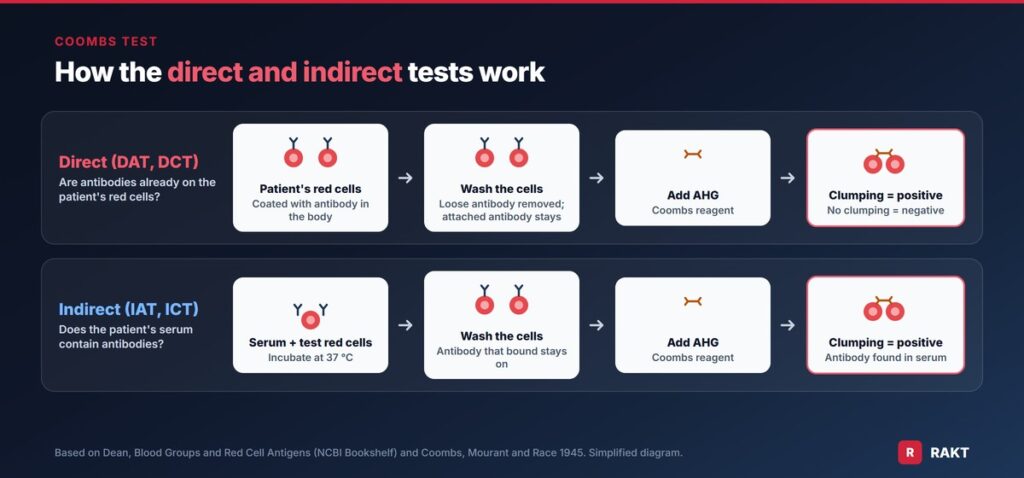
Some antibodies stick to red cells without making them clump on their own. These “incomplete” antibodies are what the test was first designed to detect.4 The Coombs test adds a second antibody, called anti-human globulin (AHG) or Coombs reagent, that binds to those first antibodies. It links the coated red cells together, so they clump (agglutinate) and the reaction becomes visible.3
- Direct test: the patient’s red cells are washed and AHG is added. If the cells clump, antibodies were already on them.3
- Indirect test: the patient’s serum is first incubated with test red cells. The cells are washed to remove free antibodies, then AHG is added. Clumping means the serum contains antibodies that bound to those cells.3
In the blood centre, reactions are graded by strength, from negative to 4+. Our guide to the crossmatch test shows how the antiglobulin phase is read.
Direct Coombs test (DAT or DCT)
A direct Coombs test is usually ordered when red cells may be breaking down too early. Common reasons include:
- Autoimmune haemolytic anaemia, where the body makes antibodies against its own red cells.2
- A newborn with jaundice, to look for the mother’s antibodies on the baby’s red cells.2, 3
- A suspected transfusion reaction. National guidance asks for a direct Coombs test in every transfusion reaction work-up.5
What does a positive direct Coombs test mean?
A positive result means antibodies that can attack red cells are on the person’s red cells. Examples of causes include autoimmune haemolytic anaemia, infections such as mycoplasma or infectious mononucleosis, chronic lymphocytic leukaemia, syphilis, lupus, and a reaction to a blood transfusion.2 A positive DAT is a clue, not a diagnosis. The doctor will look at the full picture and may order more tests. A negative direct Coombs test means no antibodies were found on the red cells.2
In a transfusion reaction, a positive DAT points to an immune cause. National guidance uses it to help define an immune acute haemolytic reaction, and a delayed haemolytic reaction usually shows a positive DAT and antibody screen.5 Our guide to blood transfusion reactions covers the full work-up.
Indirect Coombs test (IAT or ICT)
An indirect Coombs test looks for antibodies in the serum before they can do harm. It is used:
- Before a blood transfusion, as the antibody screen and in the antiglobulin (AHG) crossmatch.2, 5
- In pregnancy, as part of routine antenatal testing.2, 3
What does a positive indirect Coombs test mean?
A positive ICT means the person has antibodies that could react with red cells from someone else. Before a transfusion, the blood centre then has to identify the antibody and choose donor blood carefully. People who have had many transfusions can develop several antibodies, which makes compatible blood harder to find.2, 5 A negative ICT means no such antibodies were found.2
ICT test in pregnancy
Pregnancy is one of the main reasons for an ICT, especially for mothers who are RhD negative.
If an RhD-negative mother carries an RhD-positive baby, her body can make antibodies against the D antigen (anti-D). The first pregnancy is usually not affected. In a later pregnancy, these antibodies can cross the placenta and destroy the baby’s red cells, causing haemolytic disease of the fetus and newborn.2, 3 This can lead to anaemia and jaundice, and in severe cases, brain damage from high bilirubin (kernicterus).3
An indirect Coombs test shows whether the mother has formed these antibodies. If she has not, preventive anti-D immunoglobulin greatly reduces the risk of her forming them in future.3 Treatment can almost always prevent problems when the risk is found early, which is why testing early in pregnancy matters.2
Indian data show why this test matters. In the Delhi study of 3,577 pregnant women who had been pregnant before:1
- 1.25% had antibodies against red cells.
- That was 10.7% of RhD-negative women, against 0.12% of RhD-positive women.
- Anti-D made up 78.4% of the antibodies found. Others included anti-C, anti-M, anti-S and anti-c.
The authors noted that, in India, screening is done mainly for RhD-negative women or those with an adverse obstetric history, such as a previous stillbirth or miscarriage, and they called for larger studies.1 ABO and Kell antibodies can also affect babies, though ABO disease is usually milder than Rh disease.3
If your ICT is positive, your obstetrician will explain what it means for your pregnancy and how closely you need to be monitored.
Coombs test in newborns
When a baby is born with jaundice, a direct Coombs test helps show whether the mother’s antibodies are attacking the baby’s red cells. A positive result generally means anaemia or jaundice, and the baby will be examined and treated.2, 3
For a newborn who needs blood, national guidance asks that the baby’s sample come with the mother’s sample. Blood issued for the baby should be checked against the mother’s sample too.5
How blood centres use DAT and IAT
For a blood centre, the antiglobulin test is not a one-off. It sits inside daily work.
- Antibody screen and type and screen. Once the antibody screen shows no irregular antibodies, repeated crossmatches are not needed under a type and screen policy.5
- AHG crossmatch. National guidance’s model request form separates routine requests, tested by the AHG crossmatch technique, from urgent ones.5
- Incompatible crossmatch. The work-up includes phenotyping, an antibody screen and identification of the antibody.5
- Autoimmune haemolytic anaemia. A larger sample, 5 to 10 ml, may be needed for special techniques such as adsorption and elution.5
- Thalassaemia and other patients on regular transfusion. Antibodies should be screened at regular intervals. Once one is found, it is identified and antibody-negative crossmatched blood is given.5
- RhD-negative patients. Rh-positive red cells may be given to some RhD-negative patients only when the antibody screen is negative, only to save a life, and with informed consent.5
- DAT-positive donors. A positive DAT in a healthy donor is rare, reported at about 1 in 13,000 people. Such a donor’s red cells can come up incompatible with every recipient in the antiglobulin phase of the crossmatch.6
- Daily reagent checks. The Drugs and Cosmetics Rules list Coombs serum among the special reagents a blood centre needs. Anti-human serum, and the cells used for antibody screening and reverse grouping, must be quality-tested on each day of use.7
Our guide to the Bombay blood group shows another case where reverse grouping and an auto control change the answer.
Keep antibody results with the patient’s record
An antibody found today matters for every future transfusion. If it sits only on a paper worksheet, the next crossmatch may never see it.
RAKT keeps it with the record:
- Forward and reverse grouping are recorded separately, with phenotyping and irregular antibodies.
- Crossmatch compatibility is recorded against the bag and the request.
- A transfusion reaction is recorded against the unit that was issued, in a Transfusion Reaction Register.
See how RAKT records grouping, antibodies and crossmatch results, or book a demo on WhatsApp.
Frequently asked questions
What is a Coombs test?
A Coombs test, or antiglobulin test, is a blood test that looks for antibodies against red blood cells. The direct test checks the red cells, and the indirect test checks the serum.
What is the difference between the direct and indirect Coombs test?
The direct Coombs test (DAT or DCT) finds antibodies already attached to a person’s red cells. The indirect Coombs test (IAT or ICT) finds free antibodies in the serum that could attack red cells, such as donor cells or a baby’s cells.
What does a positive direct Coombs test mean?
It means antibodies are attached to the red cells. Causes include autoimmune haemolytic anaemia, some infections, a transfusion reaction, or a mother’s antibodies in a newborn. A doctor interprets it with other tests.
What is the ICT test in pregnancy?
It is an indirect Coombs test done during pregnancy, mainly for RhD-negative mothers, to check whether they have formed antibodies that could harm the baby’s red cells.
What happens if the ICT is positive in pregnancy?
It means antibodies against red cells were found. The antibody will be identified, and your obstetrician will explain what it means for the baby and how closely the pregnancy needs to be monitored.
Is the Coombs test done on the mother or the baby?
Both, for different reasons. The mother usually has an indirect test during pregnancy. A baby with jaundice may have a direct test to see whether the mother’s antibodies are on the baby’s red cells.
What is the normal result of a Coombs test?
The normal result is negative, meaning no antibodies were found. The test does not have a number range. A positive result is graded by strength, and in pregnancy the antibody level may be reported as a titre, which your doctor will explain.
What is a DCT or DAT test?
DCT (direct Coombs test) and DAT (direct antiglobulin test) are two names for the same test. It checks whether antibodies are already attached to red blood cells.
Do I need to fast before a Coombs test?
No. The Coombs test needs no fasting or special preparation. A small blood sample is taken from a vein.
How long does a Coombs test take?
Results are usually ready within 24 hours.
Sources
- Pahuja S, Gupta SK, Pujani M, Jain M. The prevalence of irregular erythrocyte antibodies among antenatal women in Delhi. Blood Transfus. 2011;9(4):388-93 pmc.ncbi.nlm.nih.gov
- Cleveland Clinic. Coombs Test: Purpose, Procedure and Results. Medically reviewed May 2022 my.clevelandclinic.org
- Dean L. Blood Groups and Red Cell Antigens: Hemolytic disease of the newborn. National Center for Biotechnology Information, 2005 ncbi.nlm.nih.gov
- Coombs RRA, Mourant AE, Race RR. A new test for the detection of weak and “incomplete” Rh agglutinins. Br J Exp Pathol. 1945;26(4):255-66 pmc.ncbi.nlm.nih.gov
- National Institute of Biologicals, Ministry of Health and Family Welfare. Good Blood Transfusion Practices: Guidance for Rational Use of Blood. 2022 nib.gov.in
- Parikh YN, Vekariya MM, Gondaliya VK, Rajapara MM, Joshi SR. An autoantibody to Rh-Ce protein causing positive direct antiglobulin test in a healthy blood donor. Asian J Transfus Sci. 2023;17(2):273-5 pmc.ncbi.nlm.nih.gov
- Drugs and Cosmetics Rules, 1945, Schedule F, Part XII-B, as amended by G.S.R. 166(E), 11 March 2020 cdsco.gov.in