
Compliance & Accreditation · November 11, 2026 · Updated November 14, 2026
Quality Control in Blood Bank: QC Parameters, Reagent and Equipment Checks, and EQAS
A bag of cryoprecipitate can look exactly like the one before it and still carry less Factor VIII than the standard requires. Nobody can see that. It only shows up when the unit is tested.
It happens more often than most people expect. Over five years of testing at one Kolkata blood centre, about 1 in 6 cryoprecipitate units checked fell below the Factor VIII limit. The centre still met the standard, because the rule asks for 75% of tested units to pass, not all of them.1
The good news is that Indian rules spell out what to test, how many units, how often, and what counts as a pass. This guide to quality control in blood bank work puts them in one place: the limits for every component, the daily reagent checks, equipment checks and EQAS.
What is quality control in a blood bank?
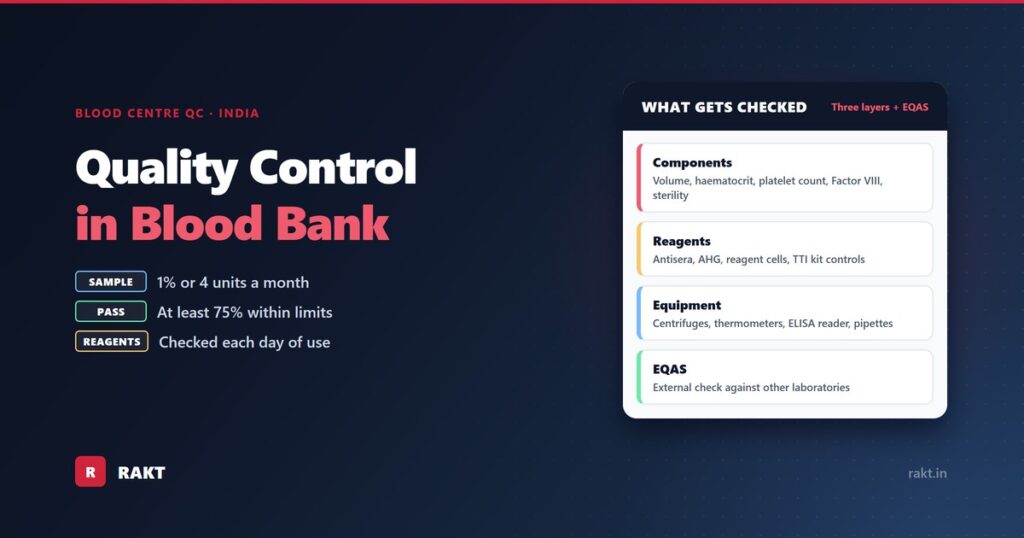
Quality control (QC) in a blood bank is the routine testing of blood components, reagents and equipment to make sure they work as they should. In India, a blood centre tests 1% of each component, or at least 4 units a month, and at least 75% must meet the set limits.2, 3
Blood bank QC has three layers:
- Components. Is the product in the bag what the label promises, in volume, cell count, clotting factors and sterility?
- Reagents. Do the antisera, reagent cells and test kits give the right answer today?
- Equipment. Are the centrifuges, refrigerators, thermometers and analysers working within their limits?
| At a glance | Blood bank QC in India |
|---|---|
| How many units | 1% of each component, or at least 4 a month, whichever is higher |
| Pass mark | At least 75% of tested units within the limits |
| Grouping and AHG reagents | Checked each day of use, with controls |
| TTI test reagents | Checked with every run |
| External check | At least one EQAS, plus NBTC proficiency testing |
| Records | All QC results kept |
The sections below explain each line, with the source for every limit.2, 3
QC vs QA vs quality indicators
These three terms are often mixed up. The national standards define them differently:2
| Term | What it means | Example |
|---|---|---|
| Quality control (QC) | Routine testing of materials, equipment, products and services to make sure they work properly | Measuring the Factor VIII level in 4 cryo units this month |
| Quality assurance (QA) | Planning, control, assessment, reporting and improvement of quality as a whole | The SOPs, training, audits and corrective actions around QC |
| Quality indicators | Measurable results of a process, tracked over time | Discard rate or transfusion reaction rate each month |
QC is one part of QA. Quality indicators show the trend. Our guide to quality indicator records for NABH covers the indicator side.
How many units to test: the 1% or 4 units rule
The Drugs and Cosmetics Rules set the legal floor. For red cells, platelets and cryoprecipitate, 1% of units prepared are tested, and at least 75% of the tested units must conform. For apheresis platelets, the sample is 1% of monthly production or 4 units a month, whichever is higher.3
The national standards apply the same idea to every component: from the total collection, test 1% or a minimum of 4 units of each component produced per month, whichever is higher, and at least 75% should fall within the acceptable range.2
In practice:
- A centre making 300 units of FFP a month: 1% is 3, so it tests 4.
- A centre making 900 units of FFP a month tests 9.
- If 4 units are tested, at least 3 must pass. If 9 are tested, at least 7 must pass.
All QC results must be kept as records.2
QC parameters for each blood component
These are the limits a tested unit has to meet. Where the Drugs and Cosmetics Rules and the national standards both give a figure, the table follows the Rules.
| Component | What is checked and the limit |
|---|---|
| Whole blood | Volume 350 or 450 ml, plus or minus 10%. PCV above 30%. Sterile on culture.2 |
| Packed red cells in CPDA-1 | Volume 250 ml plus or minus 10% (from a 450 ml bag) or 150 ml plus or minus 10% (from a 350 ml bag). Haematocrit 65 to 70%. Sterile on culture.3 |
| Packed red cells in SAGM | Haematocrit 50 to 60%. Sterile on culture.3 Volume within the centre’s validated range. |
| Leucodepleted red cells | Fewer than 5 × 10⁶ white cells per unit to prevent alloimmunisation or CMV. Fewer than 5 × 10⁸ when the aim is only to prevent febrile reactions.3 |
| Irradiated red cells | Gamma or X-ray irradiation at 25 Gy.3 |
| Random donor platelets | At least 3.5 × 10¹⁰ platelets (from 350 ml blood) or 4.5 × 10¹⁰ (from 450 ml blood). pH 6 or above at the end of storage.3 Volume 50 to 70 ml. Red cell contamination under 0.5 ml.2 |
| Platelets from buffy coat | Volume 50 to 90 ml. Platelet count 5.5 × 10¹⁰. pH above 6. Red cell contamination under 0.5 ml.2 |
| Pooled platelets | More than 2 × 10¹¹ platelets per pool.3 |
| Apheresis platelets (SDP) | At least 3 × 10¹¹ platelets per unit. pH 6 or above at the end of storage.3 Volume above 200 ml.2 |
| Fresh frozen plasma | Volume 180 to 220 ml (350 ml bag) or 220 to 300 ml (450 ml bag). Factor VIII at least 70 IU per bag.3 Fibrinogen above 200 mg per bag, and PT and APTT to check the stable clotting factors.2 |
| Cryoprecipitate | Volume 15 to 20 ml. Fibrinogen at least 150 mg per bag. Factor VIII at least 80 IU per bag.3 |
| Granulocytes (apheresis) | At least 1 × 10¹⁰ granulocytes.3 |
For the storage side of each component, see our blood storage temperature and shelf life chart. Our guides to packed red blood cells, fresh frozen plasma and SDP vs RDP platelets explain each product in more detail.
What one Indian centre found
A study from a Kolkata hospital blood centre looked at five years of component QC, from 2015 to 2019. It tested about 2% of its PRBC, platelets and FFP, and 1.6% of its cryoprecipitate:1
- Packed red cells: 91.4% met the haematocrit target.
- Random donor platelets: 90.1% met the platelet count in the Drugs and Cosmetics Rules.
- Cryoprecipitate: 93.2% had more than 150 mg of fibrinogen, and 82.9% had more than 80 IU of Factor VIII.
The authors concluded that QC met national and international standards, and that strict adherence to protocols and the manufacturer’s instructions was the key.1 The numbers also show why the 75% rule exists, and why a centre should watch the trend, not just the monthly pass.
Platelet QC needs extra care
Platelets are stored warm, at 20 to 24°C, so they need more checks than other components:3
- Units are tested at the end of the storage period for platelet count, pH (6 or above) and plasma volume.
- 1% of the platelets prepared are tested for sterility.
- Each unit is checked for swirling before issue, as a sign the platelets are still viable.
- If results do not meet the requirements, corrective action must be taken at once and recorded.
The national standards add that 1% of all platelet concentrates should be tested for bacterial contamination by a validated method as part of routine QC.2
Reagent QC in blood bank
A good component is not much use if the grouping or crossmatch reagent gives the wrong answer. The Drugs and Cosmetics Rules set how often each reagent is tested with controls:3
| Reagent or solution | How often it is tested with controls |
|---|---|
| Blood grouping antisera | Each day of use |
| Anti-human globulin (Coombs) serum | Each day of use |
| Lectins | Each day of use |
| Cells for reverse grouping and antibody screening | Each day of use |
| Enzymes | Each day of use |
| Normal saline, LISS and PBS | Each day of use |
| Bovine albumin | Each day of use |
| Hepatitis, HIV 1 and 2, and syphilis test reagents | Each run |
The national standards add column agglutination (gel) cards, checked each day of use, and more detail on how reagents are checked:2
- New batches of anti-A, anti-B and anti-D: one vial is checked on receipt for titre, specificity and avidity.
- Daily checks: all antisera are checked every day with known positive and negative controls. Any reagent that turns cloudy or changes colour is discarded.
- Two anti-D batches: the centre should always have two different batches of anti-D, from two manufacturers or two batches of the same one.
- Reagent red cells: prepared daily, free of haemolysis, and pooled from at least 3 people for each group.
- Anti-human globulin: every negative antiglobulin test is confirmed with IgG-coated check cells, which must clump. Our Coombs test guide explains why.
- Saline and buffers: pH is checked daily and should be 6.7 to 7.2.
- TTI test kits: kit and in-house positive and negative controls are run with every batch and read on a Levey-Jennings chart using Westgard rules.
Equipment QC and calibration
The Drugs and Cosmetics Rules list how often key equipment must be checked and calibrated, at a minimum:3
| Equipment | Check | How often |
|---|---|---|
| Temperature recorder | Compare against a thermometer | Daily |
| Refrigerated centrifuge | Observe speed and temperature | Each day of use |
| Haemoglobinometer | Standardise against a cyanmethaemoglobin standard | Each day of use |
| Automated blood typing | Observe controls for correct results | Each day of use |
| Electronic thermometers | Performance check | Monthly |
| General laboratory centrifuge | Tachometer check | Every 6 months |
| Haematocrit centrifuge | Standardise | Before first use, after repair and once a year |
| Certified standard weights | Calibration | Once a year |
| ELISA reader (if ELISA is used) | Performance check and calibration | Each run; calibrated once a year |
| Micropipettes (if ELISA is used) | Calibration | Once a year |
Records of calibration, maintenance and validation must be kept for every piece of equipment.2 A refrigerator or freezer that drifts out of range is also a cold-chain problem. Our guide to cold-chain excursion records covers what to write down when that happens.
Internal QC vs EQAS
Internal QC shows that a centre’s own tests agree with its own controls. It cannot show whether the centre would get the same answer as everyone else. That is the job of an External Quality Assessment Scheme (EQAS), which sends the same samples to many laboratories and compares the results.
The national standards are clear about this:2
- Every blood centre shall enrol in at least one EQAS programme.
- Blood centres shall take part in a proficiency testing programme run by the National Blood Transfusion Council.
- EQAS participation must be documented, with corrective action where needed.
EQAS is also growing nationally. With WHO support, the national External Quality Assurance Scheme has been rolled out and is being scaled up to new centres in 2026. The national plan for 2026 to 2031 lists expanding EQAS to every state and Union Territory as a priority.4
When a unit fails QC
A failed QC result is not the end of the process. It is the start of an investigation. The Drugs and Cosmetics Rules say that when platelet testing shows the product does not meet requirements, corrective action must be taken immediately and records maintained.3 The national standards ask every centre to have a process to identify deviations, report them and take corrective action.2
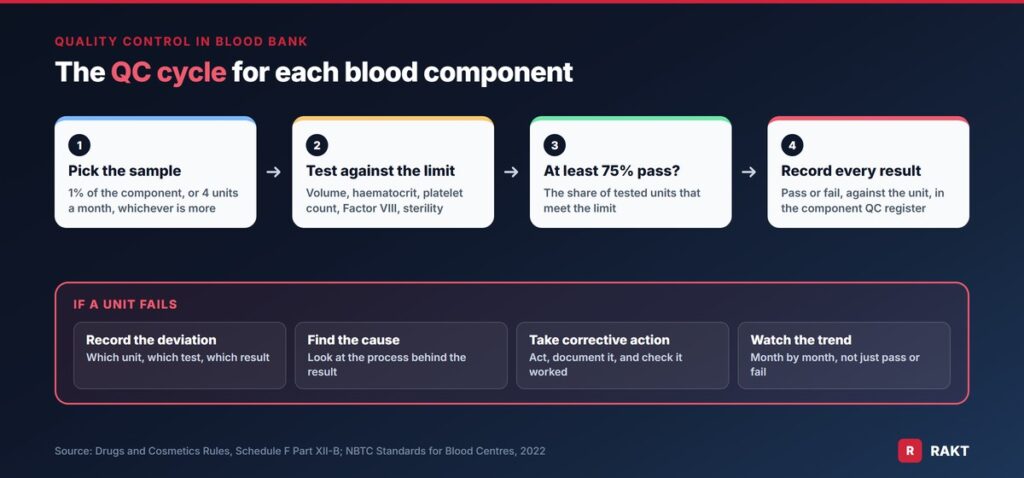
A simple way to run it:
- Pick the sample: 1% of each component, or 4 units a month, whichever is more.
- Test against the limit for that component.
- Check the pass rate: at least 75% of tested units must conform.
- Record every result, pass or fail, against the unit.
- If a unit fails, record the deviation, look for the cause, act on it and check that the fix worked.
- Watch the trend month by month, not just the pass or fail.
Keep QC results separate from yield figures. A high yield does not prove that a unit passed QC. Our guide to blood component yield reports explains the difference.
Keep QC results where the assessor looks
QC only helps if the result is easy to find when an inspector or NABH assessor asks for it. A result on a loose worksheet is hard to trace back to the bag it came from.
RAKT keeps QC with the component record:
- Quality control registers are kept per component group: PRBC and whole blood, FFP and CPP, platelet products, and cryoprecipitate.
- Component preparation records what each bag yielded, and each component has its own volume, storage condition and expiry.
- A validated component becomes issuable when it is moved to tested stock.
- NABH performance indicators are computed continuously, and each figure drills down to the bags behind it.
See how RAKT records component preparation and QC, or book a demo on WhatsApp.
Frequently asked questions
What is quality control in blood bank?
It is the routine testing of blood components, reagents and equipment to make sure they meet set limits. In India, a centre tests 1% of each component or at least 4 units a month, and at least 75% must pass.
What is the difference between QC and QA in a blood bank?
Quality control is the testing itself, such as checking the Factor VIII level in cryoprecipitate. Quality assurance is the wider system of planning, SOPs, training, audits and corrective action that QC sits inside.
How many units should be tested for QC each month?
Under the national standards, 1% of each component produced, or at least 4 units a month, whichever is higher. At least 75% of the tested units should meet the limits.
What are the QC parameters for packed red cells?
Volume of 250 ml plus or minus 10% from a 450 ml bag, or 150 ml plus or minus 10% from a 350 ml bag. Haematocrit of 65 to 70% in CPDA-1 or 50 to 60% in SAGM. The unit must be sterile on culture.
What is the platelet count required in a platelet concentrate?
At least 3.5 × 10¹⁰ platelets from 350 ml of blood and 4.5 × 10¹⁰ from 450 ml for random donor platelets. Apheresis platelets need at least 3 × 10¹¹ per unit. The pH must be 6 or above at the end of storage.
What are the QC parameters for FFP?
Volume of 180 to 220 ml from a 350 ml bag or 220 to 300 ml from a 450 ml bag, and Factor VIII of at least 70 IU per bag. The national standards also ask for fibrinogen above 200 mg per bag and PT and APTT checks.
What are the QC parameters for cryoprecipitate?
Volume of 15 to 20 ml, fibrinogen of at least 150 mg per bag and Factor VIII of at least 80 IU per bag.
How often should blood grouping reagents be checked?
Each day of use, with known positive and negative controls. Each new batch is also checked on receipt for titre, specificity and avidity.
What is EQAS in blood bank?
EQAS, or External Quality Assessment Scheme, sends the same samples to many laboratories and compares their results. Indian blood centres must enrol in at least one EQAS and take part in NBTC proficiency testing.
What happens if a blood component fails QC?
The failure is recorded as a deviation, the cause is investigated and corrective action is taken and documented. The centre also checks whether at least 75% of the tested units still passed that month.
Sources
- Das SS, Biswas RN, Sardar TP, Safi M. An insight to the internal quality control of blood components separated using the latest whole blood collection and processing systems: experience from a tertiary care hospital blood transfusion service in Eastern India. Asian J Transfus Sci. 2022;16(2):194-200 pmc.ncbi.nlm.nih.gov
- National Blood Transfusion Council and Directorate General of Health Services, Ministry of Health and Family Welfare. Standards for Blood Centres and Blood Transfusion Services. 2nd edition, 2022 clinicalestablishments.mohfw.gov.in
- Drugs and Cosmetics Rules, 1945, Schedule F, Part XII-B, as amended by G.S.R. 166(E), 11 March 2020 cdsco.gov.in
- WHO UHC Partnership. India strengthens blood safety, universal access and quality-assured blood services. 15 December 2025 extranet.who.int