
Compliance & Accreditation · November 21, 2026
Transfusion Medicine: What It Is, What the Specialist Does and the MD Path in India
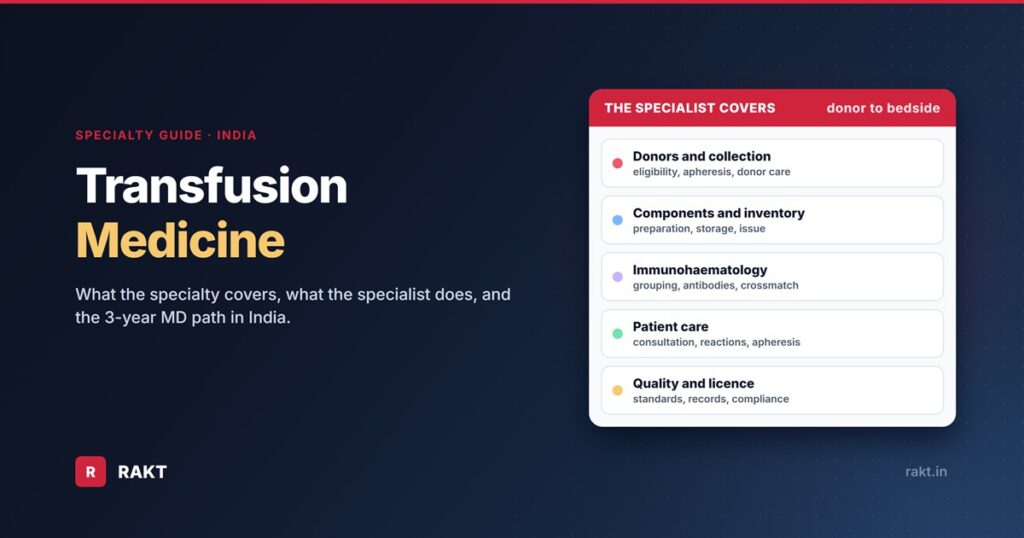
Every unit of blood a patient receives passes through a chain of decisions. Who can donate. How the bag is split into components. Which unit matches. What to do if the patient reacts. In India, the doctors trained specifically to run that chain are transfusion medicine specialists.
Their role is written into the rules. India’s national standards for blood centres say that in medical colleges and teaching institutes, when candidates with both degrees are available, a doctor with an MD or DNB in Transfusion Medicine gets preference over one in Pathology for the blood centre.1
This guide explains what transfusion medicine is, what the specialist does, and the MD path in India.
Transfusion Medicine: In Short
Transfusion medicine is the branch of medicine that covers every step of blood transfusion: choosing donors, preparing blood components, testing for compatibility, giving transfusions safely and managing reactions, along with apheresis, transplant matching and the running of blood services. In India, the main postgraduate route is a three-year MD in Transfusion Medicine, also called MD in Immunohaematology and Blood Transfusion.2, 3, 4
What is Transfusion Medicine?
The Indian Society of Transfusion Medicine describes it as the practice of laboratory and clinical medicine concerned with all aspects of blood transfusion. Its scope includes:2
- The science behind transfusion.
- Choosing and recruiting blood donors.
- Preparing blood components.
- Testing before transfusion.
- Giving transfusions, and the adverse effects that can follow.
- Transplantation and tissue matching (histocompatibility).
- Therapeutic apheresis.
- Medicolegal questions, and managing blood services, including regulation.
The specialty is also known as immunohaematology and blood transfusion (IHBT), after one of its core subjects: the study of blood group antigens and antibodies.3
What a Transfusion Medicine Specialist Does
JIPMER’s MD curriculum notes that a transfusion medicine physician’s responsibilities are more varied than those of most other specialists. They fall into five areas:3
| Area | What it covers |
|---|---|
| Patient care and consultation | Advising clinicians on transfusions, managing reactions, therapeutic apheresis |
| Laboratory direction | Running the testing laboratories, including immunohaematology |
| Component manufacture | Supervising how blood is separated into components and stored |
| Inventory and distribution | Keeping the right units available and issuing them |
| Regulatory compliance | Licences, standards and records |
The training also covers collecting and processing stem cells for transplant, and HLA typing for transplant matching.3 Much of this daily work appears in our other guides: apheresis, crossmatching, irradiated and leucodepleted blood and the massive transfusion protocol.
Transfusion Medicine, Pathology and Haematology
The fields overlap. AIIMS Bibinagar’s MD curriculum lists overlaps with clinical pathology and laboratory medicine, haematology, immunology, microbiology, intravenous therapy, regulatory and manufacturing practice, and regenerative medicine, as well as donor recruitment and care.4
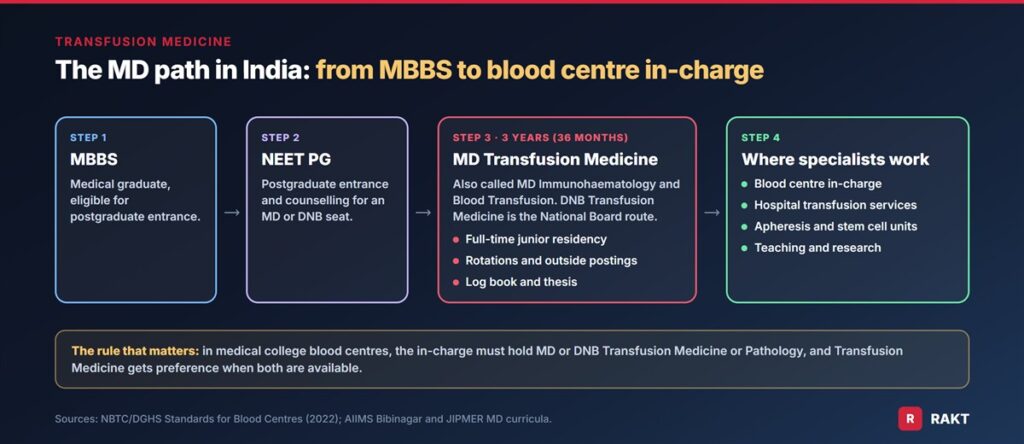
The rules reflect that overlap. A doctor with an MD or DNB in Pathology can also run a blood centre, after three months in a licensed one. But in medical colleges and teaching institutes, where candidates with both degrees are available, the national standards give preference to Transfusion Medicine. And the in-charge of a blood centre there must hold an MD or DNB in either Transfusion Medicine or Pathology.1 Our guide to the Form 28-C blood centre licence lists every qualifying route.
The MD Path in India
The postgraduate degree goes by more than one name. The national standards list MD Transfusion Medicine, DNB Transfusion Medicine and MD Immunohaematology and Blood Transfusion.1 JIPMER’s curriculum, for example, is titled MD in Immunohaematology and Blood Transfusion, but describes it as the degree of MD in Transfusion Medicine.3
| MD Transfusion Medicine | At a glance |
|---|---|
| Also called | MD Immunohaematology and Blood Transfusion (IHBT); DNB Transfusion Medicine is the National Board degree |
| Who can apply | Doctors with an MBBS, through postgraduate entrance (NEET PG) |
| Duration | 3 years (36 months), full time |
| How you train | As a full-time junior resident, with departmental rotations and postings at other institutes |
| Records | A log book of the training and procedures you complete |
| Assessment | A thesis, submitted before the final theory and practical examinations |
The duration, residency, rotations, log book and thesis are from AIIMS Bibinagar’s curriculum, which also sets out what a resident should be able to do in each of the three years, starting with selecting whole blood and apheresis donors.4
The national standards also recognise a shorter route for blood centre work: an MBBS with a Diploma in Transfusion Medicine or in Immunohaematology and Blood Transfusion, plus three months in a licensed blood centre, qualifies a doctor as a blood centre medical officer.1
What the MD Training Covers
JIPMER’s curriculum lists the subjects a resident must master:3
- Blood donation: motivating donors, whole blood versus apheresis donation, donor eligibility and deferral, and donor reactions.
- Components: preparing and storing blood components.
- Immunohaematology: blood groups, antibodies and compatibility testing.
- Histocompatibility: HLA and its role in organ and stem cell transplants.
- Therapeutic apheresis: principles, indications, replacement fluids and patient preparation.
- Stem cells: collection, processing and storage.
- Plasma fractionation: the basic steps.
- Regulation: the rules that govern blood services.
Where Transfusion Medicine Specialists Work
The clearest role is written into the rules: running a licensed blood centre. Every blood centre must operate under at least one full-time medical officer with a recognised qualification, and an MD or DNB in Transfusion Medicine is one of them.1 Our guide on how to open a blood bank in India shows where that post fits in a new centre’s staff.
JIPMER’s curriculum adds the wider aims of the degree: consultants and teachers for medical colleges, direction of academic blood centres, promoting the right use of blood, research, and training the next generation of blood centre staff.3 The training also prepares specialists for hospital transfusion services and for apheresis and stem cell units.
Is Transfusion Medicine a Good Career?
The most direct answer comes from the specialists themselves. A study published in 2025 by a team at Kasturba Medical College, Manipal, surveyed transfusion medicine specialists across India; 71 responded, a 48% response rate.5
| What specialists said | Main points |
|---|---|
| Strengths | Immunohaematology and blood safety |
| Weaknesses | Limited clinical exposure, and too little recognition within the medical profession |
| Opportunities | Working across specialties, and new advances in the field |
| Threats | Overlap with pathology, and the emergence of artificial blood products |
Their suggested strategies centred on apheresis, recruitment policy, more clinical exposure and new developments.5 So the field is valued for its core science, but it is still working for recognition and clinical reach.
We do not quote salaries, seat numbers or cut-off ranks here. There is no single official source for them, and the figures online vary widely.
Run the Blood Centre, not the Registers
A transfusion medicine specialist who heads a blood centre signs off on the registers, the licence conditions and every exception. RAKT is built to take the clerical part off that desk:
- The Donor, TTI, Grouping, Crossmatch and Issue registers write themselves while staff work.
- NABH performance indicators are computed continuously from the bags, issues and discards already recorded.
- Untested or reactive units cannot be issued, and a discard cannot be completed until the MO or MD approves it.
See how RAKT handles compliance and NABH indicators, or book a demo on WhatsApp.
Frequently asked questions
What is transfusion medicine?
Transfusion medicine is the branch of medicine that covers all aspects of blood transfusion: choosing donors, preparing blood components, compatibility testing, giving transfusions, managing reactions, apheresis, transplant matching and running blood services.
What does a transfusion medicine doctor do?
They advise clinicians on transfusions and manage reactions, direct the testing laboratories, supervise component preparation and storage, manage blood inventory, and keep the blood centre compliant with its licence and standards.
Is MD Transfusion Medicine the same as MD IHBT?
Yes. MD Transfusion Medicine and MD Immunohaematology and Blood Transfusion (IHBT) are names for the same specialty. India’s national standards list both, along with DNB Transfusion Medicine.
How long is MD Transfusion Medicine?
Three years (36 months), as a full-time junior resident, with rotations, a log book and a thesis submitted before the final examinations.
Can an MD Pathology doctor run a blood centre?
Yes, after three months’ experience in a licensed blood centre. In medical colleges and teaching institutes, however, preference goes to MD or DNB Transfusion Medicine when candidates with both degrees are available.
What is immunohaematology?
Immunohaematology is the study of blood group antigens and antibodies, and the tests built on them, such as blood grouping, antibody screening and crossmatching. It is a core subject of transfusion medicine.
Is there a diploma in transfusion medicine?
India’s national standards recognise an MBBS with a Diploma in Transfusion Medicine or in Immunohaematology and Blood Transfusion, plus three months in a licensed blood centre, as one qualification for a blood centre medical officer.
Is transfusion medicine a good career?
In a survey of Indian specialists published in 2025, the field’s strengths were immunohaematology and blood safety. Its weaknesses were limited clinical exposure and low recognition, and the main threats were overlap with pathology and artificial blood products.
What is the scope of MD Transfusion Medicine?
Specialists run licensed blood centres, where medical colleges must prefer them over pathologists when both are available, and work in hospital transfusion services, apheresis and stem cell units, teaching and research.
What subjects does MD Transfusion Medicine cover?
Blood donation, component preparation, immunohaematology, HLA and transplant matching, therapeutic apheresis, stem cell collection and processing, plasma fractionation basics and the regulation of blood services.
Sources
- National Blood Transfusion Council and Directorate General of Health Services, Ministry of Health and Family Welfare. Standards for Blood Centres and Blood Transfusion Services. 2nd edition, 2022 clinicalestablishments.mohfw.gov.in
- Indian Society of Transfusion Medicine. Welcome to ISTM. Accessed 21 November 2026 istm.net.in
- Jawaharlal Institute of Postgraduate Medical Education and Research (JIPMER), Puducherry. Curriculum: M.D. in Immunohematology and Blood Transfusion jipmer.edu.in
- All India Institute of Medical Sciences, Bibinagar. MD Immuno Haematology and Blood Transfusion curriculum aiimsbibinagar.edu.in
- Chopra A, Shastry S, Mohan G, Chenna D, Rajendran V. A comprehensive SWOT and TOWS analysis of transfusion medicine: Indian perspective. Transfus Apher Sci. 2025;64(1):104061 doi.org