
Compliance & Accreditation · November 20, 2026
How to Open Blood Bank in India: Licence, SBTC NOC, Form 27-C, Space, Staff and Cost
Opening a blood bank in India takes more than a building and a few refrigerators. You need the right kind of organisation behind it, a licence signed by both your state and the central regulator, at least 100 square metres laid out in a set way, and a medical officer whose qualifications match the rules.
The small misses cause most of the trouble: a trust that applied before getting its SBTC NOC, a floor plan without a counselling area, or a technician named on the application who isn’t on duty when the inspector arrives.
This guide takes you through the process in the order you’ll need it. It covers who can apply, the eight steps from plan to licence, the space, staff and equipment the rules require, the documents to file, and what it costs to set up and run.
In this guide: Who can open one · Blood centre or storage centre · Step-by-step process · Space and rooms · Staff · Equipment · Documents · Cost · After the licence · FAQs
Who can open a blood bank in India?
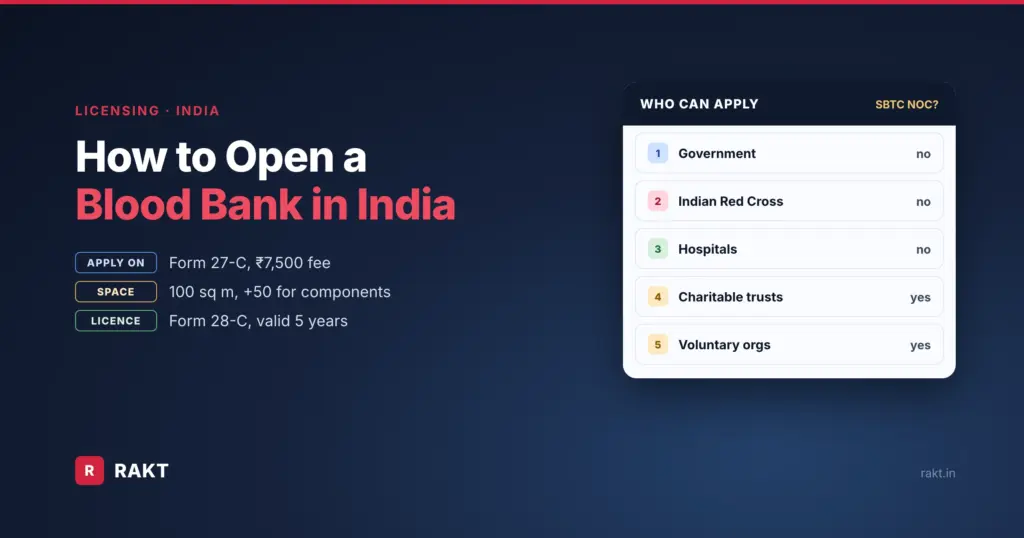
Since 2005, the rules allow only five types of organisation to apply for a blood centre licence:1
- Government
- The Indian Red Cross Society
- Hospitals
- Charitable trusts
- Voluntary organisations
An individual or a company cannot open a standalone blood bank as a business. A private hospital can run one as part of the hospital.
The SBTC NOC. A blood centre run by a charitable trust or voluntary organisation must be approved by the State or Union Territory Blood Transfusion Council (SBTC), following the procedure set by the National Blood Transfusion Council.1 A hospital blood centre does not need SBTC approval, whether the hospital is run by the government, a proprietor, a partnership, a company or a trust.2 Our guide to the State Blood Transfusion Council explains its role.
Blood bank or blood centre? Same thing. The 2020 amendment to the rules replaced “blood bank” with “blood centre”.1 Forms and portals still use both terms.
A note for standalone centres. In May 2024, news reports said the Central Licence Approving Authority had told licensing officers not to renew licences of blood centres operating outside hospitals.6 If you plan a centre that is not on hospital premises, confirm the current position with your State Drugs Controller before you invest.
Full blood centre or blood storage centre?
Many hospitals don’t need a full blood centre. If you only need to store and transfuse blood for your own patients, a blood storage centre may be enough.
| Blood centre | Blood storage centre | |
|---|---|---|
| What it does | Collects, tests, processes, stores and issues blood and components | Stores and transfuses blood received from a licensed blood centre |
| Approval | Form 28-C licence (state and central) | Approval by the State Licensing Authority under Schedule K, item 5B |
| Volume limit | None | Captive use of not more than 2,000 units a year |
| Validity | 5 years | 2 years; apply for renewal 3 months before expiry |
| Who can apply | Government, IRCS, hospitals, trusts, voluntary organisations | First Referral Units, Community and Primary Health Centres, and hospitals |
Source: Drugs and Cosmetics Rules, Rule 122-H and Schedule K, item 5B.1
The rest of this guide covers a full blood centre.
How to open a blood bank: step-by-step process
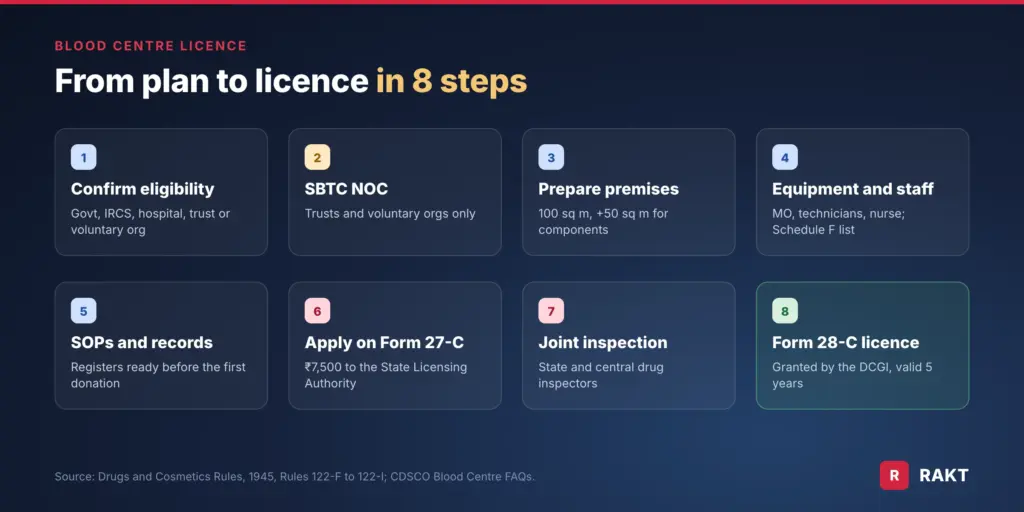
- Confirm you are eligible. Check that the applicant is one of the five allowed types. Decide on whole blood only, or whole blood plus components.
- Get the SBTC NOC (trusts and voluntary organisations only). Apply to your State Blood Transfusion Council. Hospitals skip this step.
- Prepare the premises. Build or adapt at least 100 sq m with the required rooms. Add 50 sq m if you will prepare components.
- Install equipment and hire staff. Buy the equipment listed in Schedule F Part XII-B and appoint a qualified medical officer, technicians and a registered nurse.
- Write your SOPs and set up records. Every process needs an approved SOP, and every register the rules ask for must be ready from the first donation.
- Apply on Form 27-C. Submit it to your State Licensing Authority with the ₹7,500 fee and supporting documents. Many states use the ONDLS portal.
- Face the joint inspection. State and central drug inspectors check your premises, equipment, processes, testing facilities and staff qualifications.1
- Receive Form 28-C. The State Licensing Authority sends its report to the Central Licence Approving Authority (the DCGI), which grants the licence.1
For a detailed check of the application itself, see our guide to Form 27-C. For what the licence covers once you have it, see Form 28-C.
Space and room requirements
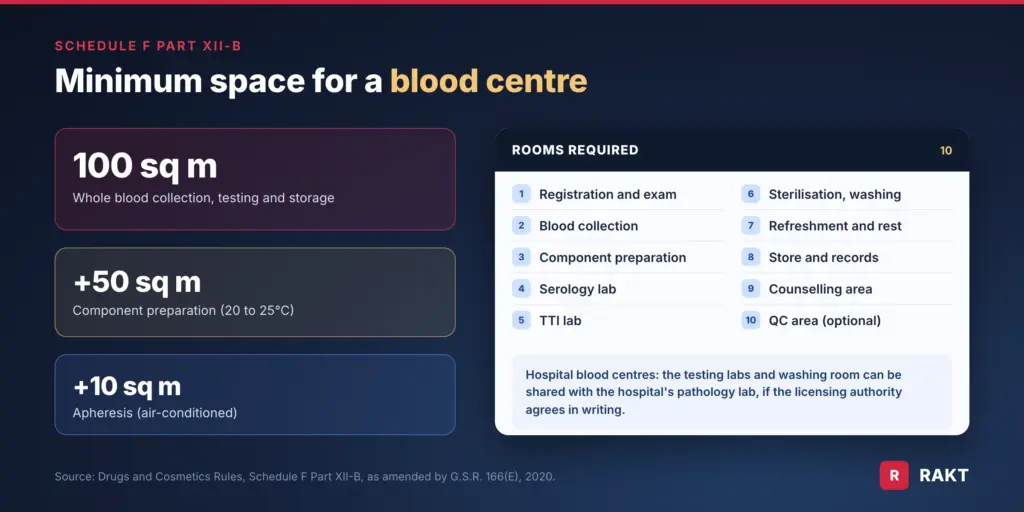
The three main requirements for opening a blood bank are space, staff and equipment. Schedule F Part XII-B sets the minimum area:12
| Activity | Minimum area |
|---|---|
| Whole blood collection and processing | 100 sq m |
| Blood component preparation | Additional 50 sq m |
| Apheresis (air-conditioned) | Additional 10 sq m |
Inside that area, you need a separate room or area for each of these:1
- Donor registration and medical examination
- Blood collection (air-conditioned)
- Component preparation (air-conditioned, 20 to 25°C)
- Blood group serology laboratory (air-conditioned)
- TTI laboratory for hepatitis, syphilis, malaria and HIV (air-conditioned)
- Sterilisation and washing
- Refreshment and rest room (air-conditioned)
- Store and records
- Counselling area with adequate privacy
- A quality control area next to component preparation (optional)
The building must be away from open sewage, drains and public toilets. Walls and floors where blood is collected or processed must be smooth and washable.1
Hospital blood centres get one relaxation. If the hospital already has a pathology laboratory and a sterilisation room shared with other departments, the licensing authorities can relax the separate testing lab and washing room requirements, with reasons recorded in writing.1
Plan the layout before you build. Moving to another floor later needs a fresh licence. Extending the approved area only needs a revised plan approved by the authorities.2
Staff requirements for a blood bank

Every blood centre must have these whole-time technical staff:12
| Role | When needed | Minimum qualification (summary) |
|---|---|---|
| Medical Officer | Always | MBBS with 1 year in a blood centre, or MBBS with a pathology or transfusion diploma, or MD/DNB Pathology, each with some licensed blood centre experience, or MD/DNB Transfusion Medicine |
| Blood Centre Technician | Always | DMLT (or transfusion or blood bank technology diploma) with 1 year’s experience, or a degree such as BMLT with 6 months’ experience, in a licensed blood centre |
| Registered Nurse | Always | Registered nurse |
| Technical Supervisor | If you prepare components | Same qualification routes as the technician |
| Counsellor or Medical Social Worker | If you run donation camps | Whole time or part time: a master’s in social work, sociology or psychology with 6 months’ experience, a science or health science degree with 1 year’s, or 10+2 with 3 years’ counselling experience |
The medical officer qualifications were revised in 2020. The full list:1
- MBBS with at least 1 year’s experience in a blood centre
- MBBS with a Diploma in Clinical Pathology or Pathology and Bacteriology, plus 6 months in a licensed blood centre
- MBBS with a Diploma in Transfusion Medicine or Immunohaematology and Blood Transfusion, plus 3 months in a licensed blood centre
- MD or DNB Pathology, plus 3 months in a licensed blood centre
- MD or DNB Transfusion Medicine, or MD Immunohaematology and Blood Transfusion
The rules set the minimum roles, not the headcount. For a 24-hour centre, you will need more than one person per role. A Jharkhand State AIDS Control Society project report for a 24-hour whole blood centre budgets 15 staff: 2 doctors, 5 technicians, 2 nurses, 2 lab attendants, 2 counsellors and 2 housekeeping staff.4
The names on your application must match the people working on the day of inspection. Any later change in technical staff must be reported to the licensing authorities straight away.1
Equipment needed to open a blood bank
Schedule F Part XII-B lists the minimum equipment.1 Here are the main items by area:
| Area | Main equipment |
|---|---|
| Donor registration and collection | Donor beds or couches, recovery beds, BP apparatus and stethoscope, haemoglobin testing, weighing devices for donors and blood bags, dielectric tube sealer |
| Storage | Blood bank refrigerators (2 to 6°C) with digital thermometer, recording thermograph and alarm, kept separate for tested and untested blood |
| Serology lab | Centrifuge, compound microscope, water bath (37 to 56°C), incubator, Rh view box if using the slide method, kit refrigerator |
| TTI lab | ELISA reader and washer with micropipettes, or a CLIA or ELFA analyser; shaker for syphilis tests |
| Component lab (if licensed) | Refrigerated centrifuge, plasma expressor, laminar air flow bench, platelet agitator with incubator, deep freezers (−30 to −40°C and −75 to −80°C), plasma thawing bath |
| Support | Autoclave, stand-by generator, insulated blood transport boxes, emergency kit with oxygen cylinder |
The rules also set minimum check and calibration frequencies, which your SOPs must follow. The refrigerated centrifuge, for example, has its speed and temperature checked on each day of use.1 Keep the calibration log from day one. The inspector will ask for it.
Setting up a new blood centre? RAKT gives you the donor, testing, component, stock and issue records the rules ask for from your first donation, with registers generated from daily work. A single centre typically goes live in two to three days. Book a 30-minute demo on WhatsApp.
Documents for a blood bank licence
Exact lists vary by state, so check your state drugs control website or the ONDLS portal. The public ONDLS checklist for Form 27-C (published for renewals) asks for the documents below.3 For a new licence, there is no existing licence to attach, but expect the rest of the list to apply. Confirm with your State Licensing Authority.
- Filled and signed Form 27-C
- Fee challan
- Plan of the premises
- Equipment list
- Constitution of the applicant or list of directors
- Ownership or tenancy documents for the premises
- Qualification and experience certificates of the technical staff
- SBTC NOC, where applicable, and trust registration if the applicant is a trust
- Copies of labels
- List of SOPs
- Self-declarations by the technical staff and directors (optional on the portal)
Biomedical waste is part of the licence conditions too. Rule 122-P requires blood centres to treat and dispose of biomedical waste under the biomedical waste rules.1 Under the current Bio-Medical Waste Management Rules, 2016, that means an authorisation from your State Pollution Control Board, so apply for it alongside the licence.
How much does it cost to open a blood bank in India?
There are two kinds of cost: the government fees, which are fixed, and the setup cost, which depends on your building and scope.
Licence fees
| Item | Fee |
|---|---|
| Licence fee (grant or renewal) | ₹6,000 |
| Inspection fee | ₹1,500 |
| Total on Form 27-C | ₹7,500 |
| Each additional item (component) applied for | ₹300 |
| Re-inspection after rejection (within 6 months) | ₹250 |
Source: Rules 122-F and 122-K.1 Some states collect fees through their own challan or portal.
Setup cost
There is no official national figure for setup cost. One public reference is the Jharkhand State AIDS Control Society’s 2021 project report for a 24-hour whole blood centre of about 100 sq m:4
| Cost head | Estimate (2021) |
|---|---|
| New construction | About ₹25 lakh |
| Rented premises: renovation instead of construction | ₹5 to 10 lakh |
| Equipment and accessories, including AC and generator | About ₹35 lakh |
| One-time total (new build) | About ₹60 lakh |
| Running cost: staff, kits, consumables, registers and labels | ₹4 to 5 lakh a month |
Treat these as a starting point, not a quote. They are for whole blood only and are five years old. Component preparation adds a refrigerated centrifuge, deep freezers, a platelet agitator and 50 sq m more space. Analysers such as CLIA, and NAT if you choose to offer it, add more.
On the income side, blood centres recover processing charges per unit, capped by the national guidelines revised in 2022.7 Our guide to blood price in India lists the 2022 rates by component.
Software is a separate line. For what blood bank software costs and what drives the price, see our guide to blood bank software cost in India.
After you get the licence
The licence is the start. These obligations begin on day one:
- Register on eRaktKosh. In March 2026, CDSCO directed that every licensed blood centre must be registered on eRaktKosh and actively using it. Verification is now part of regulatory inspections, with 11 new checklist points.5 Our eRaktKosh login guide covers registration.
- Keep the Schedule F registers. Donor records, master records, issue register, crossmatch reports, adverse reaction records and more, kept for five years. See our list of Schedule F Part XII-B records.
- Test every unit. HIV 1 and 2, hepatitis B surface antigen, hepatitis C antibody, syphilis (VDRL) and malaria, before any unit is issued.1
- Only voluntary, unpaid donors. Collecting from paid or professional donors is a licence breach.1
- Display the licence at the premises and keep the Form 35 Inspection Book ready.1
- Plan for renewal. The licence is valid for five years. Apply before it expires. Our licence renewal guide explains the process.
- Prepare for inspections. Inspectors can visit with or without notice.1 Use our licensing inspection checklist.
NABH accreditation is voluntary and separate from the licence. See SBTC inspection vs NABH assessment for the difference.
Mistakes that delay a new blood centre
- Applying for a scope you can’t show. Every component on the application needs the room, equipment, staff and SOP to match. Leave out what isn’t ready and add it later for ₹300 an item.
- Staff names that don’t match. The people named on Form 27-C must be the people on duty when the inspector arrives.
- Building first, planning later. A layout without the required rooms, or a later move to another floor, means rework or a fresh licence.
- Paper registers set up at the last minute. Inspectors check records, not just rooms. Start every register before your first donation.
Open with your records system ready
A new blood centre is judged on its records from the first inspection. RAKT is built for Indian blood centres and covers the whole unit trail from donor registration to issue:
- Registers from day one. Donor, TTI, grouping, component preparation, crossmatch, issue and discard registers are generated from the work your staff already enter.
- Safety gates staff can’t override. Untested or reactive units can’t be issued, and a discard needs MO or MD approval with a reason.
- eRaktKosh built in. Collection summaries and stock are submitted directly from RAKT, validated before sending.
- Camps ready. Donor registration on a tablet at the camp, labels printed on site and same-day reconciliation into centre stock.
- Named accounts with full history. Every record shows who entered it and every change is logged, with no per-user fee.
- Fast start. A single centre typically goes live in two to three days. Cloud-based, with no server to install.
More than 200 blood centres across 24 states run on RAKT.
Planning a new blood centre?
Book a 30-minute demo and we will walk through your setup, from the first donor registration to your first eRaktKosh submission.
Book a demo on WhatsApp, or see how RAKT works.
Frequently asked questions
Who can open a blood bank in India?
Only the government, the Indian Red Cross Society, hospitals, charitable trusts and voluntary organisations can apply for a blood centre licence. Trusts and voluntary organisations also need approval from the State Blood Transfusion Council.
Can a private individual open a blood bank?
Not on their own. An individual or company would need to apply through an eligible body, such as a hospital or a registered charitable trust, and a trust needs SBTC approval.
Is a blood bank a profitable business?
It is not run as a profit business. Paid and professional donors are banned, and blood centres recover only processing charges, capped by national guidelines. Only the government, the Red Cross, hospitals, trusts and voluntary organisations can hold a licence.
What is the minimum area required for a blood bank?
100 sq m for whole blood, plus 50 sq m for component preparation and 10 sq m for apheresis, under Schedule F Part XII-B.
What is the fee for a blood bank licence in India?
₹7,500 in total: a ₹6,000 licence fee and a ₹1,500 inspection fee. Each additional component applied for costs ₹300.
How much money is required to open a blood bank?
There is no official figure. A 2021 Jharkhand State AIDS Control Society project report estimates about ₹60 lakh for a new whole blood centre, plus ₹4 to 5 lakh a month to run it. Component preparation costs more.
Does a hospital need an SBTC NOC to open a blood bank?
No. According to CDSCO, a hospital blood centre does not need SBTC approval, whatever the hospital’s ownership. The NOC applies to charitable trusts and voluntary organisations.
Who issues the blood bank licence?
Two authorities. The State Licensing Authority (your State Drugs Controller) processes the application and inspection, and the Central Licence Approving Authority (the DCGI, through CDSCO) grants the Form 28-C licence.
How long is a blood bank licence valid?
Five years from the date of grant or renewal, unless suspended or cancelled earlier. Renew on Form 27-C before it expires.
What is the difference between a blood bank and a blood storage centre?
A blood centre collects, tests and processes blood under a Form 28-C licence. A blood storage centre only stores and transfuses blood from a licensed blood centre, is approved by the state under Schedule K, and is limited to 2,000 units a year.
Can I apply for a blood bank licence online?
Many states accept Form 27-C through the Online National Drugs Licensing System (ONDLS) or their own portal. Check with your State Drugs Controller for the current route.
Sources
- Drugs and Cosmetics Rules, 1945: Part X-B (Rules 122-F to 122-P), Schedule F Part XII-B and Schedule K item 5B, as compiled by CDSCO with the Drugs and Cosmetics (Second Amendment) Rules, 2020, G.S.R. 166(E), 11 March 2020 cdsco.gov.in
- CDSCO Blood Centre Division. FAQs for Blood Centre Licensing and Operation cdsco.gov.in
- Online National Drugs Licensing System (ONDLS). Form 27-C checklist (blood centre renewal) statedrugs.gov.in
- Jharkhand State AIDS Control Society. Blood Centre Project Report (24 hours service), 2021 jsacs.org.in
- Babu G. “CDSCO goes for strict implementation of registration of blood centres in e-RaktKosh portal.” Pharmabiz, 27 March 2026 pharmabiz.com
- “Charitable blood centres’ licences not to be renewed.” The Tribune, 23 May 2024 tribuneindia.com
- Directorate General of Health Services, Ministry of Health and Family Welfare. Revised Guidelines-2022 for Recovery of Processing Charges for Blood and Blood Components, 14 June 2022 eraktkosh.mohfw.gov.in