
Compliance & Accreditation · October 28, 2026
Form 28-C Blood Centre Licence: What It Covers, Conditions and Validity
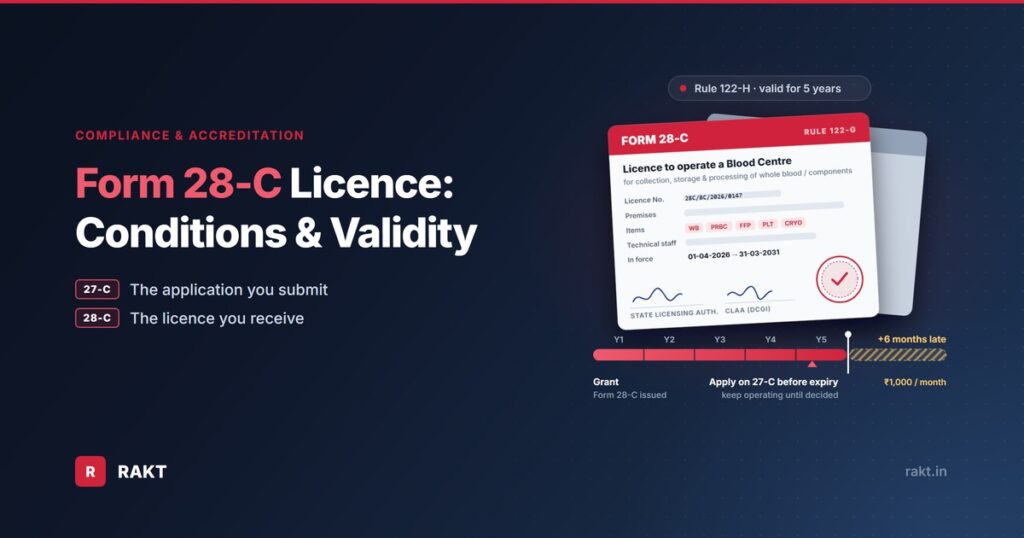
Form 28-C is the licence that allows a blood centre in India to collect, store, process and distribute whole human blood and its components. It is issued under Rule 122-G of the Drugs and Cosmetics Rules, 1945, after you apply on Form 27-C and pass a joint inspection. A Form 28-C licence is valid for five years.
This guide explains, in simple terms, what your Form 28-C covers, the conditions you must follow every day, how long the licence lasts, what it costs to renew, and what changed in 2024 and 2026. It is written for blood centre owners, medical officers and quality managers.
What is Form 28-C?
Form 28-C is the actual licence document. Its full title is “Licence to operate a Blood Centre for collection, storage and processing of whole human blood and/or its components for sale or distribution”.1
Until 2020 the rules said “blood bank”. The Drugs and Cosmetics (Second Amendment) Rules, 2020 replaced “Blood Bank” with “Blood Centre” in Form 28-C and the related rules.2 Both terms mean the same licence, so you will see “Form 28-C blood bank licence” and “Form 28-C blood centre licence” used interchangeably.
Two authorities sign it:
- The State Licensing Authority (SLA): your state’s Drugs Controller.
- The Central Licence Approving Authority (CLAA): the Drugs Controller General of India (DCGI), working through CDSCO.
That is why a blood centre licence is often called a “dual” licence.
Form 27-C, 28-C and 26-G: Which Form Does What
Most confusion comes from the form numbers. Here is the full set:
| Form | What it is | Who fills or issues it |
|---|---|---|
| Form 27-C | Application for grant or renewal of a blood centre licence | You (the applicant) |
| Form 28-C | The blood centre licence itself | SLA and CLAA |
| Form 26-G | Certificate of renewal of the Form 28-C licence | SLA and CLAA |
| Form 27-E / 28-E / 26-I | Application, licence and renewal for manufacturing blood products (such as plasma fractions). Not for blood centres. | Blood product manufacturers |
| Schedule K, item 5B approval | Approval for a blood storage centre that only stores blood from a licensed centre. Valid for 2 years. | SLA |
Sources for the table: Rules 122-F to 122-H and Schedules A and K.1 In short: you apply on Form 27-C, you receive Form 28-C, and each renewal comes as Form 26-G.
Who can get a Form 28-C Licence?
Since 2005, only these organisations can apply for a new or renewed blood centre licence:2
- Government
- The Indian Red Cross Society
- Hospitals
- Charitable trusts
- Voluntary organisations
When you need SBTC approval
Blood centres run by a charitable trust or voluntary organisation must be approved by the State or Union Territory Blood Transfusion Council (SBTC), following the procedure laid down by the National Blood Transfusion Council.2 According to CDSCO’s own FAQs:3
- A hospital-run blood centre does not need an SBTC NOC, whatever the hospital’s ownership (government, proprietor, partnership, company or trust).
- Renewal of a licence granted before 21 December 2005 does not need an SBTC NOC.
The medical officer and staff you must name
Form 28-C lists the names of your competent technical staff. The centre must run under the direct supervision of at least one whole-time medical officer with one of these qualifications (as amended in 2020):2
- MBBS with at least 1 year of experience in a blood centre
- MBBS with a Diploma in Clinical Pathology or Pathology and Bacteriology, plus 6 months in a licensed blood centre
- MBBS with a Diploma in Transfusion Medicine or Immunohaematology and Blood Transfusion, plus 3 months in a licensed blood centre
- MD or DNB Pathology, plus 3 months in a licensed blood centre
- MD or DNB Transfusion Medicine, or MD Immunohaematology and Blood Transfusion
CDSCO’s FAQs list the minimum whole-time staff as a medical officer, a technical supervisor (where components are prepared), a blood centre technician, a registered nurse, and a counsellor or medical social worker (where you run donation camps).3
How to Read Your Form 28-C
Take out your licence and check each printed field against reality. Every field is something an inspector can compare with what they see at your centre.1
| Field on Form 28-C | What to check |
|---|---|
| Licence number and date of issue | Use the same number on your eRaktKosh profile, labels and records. |
| Premises address | Must match where you actually work, down to the floor. A new location needs a fresh licence. |
| Name of the licensee (M/s …) | Must match your current legal constitution. |
| Items licensed | Only these components can be prepared and issued. Adding a component, such as SDP, needs an endorsement. |
| Competent technical staff | The names must match the people working today. |
| Validity “from … to …” | Diary the expiry date and start renewal planning about six months before it. |
| Signatures | Both the State Licensing Authority and the Central Licence Approving Authority. |
Conditions of the Form 28-C Licence
Your licence comes with two sets of conditions. Breaking them can lead to suspension or cancellation.
The four conditions printed on the licence
- No paid or professional donors. You may not collect blood from them or make components from such blood.
- Display the licence. Display the licence and any renewal certificate at the approved premises, and show the original to a drugs inspector on request.
- Report staff changes immediately. Any change in technical staff must be reported “forthwith” to the licensing authorities.
- Report a change in the firm. If the constitution of the firm changes (new owners, partners or company structure), inform the authorities in writing. The current licence then stays valid for a maximum of three months unless a fresh licence is issued in the new name.
Source: Form 28-C, Schedule A.1
General conditions under Rule 122-P
Rule 122-P adds general conditions that apply to every Form 28-C licence, on top of the special conditions in Schedule F, Part XII-B.1 In simple terms, you must:
- Keep adequate staff, equipment and premises, as required by Rule 122-G and Schedule F.
- Test blood and components in your own laboratory, and keep the records and registers for five years.
- Keep reference samples and give them to an inspector when asked.
- Let a drugs inspector enter with or without prior notice, inspect premises and records, and take samples.
- Report changes in expert staff and any major change to premises or equipment made since the last inspection.
- Withhold a unit that is held for testing until it is cleared, and recall units found not to meet standards.
- Supply blood and components only on the prescription of a registered medical practitioner.
- Keep an Inspection Book in Form 35, where inspectors record their observations.
- Destroy substandard units safely, and handle biomedical waste under the biomedical waste rules.
- Follow any new rules; they apply four months after publication in the Gazette.
Most of these conditions are proved through records. Our guide to Schedule F Part XII-B records shows which registers an inspector will ask for.
Form 28-C validity: How long the Licence Lasts
Under Rule 122-H, an original licence in Form 28-C, or a renewal in Form 26-G, is valid for five years, unless it is suspended or cancelled earlier.1
Renewing before expiry
Apply for renewal on Form 27-C before the expiry date. If you do, the rules allow you to continue operating until the authority communicates its decision, even if the inspection or approval takes longer than expected.1 In practice, start preparing about six months before expiry. Our blood bank licence renewal guide walks through the full process.
On the state online licensing portal (ONDLS), the renewal checklist asks for documents including:4
- A copy of your licence or last renewal certificate
- The plan of premises and the equipment list
- Your constitution or list of directors, and ownership or tenancy documents
- Staff qualification and experience certificates
- An SBTC NOC where applicable, and trust registration if you are a trust
- Copies of labels and the list of SOPs
- The fee challan and the filled Form 27-C
Late renewal: the 6-month window
If you miss the expiry date, you can still apply for renewal within six months of expiry. You pay the normal fees plus ₹1,000 for every month or part of a month of delay.1
Example: your licence expired on 31 March and you apply on 10 June. That is 2 months and 10 days late, which counts as 3 months. You pay ₹6,000 + ₹1,500 + ₹3,000 = ₹10,500.
The rule does not give a renewal route beyond six months. In that case, contact your SLA and expect to apply afresh. Remember also that the right to keep operating while your application is pending applies only if you applied before expiry.
Form 28-C Fees at a Glance
| Item | Fee |
|---|---|
| Licence fee (grant or renewal) | ₹6,000 |
| Inspection fee | ₹1,500 |
| Total for grant or renewal | ₹7,500 |
| Late renewal (within 6 months of expiry) | + ₹1,000 per month or part of a month |
| Each additional item (component) applied for | ₹300 |
| Duplicate licence (lost or damaged) | ₹1,000 |
| Re-inspection after rejection (within 6 months) | ₹250 |
Fees are from Rules 122-F and 122-K.1 Some states collect them through their own challan or online portal, so check your state’s payment route.
Changes That Affect Your Licence
- New medical officer or technician: report it immediately. The names on Form 28-C must match your staff.
- Change in ownership or constitution: the licence remains valid for at most three months. Apply for a fresh licence in the new name within that time.
- Moving premises: a change of licensed premises needs a fresh licence, even if you only move to another floor of the same building.3
- Extending your existing area: no fresh licence is needed, but the revised plan must be approved by the SLA or CLAA.3
- Adding components or apheresis: apply to add the items to your licence (₹300 per item). Apheresis needs its own 10 sq m area.
Suspension, Cancellation and Appeals
If you break a licence condition or the rules, the SLA or CLAA can, after giving you a chance to explain (a show-cause notice), suspend or cancel the licence. They can also order you to stop collection and processing.1
- Licence refused or not renewed: you can appeal to the State or Central Government within 30 days (Rule 122-M).
- Licence suspended or cancelled: you can appeal within three months of the order (Rule 122-O).
- Application rejected: if you fix the problems within six months, you can ask for re-inspection by paying ₹250 (Rule 122-K).
What Changed in 2024 and 2026
2024: standalone blood centres
In May 2024, news reports said the Central Licence Approving Authority had told licensing officers not to renew the licences of blood centres running outside hospitals. Blood transfusion experts objected publicly.5 If your centre is not on hospital premises, raise this with your SLA well before your renewal date.
2026: eRaktKosh is now part of inspections
In March 2026, CDSCO directed its zonal offices and state licensing authorities to make sure every licensed blood centre is registered on eRaktKosh and actively using it. Verification is now part of regulatory inspections, with 11 new checklist points.6 These include:
- Your unique eRaktKosh ID
- Correct licence details on the portal
- Stock figures that match your records
- Active logins
- Donor traceability
In practice, the licence details on your Form 28-C and on eRaktKosh must match, and your portal stock must match your registers. Our guide to eRaktKosh stock reconciliation explains how to keep them aligned.
Quick Form 28-C Compliance Checklist
- The original licence and the latest renewal certificate are displayed at the premises.
- The expiry date is in the calendar, with a reminder six months before it.
- The staff named on the licence are the staff working today.
- The address, floor and layout match the approved plan.
- You only prepare the components listed on the licence.
- Registers are complete and kept for five years.
- The Form 35 Inspection Book is available.
- The eRaktKosh profile shows the same licence details, and stock is updated.
- Any SBTC approval or NOC (for trust or voluntary centres) is on file.
For inspection day itself, use our blood centre licensing inspection checklist.
Frequently asked questions
What is Form 28-C?
Form 28-C is the licence under the Drugs and Cosmetics Rules, 1945 that allows a blood centre to collect, store, process and distribute whole human blood and its components. It is signed by the State Licensing Authority and the Central Licence Approving Authority.
What is the difference between Form 27-C and Form 28-C?
Form 27-C is the application you submit for a new licence or a renewal. Form 28-C is the licence you receive after inspection and approval. Each renewal is issued as Form 26-G.
What is the validity of a Form 28-C blood bank licence?
Five years from the date it is granted or renewed, unless it is suspended or cancelled earlier (Rule 122-H).
What happens if my blood centre licence expires?
You can apply for renewal within six months of expiry by paying ₹1,000 extra for each month or part of a month. If you applied before expiry, you may continue operating until the authority decides on your application.
Where can I download Form 28-C as a PDF?
Form 28-C is issued to you by the licensing authorities; you do not fill it in. The form you fill in is Form 27-C, available on your state drugs control website or the ONDLS portal. The official text of all the forms is in CDSCO’s published compilation of the blood centre rules.
Can I apply for a blood centre licence online?
Many states accept applications through the Online National Drugs Licensing System (ONDLS) at statedrugs.gov.in or through their own state portals. Check with your State Drugs Controller for the current route.
Does a blood storage centre need a Form 28-C licence?
No. A blood storage centre that only stores blood from a licensed blood centre is approved by the SLA under Schedule K, item 5B. The approval is valid for two years, and renewal must be applied for three months before expiry.
Do I need a new licence if I shift my blood centre?
Yes. Any change of licensed premises, even to another floor of the same building, needs a fresh licence. Extending your existing area only needs a revised plan approved by the SLA or CLAA.
Sources
- Drugs and Cosmetics Rules, 1945, Part X-B (Rules 122-F to 122-P), Schedule A (Forms 26-G, 27-C, 28-C) and Schedule K, as compiled by CDSCO with G.S.R. 166(E) cdsco.gov.in
- Drugs and Cosmetics (Second Amendment) Rules, 2020, G.S.R. 166(E), 11 March 2020 cdsco.gov.in
- CDSCO Blood Centre Division, FAQs for Blood Centre Licensing and Operation cdsco.gov.in
- ONDLS renewal checklist for Form 27-C statedrugs.gov.in
- “Charitable blood centres’ licences not to be renewed”, The Tribune, 23 May 2024 tribuneindia.com
- “CDSCO goes for strict implementation of registration of blood centres in e-RaktKosh portal”, Pharmabiz, 27 March 2026 pharmabiz.com