
Inventory Management · November 18, 2026
Irradiated vs Leukoreduced Blood: What Each Does, Who Needs It and the Rules
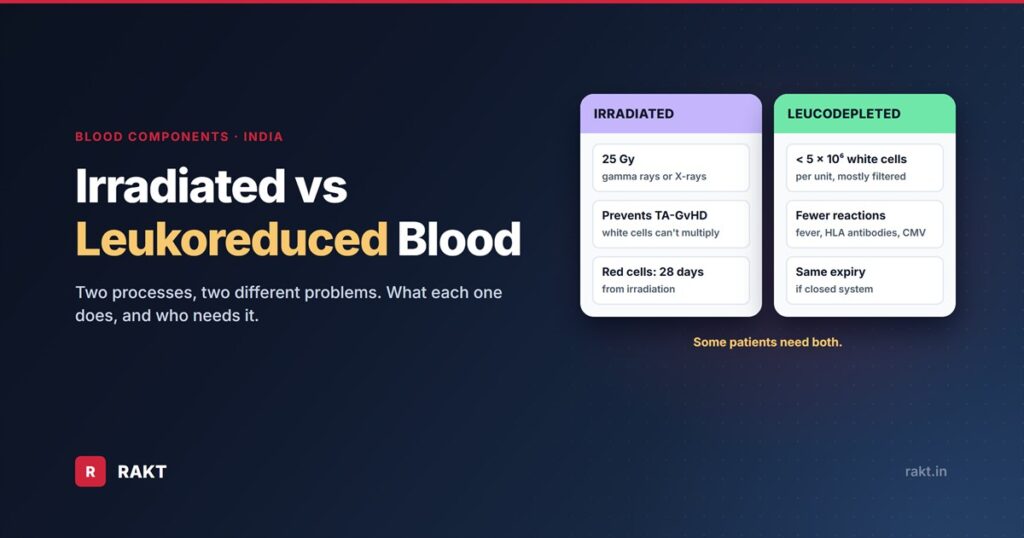
“Irradiated” and “leucodepleted” sound like two names for the same thing. They are not. Each protects the patient against a different problem, and mixing them up can leave a vulnerable patient exposed.
One of those problems is rare but deadly. According to AABB, transfusion-associated graft-versus-host disease follows fewer than one in a million transfusions, yet more than 90% of patients who develop it die.1 Only one of the two processes is designed to prevent it.
This guide explains what irradiated and leucodepleted (leukoreduced) blood are, who needs each, how they differ, and the rules for both in Indian blood centres.
Irradiated vs leukoreduced Blood: The Short Answer
Irradiated blood has been treated with 25 Gy of gamma rays or X-rays so donor white cells cannot multiply, preventing transfusion-associated graft-versus-host disease. Leukoreduced (leucodepleted) blood has had most white cells filtered out, to reduce fever reactions, antibody formation and CMV transmission.2, 3
| Pointers | Irradiated | Leucodepleted (leukoreduced) |
|---|---|---|
| What is done | Gamma rays or X-rays at 25 Gy | White cells removed, usually by a filter |
| What it prevents | Transfusion-associated graft-versus-host disease (TA-GvHD) | Febrile reactions, HLA antibody formation, CMV transmission, platelet refractoriness |
| White cells in the unit | Still there, but cannot multiply | Fewer than 5 million (5 × 10⁶) per unit |
| Red cell expiry | 28 days from irradiation, or the original date if earlier | Same as the original unit in a closed system; 24 hours if the system was opened |
| Charge allowed (red cells) | ₹1,000 per unit | ₹1,000 per unit |
The figures come from the national standards for blood centres, national guidance and the 2022 processing charge guidelines, cited in the sections below.2, 3, 4
What is Irradiated Blood?
Donated blood contains living white cells, including T lymphocytes. In most patients, the immune system destroys them. But in a patient whose immune system cannot recognise or reject them, the donor’s lymphocytes can settle in, multiply and attack the patient’s own tissues. That is transfusion-associated graft-versus-host disease (TA-GvHD).2
Irradiation stops this. The blood bag is exposed to gamma rays or X-rays, which damage the DNA of the white cells so they can no longer multiply.2 The national standards set the dose: at least 25 Gy to the centre of the bag, and no less than 15 Gy at any point.2
Only cellular components need irradiation: red cells, platelets and granulocytes. Plasma and cryoprecipitate do not contain living cells and do not need it.3 Our cryoprecipitate guide covers why.
Who Needs Irradiated Blood?
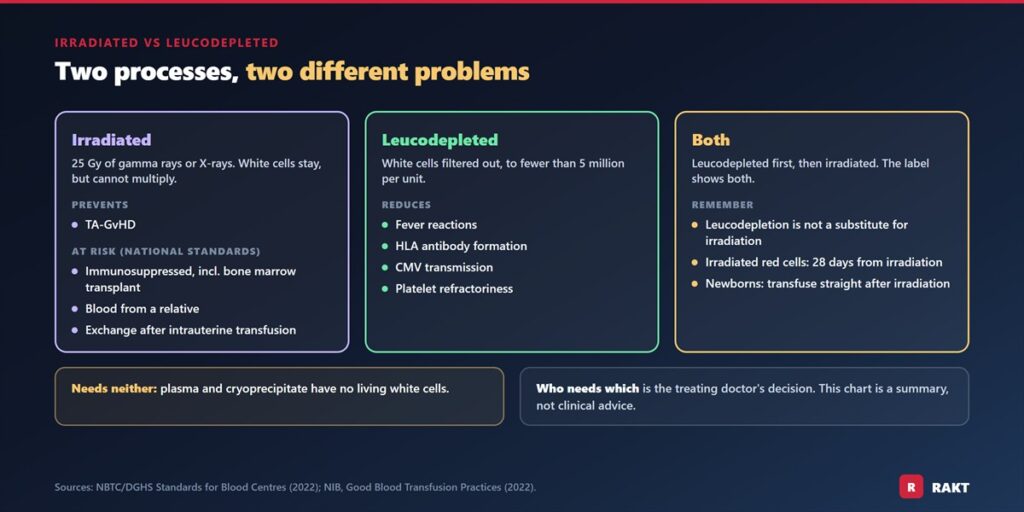
The national standards list these patients as at risk of TA-GvHD:2
- All immunosuppressed patients, including bone marrow transplant patients.
- Any patient receiving blood from a blood relative.
- Babies having an exchange transfusion after an intrauterine transfusion.
National guidance adds that a patient receiving an HLA-matched product is also at high risk.3 The standards also require irradiation of granulocytes collected by apheresis, to prevent GvHD.2
Whether a particular patient needs irradiated blood is the treating doctor’s decision. The blood centre’s job is to make sure the request reaches the bench, and that the right unit is irradiated, labelled and issued.
What is Leucodepleted (leukoreduced) Blood?
Leucodepletion removes most of the white cells from a unit, usually with a filter, and mostly before the blood is stored.2, 3 Indian rules set a clear limit: red cells can be labelled leucoreduced or leucodepleted only if the unit contains fewer than 5 million (5 × 10⁶) white cells.2
National guidance gives four reasons to leucodeplete:3
- Febrile reactions: fewer fever reactions caused by white cells.
- HLA immunisation: less chance of the patient forming antibodies against donor white cells.
- CMV: lower risk of passing on cytomegalovirus.
- Platelet refractoriness: fewer patients whose platelet count stops rising after repeated platelet transfusions.
For patients who need regular transfusions, such as those with thalassaemia, national guidance says prestorage leucodepleted blood is desirable.3 Our guide to transfusion reactions covers febrile reactions in more detail.
Can One Replace the Other?
No. They solve different problems.
A leucodepleted unit can still contain up to 5 million white cells and still be labelled leucodepleted.2 The national standards’ list of patients who need irradiated components makes no exception for leucodepleted units.2 So a patient at risk of TA-GvHD needs irradiated blood, whether or not it is also leucodepleted.
In the other direction, irradiation does not remove white cells. It only stops them multiplying. Leucodepletion is the process designed to reduce white cell reactions such as fever and antibody formation.
Some patients need both. A unit can be leucodepleted and then irradiated, and the label must show both.2
Expiry and Storage
| Component | Expiry rule |
|---|---|
| Irradiated red cells | 28 days from irradiation, or the original expiry if that is earlier |
| Irradiated components for a newborn | Transfused immediately after irradiation |
| Other irradiated components | Keep their original expiry |
| Leucodepleted red cells, closed system | Same expiry as the whole blood it came from; stored at 4 °C plus or minus 2 °C |
| Leucodepleted red cells, open system | Within 24 hours |
These rules come from the national standards.2 The irradiated red cell rule is easy to miss: the expiry on the bag must be changed after irradiation. Our blood bank labels guide lists it among the common label mistakes.
Labels and Quality Control
Labels
- Irradiated components are labelled accordingly, with the modified expiry.2
- Leucodepleted components must show how many logs of leucocytes were removed.2
Quality control for leucodepletion
- Check 1% of leucodepleted products; at least 75% must contain fewer than 5 × 10⁶ white cells.2
- Filtering must keep at least 85% of the original red cells.2
- Leukoreduced platelets: fewer than 8.3 × 10⁵ white cells for random donor platelets, and fewer than 5 × 10⁶ for single donor platelets.2
Quality control for irradiation
- Each batch must be irradiated by a method that confirms irradiation actually happened.2
- The dose delivered must be verified annually for a cesium-137 source, every six months for cobalt-60, and after installation, major repair or relocation of the irradiator.2
Our guide to quality control in blood banks covers QC for every other component.
Running a Blood Irradiator
Irradiation needs more than the machine. The national standards require:2
- A licence from the regulatory agencies for irradiating blood and components.
- Radiation badges for staff, issued, monitored and documented regularly.
- Quality assurance of irradiated components.
The standards list a blood irradiator as optional equipment, and a leucoreduction device as needed “when required”.2
What They Cost
The 2022 processing charge guidelines allow these extra charges on top of the component’s processing charge:4
| Process | Charge per unit |
|---|---|
| Leukofiltration, red cells | ₹1,000 |
| Leukofiltration, platelets | ₹1,500 |
| Irradiation | ₹1,000 |
Our guide to blood price in India shows how these appear on a real bill.
Leucodepleted Red Cells as Their own Component
A leucodepleted unit has its own expiry and its own label, and it is easy to confuse with an ordinary bag on the shelf. RAKT keeps it separate:
- Leucodepleted red cells (PRBC-LR) are recorded as their own component, alongside PRBC, FFP, platelets and cryoprecipitate.
- Each component carries its own volume, storage condition and expiry, taken from the parent bag.
See how RAKT records component preparation, or book a demo on WhatsApp.
Frequently asked questions
What is irradiated blood?
Irradiated blood is a red cell, platelet or granulocyte unit treated with 25 Gy of gamma rays or X-rays. The radiation stops donor white cells from multiplying, which prevents transfusion-associated graft-versus-host disease.
Why is blood irradiated?
To prevent transfusion-associated graft-versus-host disease in patients at risk. The disease is rare, following fewer than one in a million transfusions, but more than 90% of patients who develop it die.
What is leucodepleted PRBC?
Leucodepleted packed red blood cells are red cells with most white cells removed, usually by a filter. In India, the unit must contain fewer than 5 million white cells to be labelled leucodepleted.
What is the difference between irradiated and leukoreduced blood?
Irradiation leaves white cells in the bag but stops them multiplying, to prevent TA-GvHD. Leukoreduction removes most white cells, to reduce fever reactions, antibody formation and CMV transmission.
Does leucodepletion prevent TA-GvHD?
It is not a substitute for irradiation. A leucodepleted unit can still contain up to 5 million white cells, and India’s national standards make no exception for leucodepleted units in patients who need irradiated blood.
Who needs irradiated blood?
Under India’s national standards: immunosuppressed patients including bone marrow transplant patients, patients receiving blood from a relative, and babies having an exchange transfusion after an intrauterine transfusion. The treating doctor decides for each patient.
How long do irradiated red cells last?
28 days from the date of irradiation, or the original expiry if that is earlier. For a newborn, the unit should be transfused immediately after irradiation.
Do plasma and cryoprecipitate need irradiation?
No. Plasma and cryoprecipitate do not contain living white cells, so they do not need irradiation.
Can blood be both leucodepleted and irradiated?
Yes. A unit can be leucodepleted and then irradiated for a patient who needs both. Its label must show both processes and the modified expiry.
How much do irradiation and leucodepletion cost?
The 2022 processing charge guidelines allow ₹1,000 per unit for irradiation, ₹1,000 for leukofiltration of red cells and ₹1,500 for leukofiltration of platelets, on top of the component’s processing charge.
Sources
- AABB. Irradiation. Accessed 18 November 2026 aabb.org
- National Blood Transfusion Council and Directorate General of Health Services, Ministry of Health and Family Welfare. Standards for Blood Centres and Blood Transfusion Services. 2nd edition, 2022 clinicalestablishments.mohfw.gov.in
- National Institute of Biologicals, Ministry of Health and Family Welfare. Good Blood Transfusion Practices: Guidance for Rational Use of Blood. 2022 nib.gov.in
- Directorate General of Health Services, Ministry of Health and Family Welfare. Revised Guidelines-2022 for Recovery of Processing Charges for Blood and Blood Components. 14 June 2022 eraktkosh.mohfw.gov.in