
Blood Bank Software · November 18, 2026
Forward and Reverse Blood Grouping: Principle, Procedure, Chart and Discrepancies
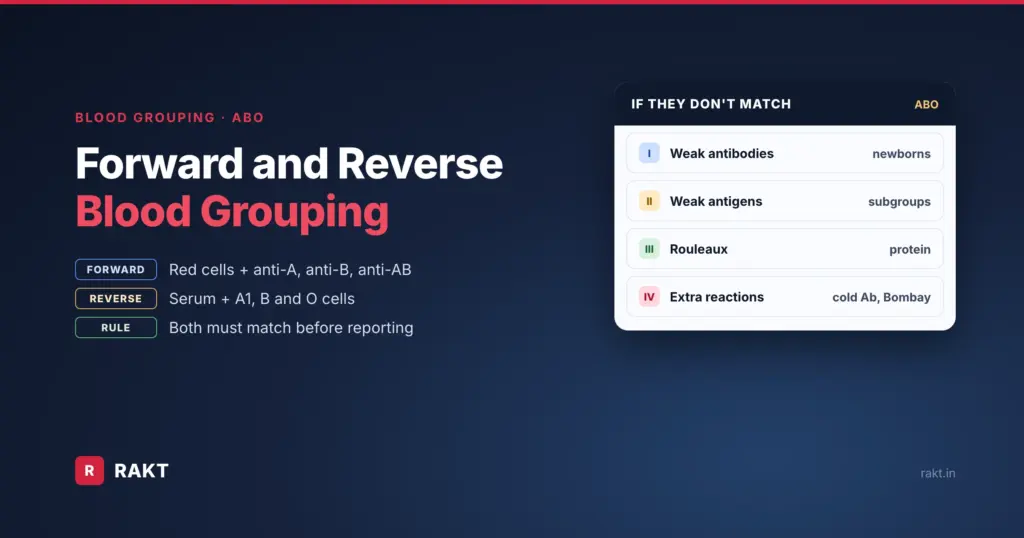
A technician groups a patient sample. The red cells don’t react with anti-A or anti-B, so forward grouping says O. Then the serum is tested, and it clumps A cells, B cells and the O cells too.
Forward grouping says O. Reverse grouping says something else is going on. In this case it is the Bombay blood group, and calling it O would put the patient at risk of a severe transfusion reaction.
That is why every ABO group is tested twice. This guide explains forward and reverse blood grouping: how each test works, the reaction chart, the tube procedure, and what to do when the two results don’t match.
In this guide: Forward vs reverse · Principle · Reaction chart · Tube procedure · Grading · Discrepancies · How to resolve · FAQs
What is forward and reverse blood grouping?
ABO grouping looks for two things: the A and B antigens on red cells, and the anti-A and anti-B antibodies in serum. Forward grouping checks the first. Reverse grouping checks the second.1
Here is the difference between forward and reverse grouping at a glance. “Antisera” are reagents with known antibodies, and “agglutination” means the red cells clump together.
| Forward grouping | Reverse grouping | |
|---|---|---|
| Also called | Cell grouping, front typing | Serum grouping, back typing |
| What is tested | The person’s red cells | The person’s serum or plasma |
| Tested with | Known antisera: anti-A, anti-B, anti-AB | Known red cells: A1, B and O cells |
| What it finds | A and B antigens on the cells | Anti-A and anti-B antibodies in the serum |
| Positive result | Clumping (agglutination) with an antiserum | Clumping of a known cell |
Each test is a check on the other. A labelling error, a weak antigen or an unusual antibody shows up as a mismatch.
Principle of forward and reverse blood grouping
The rule is simple. People make antibodies against the ABO antigens they don’t have.1
- Group A has A antigen on the cells and anti-B in the serum.
- Group B has B antigen and anti-A.
- Group AB has both antigens and neither antibody.
- Group O has neither antigen and both anti-A and anti-B.
These antibodies form naturally, without a transfusion or pregnancy. Babies start making them at around 4 to 6 months, as gut bacteria with A-like and B-like structures train the immune system.1
So if forward grouping finds A antigen, reverse grouping should find anti-B. If it doesn’t, something needs explaining.
Forward and reverse blood grouping chart
This is the reaction table every grouping result is read against. “+” means agglutination. “−” means no agglutination.
| Blood group | Anti-A (forward) | Anti-B (forward) | Anti-AB (forward) | A1 cells (reverse) | B cells (reverse) | O cells (reverse) |
|---|---|---|---|---|---|---|
| A | + | − | + | − | + | − |
| B | − | + | + | + | − | − |
| AB | + | + | + | − | − | − |
| O | − | − | − | + | + | − |
| Bombay (Oh) | − | − | − | + | + | + |
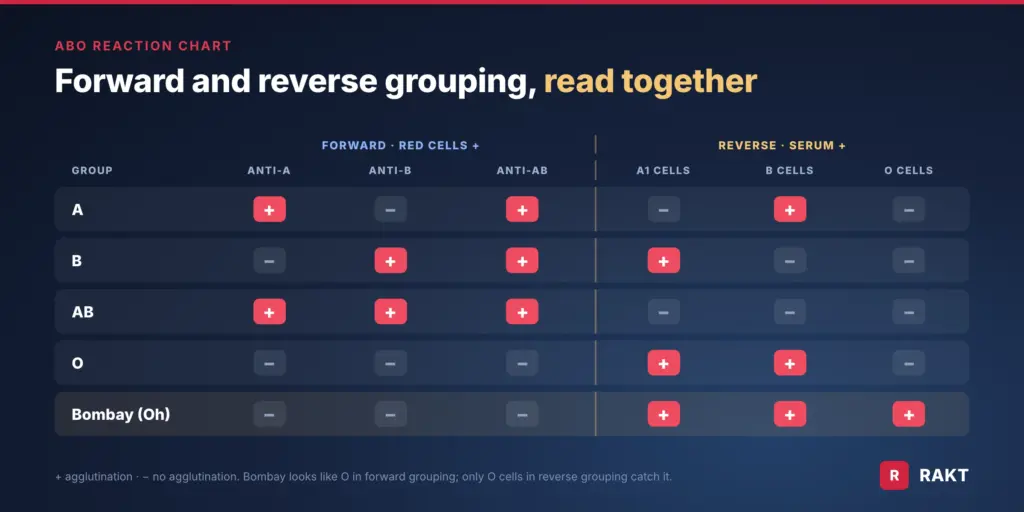
Notice the last two rows. Bombay looks exactly like O in forward grouping. Only the reaction with O cells in reverse grouping gives it away.
Why anti-AB and O cells are used
Indian rules require red cells to be tested with anti-A, anti-B and anti-AB, and serum to be tested with known A, B and O cells.3 This is the reagent set used in Indian blood centre studies too.2 The two extra reagents each catch something the basic test would miss.
- Anti-AB helps pick up weak A or B subgroups that react poorly with anti-A or anti-B alone.
- O cells have no A or B antigen, so serum should never clump them. If it does, the serum has an antibody outside the ABO system, such as anti-H in a Bombay donor or a cold antibody.
- A1 cells are used for reverse grouping because A1 is the most common A subgroup and carries the most A antigen, so anti-A in the serum gives a clear reaction.
Rh (D) typing is done alongside, but only as a forward test with anti-D. There is no reverse test for Rh because anti-D does not occur naturally.1
Grouping tells you the patient’s group. Before a unit is issued, a crossmatch confirms that the specific bag is compatible with the patient.
Forward and reverse blood grouping procedure (tube method)
Blood centres in India use the tube method, column agglutination (gel cards) or an automated analyser. The steps below are the general tube method. Always follow your centre’s SOP and the reagent manufacturer’s instructions for volumes, cell concentration and spin times.
Forward grouping
- Label three tubes: anti-A, anti-B and anti-AB.
- Add one drop of each antiserum to its tube.
- Add one drop of the person’s red cell suspension in saline to each tube.
- Mix and centrifuge as per the reagent insert.
- Gently shake loose the cell button at the bottom of the tube and read for agglutination. Grade each reaction.
Reverse grouping
- Label three tubes: A1 cells, B cells and O cells.
- Add two drops of the person’s serum or plasma to each tube.
- Add one drop of each reagent cell suspension to its tube.
- Mix and centrifuge as per the reagent insert.
- Resuspend gently, read and grade.
Then compare the two results against the chart. They should point to the same group.
Grading the reactions
Agglutination is graded by strength. Normal ABO reactions in both tests are strong, 3+ or 4+. Weak reactions of 1+ or 2+ are a warning sign of a discrepancy.1
| Grade | What you see |
|---|---|
| 4+ | One solid clump, clear background |
| 3+ | Several large clumps, clear background |
| 2+ | Medium clumps, clear background |
| 1+ | Small clumps, cloudy background |
| 0 | No clumps, smooth suspension |
| Mixed field | Clumps among many free cells, often after a transfusion of another group |
Record the grade, not just “positive”. A 1+ reaction where a 4+ is expected is the first clue to a subgroup or a weak antibody.
Run a blood centre? RAKT records forward and reverse grouping separately against each bag and request, and a unit can’t be allotted until grouping is complete. Book a 30-minute demo on WhatsApp.
ABO discrepancy: when forward and reverse grouping don’t match
A mismatch is called an ABO discrepancy. It is not common. In a study of 211,568 samples at Tata Memorial Centre, Mumbai, 117 had a discrepancy, about 0.06%. They were rarer in donors than in patients.2
Discrepancies are grouped into four types.1
| Type | What goes wrong | Common causes |
|---|---|---|
| I | Weak or missing antibodies (reverse grouping) | Newborns and infants, elderly patients, hypogammaglobulinaemia, immunosuppressive drugs, chimerism |
| II | Weak or missing antigens (forward grouping) | A or B subgroups, leukaemia and other blood cancers, acquired B, recent transfusion, ABO-incompatible stem cell transplant |
| III | Protein or plasma problems causing false clumping | Rouleaux (red cells stacking like coins) from high globulin or fibrinogen, for example in myeloma; plasma expanders; Wharton’s jelly in cord blood |
| IV | Miscellaneous extra reactions | Cold autoantibodies, non-ABO antibodies, recent IVIG (intravenous immunoglobulin), Bombay phenotype, reagent issues |
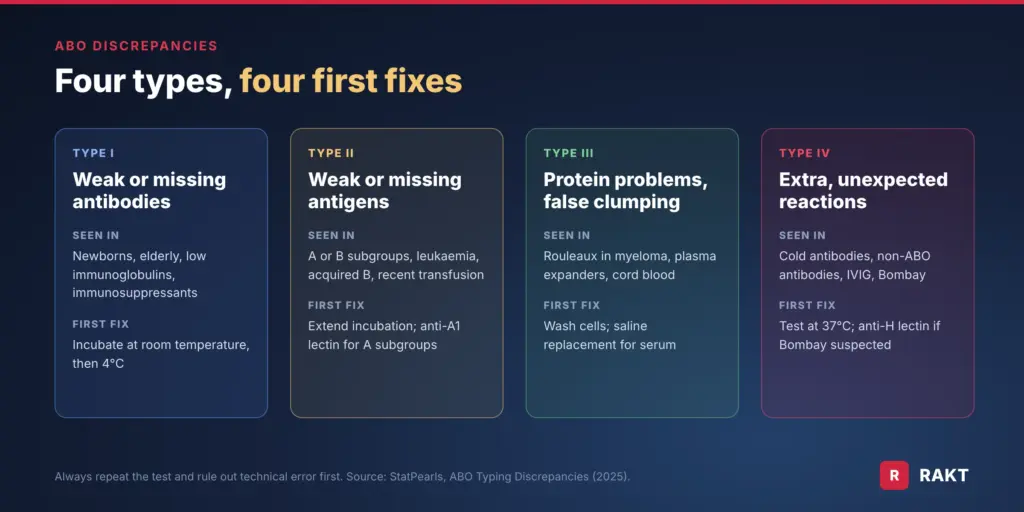
In the Mumbai study, the pattern differed by who was tested. Most donor discrepancies were weak subgroups. In patients, the causes were spread across all four types, with many in young children and in patients with acute leukaemia.2
How to resolve an ABO discrepancy
Work from the simplest cause to the rarest.12
- Repeat the test on the same sample. Many discrepancies are technical: a labelling mix-up, a missed reagent, or a wrong cell suspension.
- Check reagents and equipment. Expiry, quality control results and centrifuge calibration.
- Test a fresh sample. This rules out a wrong-patient sample.
- Check previous records. Has this person been grouped before? Was the result the same?
- Review the history. Age, diagnosis, recent transfusion, transplant, pregnancy, IVIG.
- Do targeted tests. Depending on the type of discrepancy:
- Weak antibodies: incubate at room temperature for 15 to 30 minutes, then at 4°C if needed.
- Weak antigens: extend incubation; use anti-A1 lectin (a plant extract that reacts only with A1 cells) to separate A1 from A2.
- Rouleaux: wash the cells with saline, or use saline replacement for the serum.
- Cold antibodies: warm the sample to 37°C and wash the cells, or do a cold autoadsorption.
- Suspected Bombay: test with anti-H lectin and check secretor status (whether A, B or H substance appears in saliva).
Do not report a blood group until the discrepancy is resolved. If a patient needs blood urgently in the meantime, StatPearls advises giving O-negative red cells while the workup continues.1 Follow your centre’s SOP for emergency issue.
Every step should be recorded: the original results, each repeat, and the final interpretation. Our guide on blood group discrepancy records covers what an assessor expects to see.
For blood centres: grouping that can’t be skipped or overwritten
In a busy lab, the bigger risks are rarely about reading the chart. They are a result typed against the wrong bag, a weak reaction recorded as plain “+”, or a corrected group that leaves no trace of the original.
RAKT is built around the grouping record:
- Forward and reverse grouping recorded separately. Both results sit against the bag or the blood request, along with phenotyping and irregular antibody results.
- Analyser results read directly. Grouping results from analysers such as Matrix AutoMax-80 come in against the sample, so nothing is retyped from a printout.
- No issue before grouping. A unit can’t be allotted until grouping and TTI screening are complete. Staff can’t override this at the counter.
- Corrections leave a trail. Every change keeps the old value, the new value, who made it and when.
- Labels from the result. The ABO and Rh on the ISBT 128 label come from the grouping record, not from a separate entry.
- Grouping Register generated. The register your inspector asks for is built from the same entries.
More than 200 blood centres across 24 states run on RAKT.
See grouping and crossmatch in RAKT
Book a 30-minute demo and we will run a sample from grouping to issue on your own workflow.
Book a demo on WhatsApp, or see lab automation.
Frequently asked questions
What is forward and reverse blood grouping?
Forward grouping tests red cells with anti-A, anti-B and anti-AB to find the A and B antigens. Reverse grouping tests serum with known A1, B and O cells to find anti-A and anti-B antibodies. Both must agree.
What is the difference between forward and reverse grouping?
Forward grouping tests the person’s cells with known antibodies. Reverse grouping tests the person’s serum with known cells. One finds antigens, the other finds antibodies.
Why is reverse grouping done?
To confirm the forward result. It catches labelling errors, weak subgroups, unusual antibodies and conditions like the Bombay phenotype that forward grouping alone would miss.
Why is reverse grouping not done in newborns?
Babies don’t make their own anti-A and anti-B until around 4 to 6 months of age, and any antibodies present may come from the mother. Reverse grouping would give weak or misleading results, so newborns are usually grouped by forward grouping only.
Why are O cells used in reverse grouping?
O cells have no A or B antigen, so serum should not clump them. A reaction with O cells points to an antibody outside the ABO system, such as anti-H in the Bombay phenotype or a cold antibody.
What is an ABO discrepancy?
It is when forward and reverse grouping results don’t match. The blood group must not be reported until the cause is found and resolved.
What are the types of ABO discrepancies?
Type I is weak or missing antibodies, type II is weak or missing antigens, type III is false clumping from protein problems such as rouleaux, and type IV covers other causes such as cold antibodies.
Is Rh typing done by forward and reverse grouping?
No. Rh (D) typing is a forward test only, using anti-D. Anti-D antibodies don’t occur naturally, so there is nothing to detect in a reverse test.
Which method is used for blood grouping in blood banks?
Blood centres use the tube method, column agglutination (gel cards) or automated analysers. Slide grouping is sometimes used as a quick screen, but reverse grouping needs the tube or column method.
What does mixed field agglutination mean?
Clumps sit among many free cells. It usually means two cell populations are present, for example after a transfusion of a different group or a stem cell transplant.
Sources
- Fathima S, Killeen RB. ABO Typing Discrepancies. StatPearls. Treasure Island (FL): StatPearls Publishing; updated 26 February 2025 ncbi.nlm.nih.gov
- Desai P, Navkudkar A, Rajadhyaksha S. ABO blood group discrepancies in blood donor and patient samples at a tertiary care oncology centre: analysis and serological resolution. Hematol Transfus Cell Ther. 2024;46(4):402–407 pmc.ncbi.nlm.nih.gov
- Drugs and Cosmetics Rules, 1945, Schedule F, Part XII-B, as amended by G.S.R. 166(E), 11 March 2020 cdsco.gov.in