
Blood Bank Software · November 7, 2026
Bombay Blood Group (hh): Why It Looks Like O and How Blood Centres Detect It
A patient’s report says group O. The hospital orders O blood, and the transfusion starts. Soon after, the patient reacts as if they had been given the wrong group, because, in effect, they have.
This happens in real hospitals. In one 2024 case report, two patients reached a blood bank already labelled group O by outside laboratories. Both were actually Bombay group, and one had already had a haemolytic reaction to a transfusion.1 In India, about 1 in 10,000 people has an H-deficient blood group like this.2
The good news is that a few simple checks in routine grouping catch it. This guide explains what the Bombay blood group is, how rare it is in India, how blood centres detect it, and how Bombay blood is found when a patient needs it.
What is the Bombay blood group?
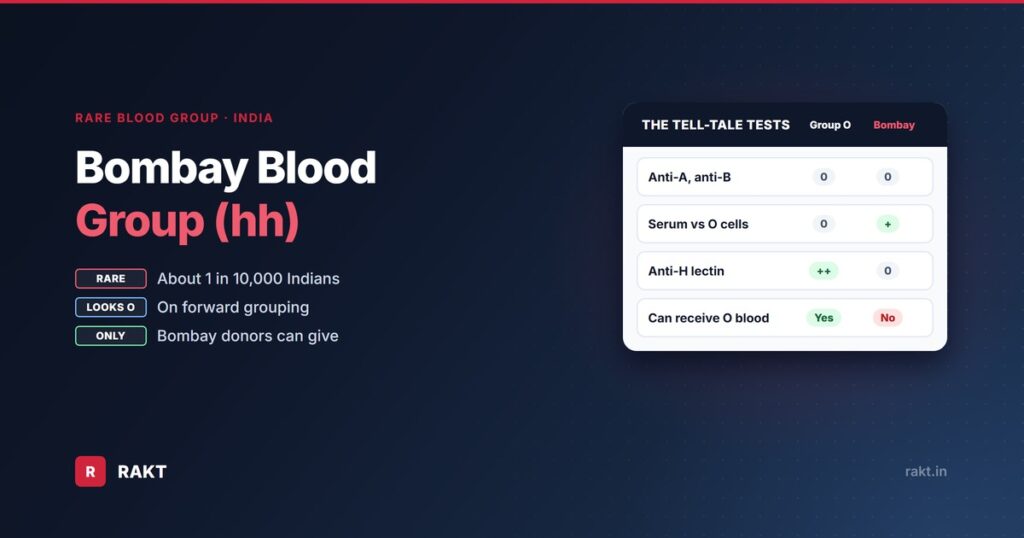
The Bombay blood group, also called hh or Oh, is a rare blood type in which the red cells lack the H antigen, the base on which the A and B antigens are built. It looks like group O in routine forward grouping, but people with it make anti-H and can receive blood only from another Bombay donor.2
It is named after the city where it was first found. The first paper describing it was published in 1952 by Dr Y. M. Bhende and colleagues in Bombay, now Mumbai.2 Being Bombay group does no harm to health. It matters only when a person needs a transfusion.2 The name “Oh” means a group O-like result with the H antigen missing. The small “h” has nothing to do with the Rh factor.
| At a glance | Bombay blood group |
|---|---|
| Also called | hh, Oh, H-deficient |
| First described | 1952, Bombay (Mumbai) |
| How common in India | About 1 in 10,000 people |
| Routine forward grouping shows | Group O |
| Antibodies in plasma | Anti-A, anti-B and anti-H |
| Can receive | Only Bombay red cells |
| Tests that catch it | Reverse grouping with O cells, anti-H lectin |
How it works: the missing H antigen
Almost every red cell carries the H antigen. It is the building block for the ABO system: in group A and group B, the A or B antigen is added on top of H. Group O cells keep H as it is, so they carry the most H of all.1, 2
H is made by an enzyme coded by the FUT1 gene. A person needs at least one working copy of the gene to make H. If both copies are inactive, no H is made, so no A or B can be made either. That is the Bombay phenotype.2 A second gene, FUT2, makes a soluble form of H that appears in saliva and other body fluids in people called secretors.2
Bombay blood group vs group O
On a routine forward grouping, the two look the same. Everything else is different.
| Group O | Bombay (Oh) | |
|---|---|---|
| Antigens on red cells | H (no A or B) | No A, no B and no H |
| Antibodies in plasma | Anti-A and anti-B | Anti-A, anti-B and anti-H |
| Forward grouping (anti-A, anti-B) | No reaction | No reaction, so it reads as O |
| Reverse grouping with O cells | No reaction | Reaction, because of anti-H |
| Anti-H lectin on red cells | Strong reaction | No reaction |
| Can receive | Group O red cells | Only Bombay red cells |
These differences come from the antigens and antibodies each group carries.1, 2 Classical Bombay group people are also non-secretors, with no H in their saliva.3
How rare is the Bombay blood group in India?
H deficiency, counting the Bombay and para-Bombay types together, is found in about 1 in 10,000 people in India. That compares with about 1 in 8,000 in Taiwan and 1 in a million in Europe.2 Within India, the numbers vary a lot by region:
- Maharashtra: a Mumbai-based survey found 1 in 7,600 in Mumbai city and 1 in 2,500 in some parts of the state.4
- Andhra Pradesh: a study at a Tirupati hospital found 13 Bombay group people, 0.048% of those tested. That was higher than the 0.004% reported in Tamil Nadu and 0.005% in Karnataka.3
The type is inherited: a person is Bombay only with two inactive copies of the gene, one from each parent.2 In the Tirupati study, the parents were related by blood in 10 of the 13 cases.3 Treat any national figure as an estimate. The studies used different groups of people and different methods.
Bombay positive and Bombay negative: what about Rh?
The Bombay type is about the H antigen in the ABO system. RhD is tested separately, so a Bombay person can be RhD positive or RhD negative, and the full group is written as “Bombay, Rh positive” or “Bombay, Rh negative”. In the Tirupati study, 10 of the 13 Bombay people were RhD positive and 3 were RhD negative.3 Both patients in the 2024 case report were Bombay, Rh positive.1
Why routine grouping misses it, and how blood centres catch it
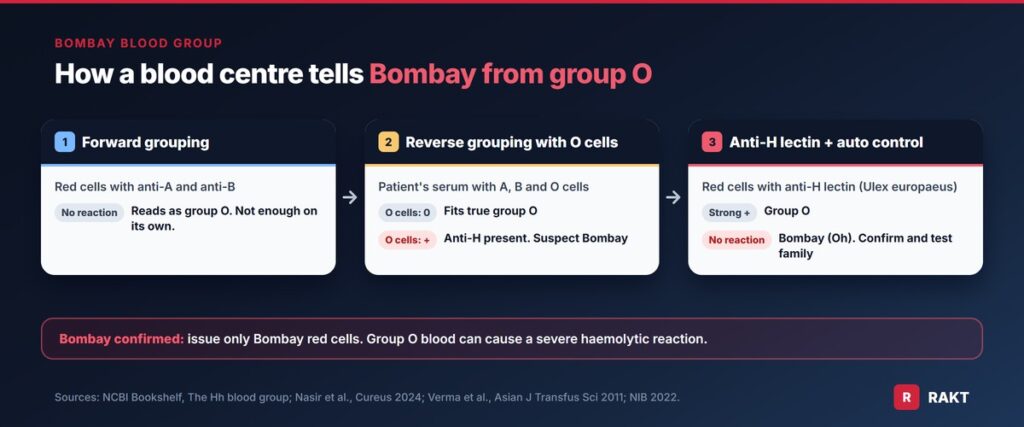
If a laboratory does only forward grouping, a Bombay sample shows no reaction with anti-A or anti-B and gets reported as group O.1 The checks that catch it are simple and already part of good practice.
- Do reverse grouping, with O cells. The patient’s serum is tested against A cells, B cells and O cells. Group O serum does not react with O cells. Bombay serum does, because it carries anti-H.1
- Test the red cells with anti-H lectin. This reagent, made from the plant Ulex europaeus, reacts strongly with group O cells and not at all with Bombay cells.1, 3
- Run an auto control in any discrepant result, so that an autoantibody is not mistaken for anti-H.1
- Confirm and screen the family. The type can be confirmed further, for example with saliva testing for secretor status.3 Family members, especially brothers and sisters, should be tested as possible donors.1, 4
| Test | Group O | Bombay |
|---|---|---|
| Anti-A | 0 | 0 |
| Anti-B | 0 | 0 |
| A cells | Positive | Positive |
| B cells | Positive | Positive |
| O cells | 0 | Positive |
| Anti-H lectin | Strong positive | 0 |
National guidance already asks for both forward and reverse ABO grouping on every patient sample, and its model crossmatch record has a column for O cells.5 The Drugs and Cosmetics Rules list lectin among the reagents to be quality-checked on each day of use.6 In the 2024 case report, the authors recommend O cells in routine reverse grouping and anti-H lectin in every discrepancy.1 Our guide to blood group discrepancy records covers how to document a forward and reverse mismatch.
Recording grouping on paper? In RAKT, forward and reverse grouping are recorded separately, and both must be recorded before a patient can be matched. See how RAKT records grouping and crossmatch results.
What happens if a Bombay patient gets group O blood
Anti-H is a naturally occurring IgM antibody, and it can destroy transfused red cells inside the blood vessels. Group O cells carry the most H, so “safe” O blood is exactly the wrong choice. The result can be an acute haemolytic transfusion reaction, which can lead to disseminated intravascular coagulation (DIC) or kidney failure, and can be fatal.1, 2 Our guide to blood transfusion reactions covers the signs and the bedside steps.
The risk is highest in an emergency, when O-negative units are given before grouping is complete. The case report’s authors advise keeping rare groups in mind whenever a patient reacts to emergency O blood.1 A full crossmatch with the patient’s serum would also show group O donor cells as incompatible, which is one more reason not to skip it when there is time.
Finding Bombay blood in India
Bombay is the rare blood group most often requested in India. A rare phenotype is usually defined as one found in fewer than 1 in 1,000 donors.4 When a Bombay patient needs blood, these are the routes.
- Family first. Brothers and sisters are tested first. In the 2024 case report, two siblings of one patient were also Bombay group, and one became her donor.1 Researchers also recommend screening family members to find rare donors.4
- The national registry. ICMR’s National Institute of Immunohaematology (NIIH) in Mumbai has set up the Rare Donor Registry of India.4 In June 2025, South First reported that the registry included 170 Bombay group donors, and that national demand for Bombay blood is about 120 to 150 units a year.7 NIIH was also in talks to link the registry with e-RaktKosh, the national blood portal. That link had been planned, not confirmed as live, at the time of the reports.7, 8
- The patient’s own blood. For planned surgery, a diagnosed Bombay patient may be able to donate their own blood in advance.1
One gap remains. As of 2023, India had no operational frozen red cell storage facility, so rare units could not be banked for years the way some countries do. Each unit has to be found, collected and processed when the need arises.4
What is para-Bombay?
Para-Bombay is a related, partial form of H deficiency. Like the Bombay type, it comes from changes in the FUT1 gene.2 India’s 1 in 10,000 estimate counts both types together.2
Record both directions, every time
Reverse grouping only protects a Bombay patient if it is done, and recorded, on every sample. A forward-only result looks complete on paper, so the missing step is easy to overlook.
RAKT makes the second direction part of the record:
- Forward and reverse grouping are recorded separately, with phenotyping and irregular antibodies.
- Both directions must be recorded before a patient can be matched.
- Grouping and crossmatch results are recorded against the bag and the request.
See how RAKT handles grouping, crossmatch and issue, or book a demo on WhatsApp.
Frequently asked questions
What is the Bombay blood group?
The Bombay blood group (hh or Oh) is a rare blood type in which the red cells have no H antigen, and so no A or B antigen either. It looks like group O in routine tests, but people with it can receive blood only from another Bombay donor.
Why is it called the Bombay blood group?
It is named after Bombay, now Mumbai, where it was first found. The first paper describing it was published in 1952 by Dr Y. M. Bhende and colleagues.
How rare is the Bombay blood group in India?
About 1 in 10,000 people in India has H-deficient blood, counting the Bombay and para-Bombay types together. It is more common in some areas: one survey found 1 in 7,600 in Mumbai city and 1 in 2,500 in parts of Maharashtra.
Can a person with Bombay blood group receive O blood?
No. People with the Bombay group make anti-H, which attacks group O red cells, because O cells carry the most H. Giving them O blood can cause a severe, even fatal, haemolytic reaction. They can receive red cells only from another Bombay donor.
Can people with Bombay blood donate to others?
Their red cells have no A, B or H antigens, but their plasma carries anti-A, anti-B and anti-H. Bombay blood is also so scarce that it is needed for Bombay patients, who cannot receive any other group. So Bombay donors matter most to other Bombay patients.
How is the Bombay blood group tested?
Forward grouping alone reads it as O. Reverse grouping with O cells shows a reaction, because of anti-H, and the red cells do not react with anti-H lectin. Further tests, such as saliva testing, can confirm it, and family members should be tested too.
Is the Bombay blood group a disease?
No. Having the Bombay group causes no health problems. It matters only when a person needs a blood transfusion.
Can the Bombay blood group be Rh positive or Rh negative?
Yes. Rh is tested separately, so a person can be Bombay, Rh positive or Bombay, Rh negative. In one Indian hospital study, 10 of 13 Bombay people were RhD positive.
Is the Bombay blood group a problem in pregnancy?
In theory, a Bombay mother’s anti-H could affect a baby who is not Bombay group, but such cases have not been described, possibly because the group is so rare. A Bombay mother should tell her doctor and blood centre early, so that compatible blood can be planned.
Is the Bombay blood group the same as golden blood?
No. “Golden blood” is the popular name for Rh-null, a different rare type whose red cells carry none of the Rh antigens. The Bombay group is about the missing H antigen in the ABO system.
Sources
- Nasir A, Minhas A, Imran A, Chughtai O, Chughtai AS. Bombay blood group: a report of two cases. Cureus. 2024;16(5):e59620 pmc.ncbi.nlm.nih.gov
- Dean L. Blood Groups and Red Cell Antigens. Chapter 6, The Hh blood group. National Center for Biotechnology Information, 2005 ncbi.nlm.nih.gov
- Verma A, Vani KG, Chaitanya Kumar IS, Jothi Bai DS. Prevalence of Bombay blood group in a tertiary care hospital, Andhra Pradesh, India. Asian J Transfus Sci. 2011;5(1):57-58 pmc.ncbi.nlm.nih.gov
- Datta SS, Sil S, Mandal S. Rare blood group registry in India: current challenges and future perspectives. Front Genet. 2023;14:1264853 pmc.ncbi.nlm.nih.gov
- National Institute of Biologicals, Ministry of Health and Family Welfare. Good Blood Transfusion Practices: Guidance for Rational Use of Blood. 2022 nib.gov.in
- Drugs and Cosmetics Rules, 1945, Schedule F, Part XII-B, as amended by G.S.R. 166(E), 11 March 2020 cdsco.gov.in
- Jha S. Finding rare blood just got easier: India launches national registry for hard to find blood types. South First, 22 June 2025 thesouthfirst.com
- Press Trust of India. India to soon get rare blood donor registry. The Tribune, 22 June 2025 tribuneindia.com