
Compliance & Accreditation · November 14, 2026 · Updated November 18, 2026
Blood Bank Labels in India: What Every Blood Bag Label Must Show, Colour Codes and ISBT 128
At the bedside, the label is often the last thing anyone reads before a transfusion starts. If it is wrong, unclear, or smudged, a bag can reach the wrong patient.
That is why Indian rules spell out the label in detail. The Drugs and Cosmetics Rules list 14 particulars that must appear on every bag of blood or blood component.1
This guide explains the blood bank labels in plain words, along with the ABO colour code, the extra rules for component labels, and how ISBT 128 bar code labels work.
What Do Blood Bank Labels Mean
A blood bank label identifies one unit of blood or component, shows what it is, how it was tested, how to store it and when it expires. In India, its contents and colour code are set by the Drugs and Cosmetics Rules and the national standards for blood centres.1, 2
The national standards give a label three jobs:2
- Traceability: any unit can be traced from the donor to the patient, and back.
- Storage and handling: staff can see at a glance how to keep the unit.
- Selection: the right unit is chosen for each transfusion.
What Every Blood Bag Label Must Show in India?
The Drugs and Cosmetics Rules list these particulars for every bag containing blood or a component:1
| # | On the label | What it means in practice |
|---|---|---|
| 1 | Proper name of the product | For example “Whole Human Blood”, in bold and in a prominent place |
| 2 | Name and address of the blood bank | The collecting centre |
| 3 | Licence number | The blood centre’s licence |
| 4 | Serial number | The unit’s own number, used for tracing |
| 5 | Date of collection and date of expiry | Expiry as prescribed in the rules |
| 6 | A coloured label for the ABO group | Blue, yellow, pink or white (see below) |
| 7 | Results of the mandatory tests | Hepatitis B surface antigen, hepatitis C antibody, syphilis, HIV I and II antibodies and malarial parasite |
| 8 | Rh group | Rh (D) positive or negative |
| 9 | Volume, preparation and anticoagulant | Total volume, and the type and percentage of anticoagulant |
| 10 | Storage temperature | 2 to 6 °C for whole blood |
| 11 | Use a disposable transfusion set with filter | An instruction to the user |
| 12 | Use compatible, crossmatched blood | An instruction to the user |
| 13 | Do not use if deteriorated | For example haemolysis, clotting or discolouration |
| 14 | Donor classification | “Voluntary Donor” or “Replacement Donor”, as prominent as the product name |
For a component, the collection date, test results, Rh group, volume details and donor classification are those of the blood it was made from.1 The storage line in the rules still reads 2 to 6 °C for blood and components. The 2022 standards require each component label to show its own storage temperature, so a platelet or plasma label carries its own.1, 2 Our blood storage temperature chart lists them all.
The national standards repeat most of these and add detail. The label shows the name and amount of anticoagulant with the approximate volume collected, and for platelets, plasma and apheresis components, the approximate volume of the component.2 Our guide to blood bag types and anticoagulants explains what goes into each bag.
Blood Bag Label Colour Code
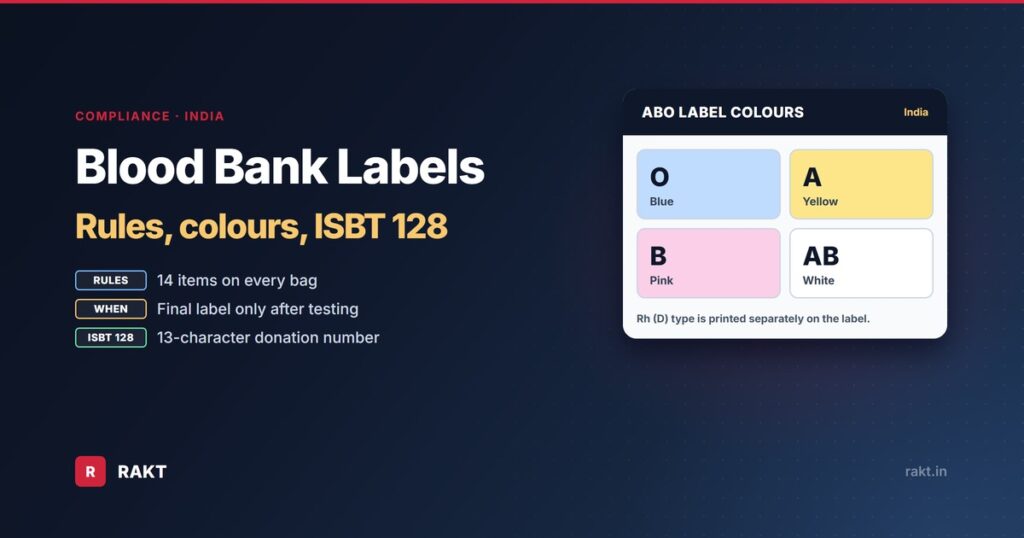
Every bag containing blood carries a coloured label for its ABO group. The colour scheme is the same in the Drugs and Cosmetics Rules and the national standards:1, 2
| ABO blood group | Label colour |
|---|---|
| O | Blue |
| A | Yellow |
| B | Pink |
| AB | White |
The colour shows the ABO group only. The Rh (D) type is printed on the label as well. If a unit tests D negative, it is then tested for weak D. If weak D is positive, the label reads “Rh (D) Positive”. If it is negative, the label reads “Rh (D) negative”.2
Extra Rules For Component Labels
Components carry everything above, plus some rules of their own:2
- Storage and expiry: the storage temperature and the expiry date and time must be shown.
- Plasma: the Rh (D) type is not required on plasma.
- Platelets and granulocytes: the Rh (D) type is needed, especially if there is red cell contamination.
- Cryoprecipitate: the ABO group and Rh (D) type need not be on the label. Our cryoprecipitate guide covers its other rules.
- Apheresis: the label should say if the component was collected by apheresis.
- Additives: any adjuvant or cryoprotective agent added must be stated.
- Irradiated red cells: the expiry changes to 28 days after irradiation, or the original expiry if that is earlier.
- Leukodepleted products: the label states how many logs of leucocytes were removed.
- Broken seal: if the bag’s hermetic seal is breached, the shelf life is shortened accordingly.
- Plasma for fractionation: it is documented and labelled for that purpose.
- Pooled cryoprecipitate or platelets: the same label as a single unit, plus a unique pool number or the donation numbers of every unit in the pool.1, 2
The label must also identify every facility that carried out any part of the preparation.2 For the components themselves, see our guides to PRBC and SDP and RDP platelets.
When and How the Label Goes on
The national standards set clear rules for the label itself:2
- Only after testing. The final label goes on only after all the mandatory tests are complete.
- Firmly attached and readable. Anything hand-written must be legible, in permanent and moisture-proof ink.
- A traceable number. Each unit gets a numeric or alphanumeric number from the collecting facility that traces it from source to final destination. The standards say a bar code system is preferable.
- No more than two numbers. A bag should carry at most two identification numbers, one of them the collecting facility’s. A patient identification can still be added.
- No donor name. The donor’s name should not be written on the label.
- Keep the original label. If a unit moves to another blood centre, the original label and number stay on the bag.
The standards also list instructions to print on the label: do not use if there is visible deterioration, keep red cells at 4 °C plus or minus 2 °C if there is a delay, shake gently, add no medication, check the group on the label against the patient’s, use a sterile disposable set with a filter, and do not dispense without a prescription.2
Labels at Issue and for Special Units
- At issue. Before a unit leaves the blood centre, a label or tag is attached with the patient’s name, hospital, identification number, the unit number and the crossmatch result.2 Our guide to the crossmatch test covers that step.
- Autologous units. Blood a patient donates for their own surgery is labelled “For Autologous Use Only”, with the donor-patient’s signature on the label.2
- Units supplied to blood storage centres. The label must carry the results of the mandatory tests and the date of testing.1
What is ISBT 128?
ISBT 128 is an international standard for identifying and labelling blood components and other medical products of human origin. Its data is printed on labels as barcodes. It is developed, managed and licensed by ICCBBA, a non-profit organisation.3
Its core is the Donation Identification Number (DIN), a 13-character number made of three parts:4
- Facility Identification Number (FIN): 5 characters that identify the facility, registered with ICCBBA.
- Year: 2 digits, the year the number was assigned.
- Sequence number: 6 digits for the donation, or for a pool.
The ISBT 128 data dictionary gives A999908123456 as an example DIN.5 Read with the structure above, A9999 is the facility, 08 the year and 123456 the sequence number. ICCBBA says a DIN is not duplicated anywhere in the world for 100 years.3, 4
Two more parts sit next to the DIN on the label:3
- Flag characters: 2 characters used for process control. They are not part of the 13-character DIN.
- Check character: printed in a box, it lets staff confirm a number typed by hand when the bar code cannot be scanned.
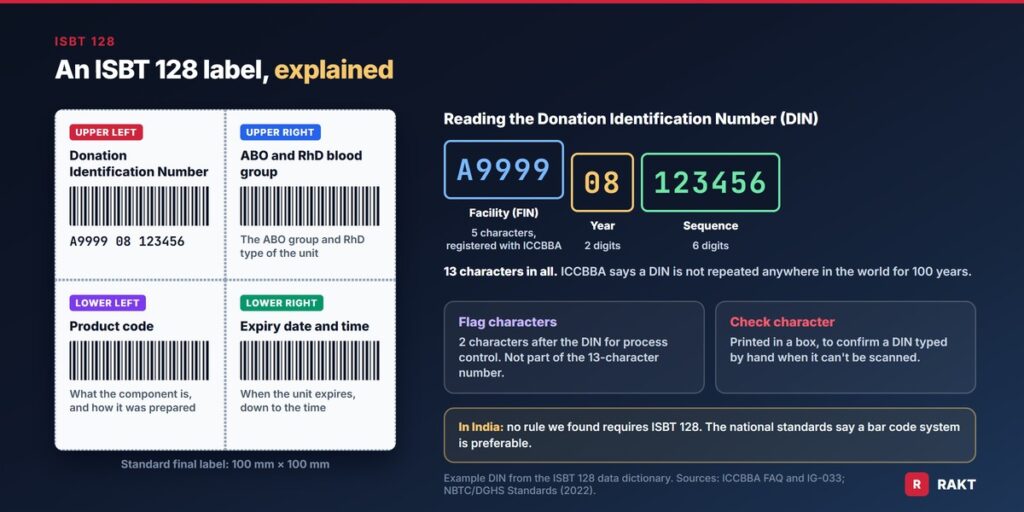
The four quadrants of an ISBT 128 label
On the standard 100 mm by 100 mm final label, four barcodes must appear at a minimum:3
| Quadrant | Bar code |
|---|---|
| Upper left | Donation Identification Number |
| Upper right | ABO and RhD blood group |
| Lower left | Product code |
| Lower right | Expiry date and time |
When units are pooled, the pooling facility gives the pool a new DIN with its own facility number, and keeps a record of every DIN in the pool.3
ICCBBA lists the benefits as fewer identification errors and misreads, an expiry time that machines can read, and no renumbering when units arrive from another facility.3 Our guide to traceability from donor to recipient shows why that matters.
Is ISBT 128 Required in India?
We found no Indian rule that requires ISBT 128. The national standards say a bar code system is preferable for identifying units, but they do not name a standard.2 The Drugs and Cosmetics Rules set what the label must say, not the bar code format.1
If a blood centre does adopt ISBT 128, two registrations are involved:3
- The blood centre. A facility that applies ISBT 128 labels, including one that pools or modifies units and relabels them, must register with ICCBBA. It pays a one-time registration fee and an annual licence fee.
- The software vendor. A vendor can only provide the capability to use ISBT 128. Its registration does not cover the blood centre.
A facility that only scans ISBT 128 bar codes, without applying new labels, does not need to register. ICCBBA itself does not provide software or labels; licensed vendors do.3
Common Label Mistakes to Check for
Each of these breaks a rule set out above:1, 2
- A final label put on before all the mandatory tests are complete.
- Hand-written details in ink that smudges or fades.
- The donor’s name written on the bag.
- A colour that does not match the ABO group.
- No “Voluntary Donor” or “Replacement Donor” line, or one printed smaller than the product name.
- A component label with no storage temperature or expiry time.
- An irradiated unit still showing its old expiry.
- A unit transferred from another centre and relabelled with a new number.
Labels from the Bag You Already Recorded
When the same details are typed twice, once in the register and again on a label, the two can drift apart. RAKT prints the label from the record staff already made:
- RAKT is an ICCBBA registered software vendor for the ISBT 128 standard.
- The ABO/Rh and product code structures are encoded from the grouping and component records, along with collection and expiry.
- Labels print on Zebra-class printers at the bench, or on RAKT Pass at a camp.
- The code on the bag comes from the same unit the donor, grouping and component registers already hold.
Vendor registration is not a product certification, and a centre that assigns Donation Identification Numbers still needs its own ICCBBA facility licence where that applies. See how RAKT handles ISBT 128 labels, or book a demo on WhatsApp.
Frequently asked questions
What should a blood bag label contain?
In India, it must show the product name, the blood bank’s name, address and licence number, the serial number, collection and expiry dates, the ABO colour label, the mandatory test results, the Rh group, volume and anticoagulant, storage temperature, use instructions and whether the donor was voluntary or replacement.
What is the colour code for blood bag labels?
Group O is blue, group A is yellow, group B is pink and group AB is white. The same scheme appears in the Drugs and Cosmetics Rules and the national standards for blood centres.
What colour is the label on an O positive blood bag?
Blue. The colour shows the ABO group only, so O positive and O negative both have blue labels. The Rh (D) type is printed on the label separately.
Is the donor’s name written on the blood bag label?
No. The national standards say the donor’s name should not be written on the label. The unit is identified by its number, which links back to the donor record.
When is the final label put on a blood bag?
Only after all the mandatory tests on the unit are complete. Hand-written details must be in permanent, moisture-proof ink.
Does a cryoprecipitate label need the blood group?
No. The national standards say the ABO group and Rh (D) type need not be shown on a cryoprecipitate label. Plasma labels also do not need the Rh (D) type.
What is ISBT 128?
ISBT 128 is an international standard for identifying and labelling blood components and other medical products of human origin, usually as bar codes on the label. It is managed and licensed by ICCBBA.
What is a Donation Identification Number?
It is the 13-character ISBT 128 number for a donation: 5 characters for the facility, 2 digits for the year and a 6-digit sequence number. ICCBBA says it is not repeated anywhere in the world for 100 years.
Is ISBT 128 mandatory in India?
We found no Indian rule that requires it. The national standards say a bar code system is preferable for identifying units, but they do not name a specific standard.
Do blood banks need to register with ICCBBA?
Only if they apply ISBT 128 labels. They then pay a one-time registration fee and an annual licence fee. A facility that only scans ISBT 128 bar codes does not need to register.
Sources
- Drugs and Cosmetics Rules, 1945, Schedule F, Part XII-B, as amended by G.S.R. 166(E), 11 March 2020 cdsco.gov.in
- National Blood Transfusion Council and Directorate General of Health Services, Ministry of Health and Family Welfare. Standards for Blood Centres and Blood Transfusion Services. 2nd edition, 2022 clinicalestablishments.mohfw.gov.in
- ICCBBA. Frequently Asked Questions. Accessed 14 November 2026 iccbba.org
- ICCBBA. Implementation Guide: Use of the Donation Identification Number [Data Structure 001], IG-033, version 1.2.0. November 2017 iccbba.org
- ICCBBA. ISBT 128 data dictionary: Donation Identification Number isbt128.org