
Blood Bank Software · November 5, 2026 · Updated November 14, 2026
Blood Bag Types and Anticoagulants Used in Blood Banks: CPDA-1, SAGM, ACD and CPD
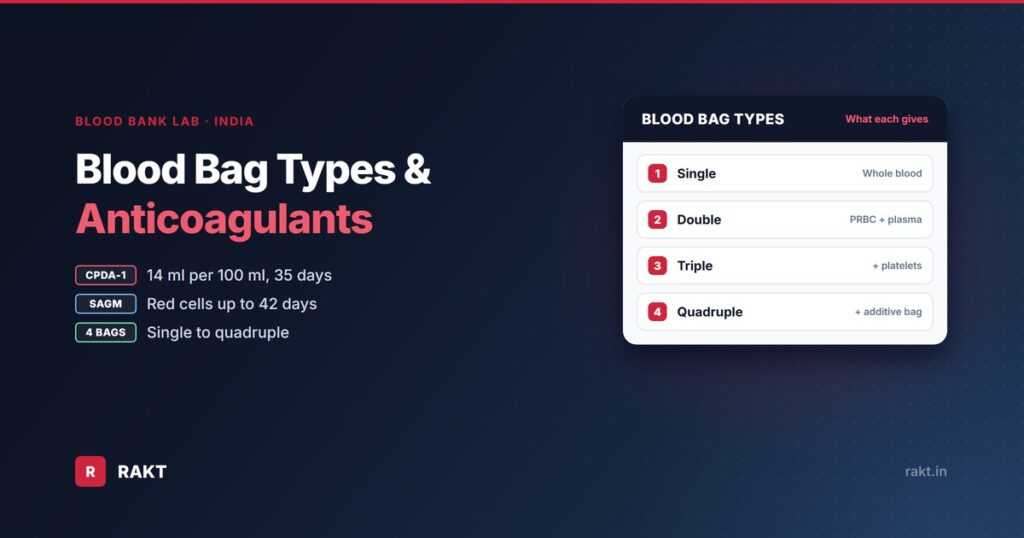
The bag a technician picks at the donor couch decides what that donation can become. Collect it in a single bag, and it can only ever be whole blood. Collect it in a quadruple bag, and the same donation can give red cells, platelets and plasma to three different patients.
The choice also changes quality. When Medanta in Gurgaon moved from triple bags to quadruple top-and-bottom bags, its platelet yield per unit rose from 6.47 to 7.67 × 10¹⁰. Its red cells also carried far fewer white cells.1
This guide explains every blood bag type used in Indian blood centres and the anticoagulants used in blood banks, with their full forms and shelf lives. It also covers what the Drugs and Cosmetics Rules require. It is written for technicians, medical officers and students, with tables you can use at the bench.
Anticoagulants used in blood banks: the short answer
Blood banks in India collect blood into anticoagulant-preservative solutions, mainly CPDA-1 (citrate phosphate dextrose adenine, 14 ml for every 100 ml of blood) or ACD (acid citrate dextrose, 15 ml for every 100 ml). Red cells can then be moved into an additive solution such as SAGM (saline adenine glucose mannitol). This lets them be stored for up to 42 days.2
The citrate in each of these solutions is what stops clotting: it binds calcium, which the clotting process needs.3 The other ingredients keep the red cells alive during storage. In practice, whole blood is collected as 350 ml or 450 ml, in CPDA-1 or in bag sets that carry an additive solution.4
Anticoagulants used in blood bank: CPDA-1, ACD, CPD and SAGM compared
| Solution | Full form | Type | Amount | Red cell storage |
|---|---|---|---|---|
| CPDA-1 | Citrate Phosphate Dextrose Adenine | Anticoagulant-preservative, in the collection bag | 14 ml per 100 ml of blood2 | Up to 35 days2 |
| ACD (Formula A) | Acid Citrate Dextrose | Anticoagulant, in the collection bag | 15 ml per 100 ml of blood2 | Up to 21 days2 |
| CPD | Citrate Phosphate Dextrose | Anticoagulant, in the collection bag; used with an additive solution for the red cells5 | As specified by the bag manufacturer | Depends on the additive used |
| SAGM | Saline Adenine Glucose Mannitol | Additive solution, in a satellite bag, added to red cells after the plasma is removed | As specified by the bag manufacturer | Up to 42 days2 |
The rules name CPDA and CPDA-1 first. They also allow additive solutions such as SAGM, ADSOL and NUTRICEL for storing red cells for up to 42 days.2 The red cell storage figures above are also the deadlines for separating packed red cells. Blood in ACD must be separated within 21 days of collection, and blood in CPDA-1 within 35 days.2
CPDA full form and what each part does
CPDA stands for Citrate Phosphate Dextrose Adenine. In blood bags you will usually see it written as CPDA-1.
- Citrate binds calcium, so the blood cannot clot.3
- Phosphate helps hold the pH steady as the cells make acid during storage.
- Dextrose is sugar, the red cells’ fuel.
- Adenine helps red cells keep making ATP, the energy they need to survive storage. Blood in CPDA-1 can be stored for up to 35 days, against 21 days in ACD.2
SAGM full form, and why it adds a week
SAGM stands for Saline Adenine Glucose Mannitol. It is not an anticoagulant. It is an additive solution that goes onto the red cells after most of the plasma has been removed. Saline suspends the cells, adenine and glucose feed them, and mannitol protects the red cell membrane.
The first additive, SAG, was developed in Europe in the late 1970s. In 1981, its developers added mannitol to reduce haemolysis, which allowed red cells to be stored for up to six weeks. SAGM is now the most widely used red cell additive solution in the world.5
For a blood centre, the result shows up in two numbers. Red cells in CPDA-1 have a haematocrit of 65 to 70%, while red cells in SAGM sit at 50 to 60%, so they flow more easily. And they last up to 42 days instead of 35.2 Our guide to PRBC compares the two on the label.
Why not heparin or EDTA?
Heparin and EDTA are anticoagulants too, but neither is on the list Indian rules allow for blood collection bags.2 EDTA is used in blood sample tubes instead. For example, after a transfusion reaction, the ward sends clotted and EDTA samples to the blood centre for testing.6
Blood bag types: single, double, triple, quadruple
Indian rules allow only disposable PVC blood bags, used as a closed system.2 A blood bag set is one collection bag, called the primary bag, joined by tubing to empty satellite bags. Whole blood is collected into the primary bag, spun in a refrigerated centrifuge, and the separated layers are pressed into the satellite bags without the system ever being opened.4
| Bag type | Bags in the set | What it can give | Typical method |
|---|---|---|---|
| Single | 1 | Whole blood only. Red cell concentrate is possible with a separate transfer bag2 | No component separation |
| Double | 2 | Packed red cells and plasma | One heavy spin4 |
| Triple | 3 | Packed red cells, platelets and fresh frozen plasma | Platelet-rich plasma (PRP) method1, 4 |
| Quadruple | 4 | Packed red cells, platelets and fresh frozen plasma, with a fourth bag (for example for additive solution) | Buffy coat method, in top-and-bottom designs1, 4 |
| Penta | 5 | As quadruple, with one more satellite bag | Used by some centres4 |
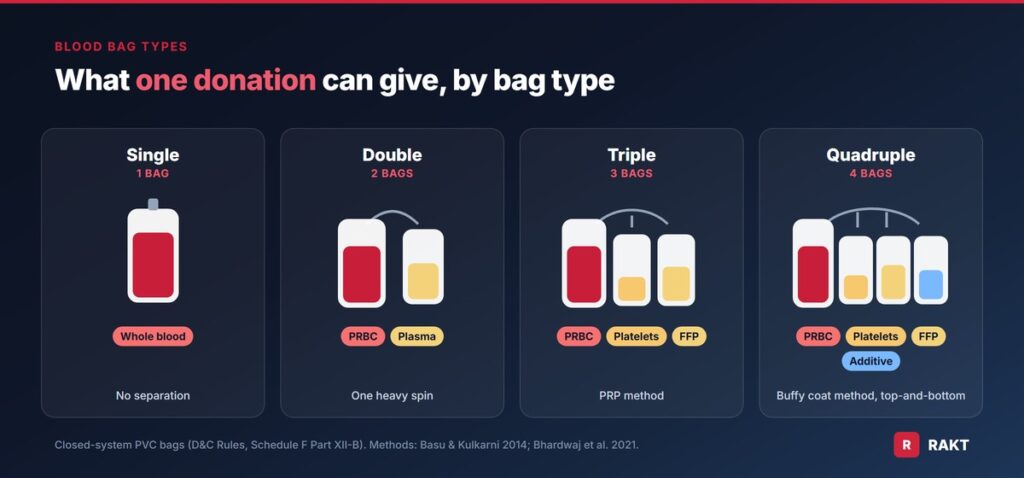
Fresh frozen plasma from any of these can be processed further into cryoprecipitate and cryo-poor plasma.4 Once filled, each bag is stored by what it holds: whole blood and red cells at 2 to 6 °C, plasma and cryoprecipitate below minus 30 °C, and platelets at 20 to 24 °C.6 Our blood storage temperature chart gives the shelf life of each, and our guide to fresh frozen plasma (FFP) covers its volume by bag size, thawing and dose.
Triple vs quadruple bags: PRP vs buffy coat
Most component work in India uses one of two methods, and the bag decides which one you can run.1
- PRP method (usually triple bags): a light spin separates platelet-rich plasma from the red cells, then a heavy spin splits that plasma into platelets and plasma. It is simple to do by hand and cheaper, but gives less platelet and plasma yield.4
- Buffy coat method (quadruple top-and-bottom bags): a heavy spin first separates red cells, the buffy coat and plasma. A light spin of the buffy coat then gives the platelets. It gives better products, but it is complicated by hand and needs automation.4
The Medanta study shows the difference in numbers. Half of 100 donations went through triple bags by the PRP method and half through quadruple top-and-bottom bags, with an integral filter, by the buffy coat method.1
| Measure | Triple bag, PRP method | Quadruple bag, buffy coat method |
|---|---|---|
| Red cell haematocrit | 56.0% | 61.3% |
| White cells left in red cells | 5.41 × 10⁵ | 6.3 × 10⁴ |
| Platelet yield per unit | 6.47 × 10¹⁰ | 7.67 × 10¹⁰ |
| White cells in platelet units | 1.5 × 10⁴ | 8.24 × 10³ |
All four differences were statistically significant.1 If your centre is weighing the move to quadruple bags, our guide to SDP vs RDP platelets covers the platelet side of that decision.
Specialised blood bag sets
Beyond the standard sets, Indian manufacturers also make penta bags, top-and-bottom extraction systems, bags with an in-line leucodepletion filter, CPD-SAGM bags, bags with a sampling pouch, ACD bags and cord blood bags.7
In-line filters matter when red cells must carry very few white cells. National guidance sets a limit below 5 × 10⁶ white cells per unit to prevent alloimmunisation or CMV infection, and reaching it usually needs a leucocyte filter.6
350 ml vs 450 ml blood bags
Blood bags come in two collection sizes. The size decides who can donate into it and how much each component will hold.2 With the anticoagulant included, one unit of whole blood measures about 365 to 560 ml.6
| 350 ml bag | 450 ml bag | |
|---|---|---|
| Minimum donor weight | 45 kg | More than 55 kg |
| Packed red cells | 150 ml ± 10% | 250 ml ± 10% |
| Fresh frozen plasma | 180 to 220 ml | 220 to 300 ml |
| Platelets per unit (minimum) | 3.5 × 10¹⁰ | 4.5 × 10¹⁰ |
These are the quality control targets the rules set for each component.2 Our guide to the blood component yield report shows how to track them month by month.
Comparing bag types at your own centre? RAKT records what each bag yielded, unit by unit, so you can see your own numbers. See how RAKT tracks component preparation.
Parts of a blood bag
- Needle and donor tubing that carry blood from the donor’s arm to the primary bag.
- Primary (collection) bag, pre-filled with the anticoagulant.
- Satellite bags, empty or holding additive solution, joined by integral tubing.
- Pilot sample tubes (segments). One or more must stay attached to every packed red cell unit in a tamper-proof way.2 Crossmatching from these makes sure the cells tested come from the unit issued.
- Integral filter in some bag sets, to remove white cells.1
What the rules require for bags and anticoagulants
- Only disposable PVC bags, used as a closed system, meeting IP, USP or BP specifications.2
- Anticoagulant solutions must be sterile, pyrogen-free and from a licensed manufacturer, and the bags must come with the manufacturer’s certificate of analysis.2
- Components must be prepared in a closed system of single, double, triple or quadruple bags. The one exception is red cell concentrate, which may be made in a single bag with a transfer bag.2
- Records must be kept for ACD, CPD, CPDA and SAGM bags: the manufacturer, batch number, date of supply and test results.2 Our guide to Schedule F Part XII-B records lists the rest.
Timing matters as well. Components should be separated within 5 to 8 hours of collection.4
Track every bag type without a second register
With several bag types and solutions in use, a centre has to know three things for every unit: which bag it came from, which solution it sits in, and when it expires. On paper that means cross-checking the donor register, the component preparation record and the stock register. The bag label carries the anticoagulant and the expiry date too; our guide to blood bank labels lists every item it must show.
RAKT keeps it in one record:
- Bag entry records the bag number, anticoagulant and bag type, volume, collection start and end times, and the phlebotomist.
- Component preparation records what each bag yielded, such as PRBC, leucodepleted PRBC, FFP, cryo-poor plasma, platelets and cryoprecipitate, each with its own volume, storage temperature and expiry.
- Every component carries its parent bag number, so it traces back to one donor, and the separation figures cannot add up to more than was collected.
- Near-expiry components are flagged while there is still time to use them.
See how RAKT follows one bag from collection to issue, or book a demo on WhatsApp.
Frequently asked questions
What is the full form of CPDA?
CPDA stands for Citrate Phosphate Dextrose Adenine. CPDA-1 is the anticoagulant-preservative used in blood bags, at 14 ml for every 100 ml of blood. Blood collected in CPDA-1 can be stored for up to 35 days.
What is the full form of SAGM?
SAGM stands for Saline Adenine Glucose Mannitol. It is an additive solution added to red cells after the plasma is removed, and it lets red cells be stored for up to 42 days.
Which anticoagulants are used in blood banks in India?
CPDA-1 (14 ml per 100 ml of blood) and ACD Formula A (15 ml per 100 ml) are the anticoagulants named in the Drugs and Cosmetics Rules. CPD is used in bag systems that move red cells into SAGM or another additive solution.
How much anticoagulant is in a blood bag?
For CPDA-1, 14 ml is needed for every 100 ml of blood. For ACD Formula A, 15 ml is needed for every 100 ml.
What is the shelf life of blood in CPDA-1 and SAGM?
Red cells can be stored for up to 35 days in CPDA-1 and up to 42 days in SAGM. Blood in ACD must have its red cells separated within 21 days.
What is the difference between triple and quadruple blood bags?
A triple bag gives red cells, platelets and plasma, usually by the platelet-rich plasma method. A quadruple bag adds a fourth bag, often for additive solution or the buffy coat method, which in one Indian study gave higher platelet yield and fewer white cells.
Why is EDTA not used in blood bags?
EDTA is not among the anticoagulants Indian rules allow for blood collection bags. It is used in blood sample tubes, such as the samples sent for testing after a transfusion reaction.
How many ml are in one blood bag?
Blood is collected as 350 ml or 450 ml. With the anticoagulant included, one unit of whole blood measures about 365 to 560 ml.
What is the difference between a 350 ml and a 450 ml blood bag?
A 350 ml bag can be used for donors weighing at least 45 kg, and a 450 ml bag for donors over 55 kg. The larger bag yields more of each component, for example about 250 ml of packed red cells instead of about 150 ml.
Sources
- Bhardwaj G, Tiwari AK, Aggarwal G, Pabbi S, Sharma J, Luthra A, et al. Evaluation of quality matrix when practice changed from triple bags to quadruple (top and bottom) bags: in vitro analysis of blood components. Asian J Transfus Sci. 2021;15:30-6 pmc.ncbi.nlm.nih.gov
- Drugs and Cosmetics Rules, 1945, Schedule F, Part XII-B, as amended by G.S.R. 166(E), 11 March 2020 cdsco.gov.in
- Li K, Xu Y. Citrate metabolism in blood transfusions and its relationship due to metabolic alkalosis and respiratory acidosis. Int J Clin Exp Med. 2015;8(4):6578-84 pmc.ncbi.nlm.nih.gov
- Basu D, Kulkarni R. Overview of blood components and their preparation. Indian J Anaesth. 2014;58:529-37 pmc.ncbi.nlm.nih.gov
- Sparrow RL. Time to revisit red blood cell additive solutions and storage conditions: a role for “omics” analyses. Blood Transfus. 2012;10(Suppl 2):s7-s11 pmc.ncbi.nlm.nih.gov
- National Institute of Biologicals, Ministry of Health and Family Welfare. Good Blood Transfusion Practices: Guidance for Rational Use of Blood. 2022 nib.gov.in
- Poly Medicure Ltd. Blood bags product range. Accessed 5 November 2026 polymedicure.com