
Inventory Management · November 19, 2026 · Updated November 20, 2026
Massive Transfusion Protocol (MTP): Definition, Ratios and What the Blood Bank Does
When a doctor calls a massive transfusion protocol, the blood bank has minutes, not hours. The first units must leave fast. The next rounds must follow in the right mix. And every bag must still be traced to the right patient.
Speed alone is not enough. At one Indian teaching hospital, the blood bank turned massive transfusion requests around in 16 minutes on average, yet fewer than half of the protocol activations were appropriate.1 And India has no national massive transfusion protocol, so each hospital has to write its own.2
This guide explains what massive transfusion is, what a protocol contains, what the 1:1:1 ratio means, and what the blood bank does from the first call to the last unit.
Massive Transfusion Protocol: The Short Answer
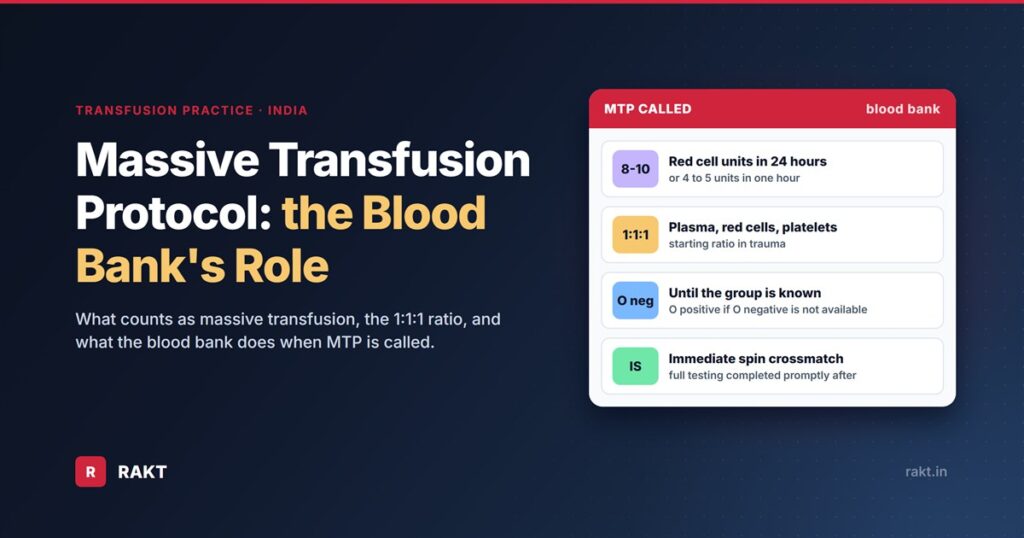
A massive transfusion protocol (MTP) is a hospital’s pre-agreed plan for patients who are bleeding so heavily that they may need 8 to 10 or more red cell units in 24 hours. It sets who activates it, which blood components go out in each round, starting at 1:1:1 plasma, red cells and platelets in trauma, and when it stops.2
| Question | Answer under Indian guidance |
|---|---|
| What counts as massive transfusion? | 8 to 10 red cell units in 24 hours, 4 to 5 units in one hour, or replacing more than one blood volume in 24 hours |
| Starting ratio in trauma | 1:1:1 plasma, red cells and platelets |
| Blood before the group is known | Group O Rh(D) negative red cells; O Rh(D) positive if O negative is not available |
| Crossmatch in an emergency | Immediate spin, with full compatibility testing completed promptly afterwards |
| Who writes the protocol | Each hospital, through its hospital transfusion committee |
The details come from national guidance and the national standards for blood centres, cited in the sections below.2, 3
What is Massive Transfusion?
National guidance defines massive transfusion in an adult as any one of these:2
- 8 to 10 red cell units in 24 hours.
- 4 to 5 red cell units within one hour.
- Replacing more than one blood volume in 24 hours.
- Replacing more than half the blood volume in 4 hours.
An adult’s blood volume is about 70 mL per kg of body weight. The same guidance also treats blood loss of more than 150 mL an hour as massive.2
Causes include injury, bleeding in childbirth, bleeding in the gut, and heart and liver surgery.2 In trauma, bleeding causes almost half of the deaths in the first 24 hours after injury.2 At one Indian level 1 trauma centre, 104 of 986 severely injured patients (11.8%) needed a massive transfusion.4
What is a Massive Transfusion Protocol?
A massive transfusion protocol is a plan agreed before the emergency. It answers the questions nobody has time to argue about at the bedside: who can activate it, how the blood bank is told, what goes in each round, which tests are repeated, and who stands it down.
National guidance sets out what the protocol is for:2
- Recognise the blood loss early and activate the protocol.
- Keep the tissues supplied with blood and oxygen by restoring blood volume and haemoglobin.
- Stop the bleeding, including by early surgery or radiology.
- Use blood components carefully to correct clotting problems.
It also describes good practice: a clear definition of massive transfusion in the hospital, a way to predict which patients will need it so the protocol starts early without being overused, a clear plan for activation, and sticking to the protocol once it is running.2
Is There a National Massive Transfusion Protocol in India?
No. National guidance states that no massive transfusion protocol exists in India for managing massive bleeding. It says Indian hospitals need to write protocols suited to their own needs and resources.2
The national standards require every hospital that uses blood to form a hospital transfusion committee.3 National guidance expects that committee to develop the local massive transfusion protocol, for example for major bleeding in childbirth.2
One Indian study shows why the written plan matters. At PGIMER Chandigarh, 70 patients who received massive transfusion had no fixed ratio of components. On average they received 1 unit of red cells to 0.9 units of plasma and 0.6 units of platelets.5 The authors called for hospitals in developing countries to follow a massive transfusion protocol too.5
The 1:1:1 Ratio and what the Evidence Says
National guidance says resuscitation should start straight away with ratio-based component therapy. Too much crystalloid fluid and red cells alone dilute the patient’s platelets and clotting factors.2
For adult trauma patients with, or at risk of, massive bleeding, it recommends starting with plasma, red cells and platelets in a 1:1:1 ratio, and giving tranexamic acid as soon as possible after injury.2
The main trial behind this is PROPPR. It compared a 1:1:1 ratio with a 1:1:2 ratio (plasma, platelets and red cells) in 680 severely injured patients at 12 trauma centres in North America.6
| Outcome | 1:1:1 | 1:1:2 |
|---|---|---|
| Deaths at 24 hours | 12.7% | 17.0% |
| Deaths at 30 days | 22.4% | 26.1% |
| Deaths from bleeding in the first 24 hours | 9.2% | 14.6% |
| Bleeding stopped | 86% | 78% |
The differences in deaths at 24 hours and 30 days were not statistically significant. But fewer patients in the 1:1:1 group bled to death in the first 24 hours, and more had their bleeding stopped.6 The 1:1:1 group used more plasma and platelets, with no other safety differences.6
Two more points matter to the blood bank:
- Platelets: in severe bleeding during massive transfusion, national guidance uses a platelet count of 50,000 per µL as the trigger for a platelet transfusion.2
- Fibrinogen: in bleeding after childbirth, the guidance says cryoprecipitate should be considered to replace fibrinogen.2 Our cryoprecipitate guide explains the component.
Some hospitals also use viscoelastic tests such as thromboelastography (TEG) and ROTEM. They test whole blood, show where clotting is failing, and can guide which component to give next.2
What the Blood Bank Does when MTP is Called
The clinical team decides what the patient needs. The blood bank’s job is to get safe, traceable units out fast, round after round. Here is how that works under India’s national rules.
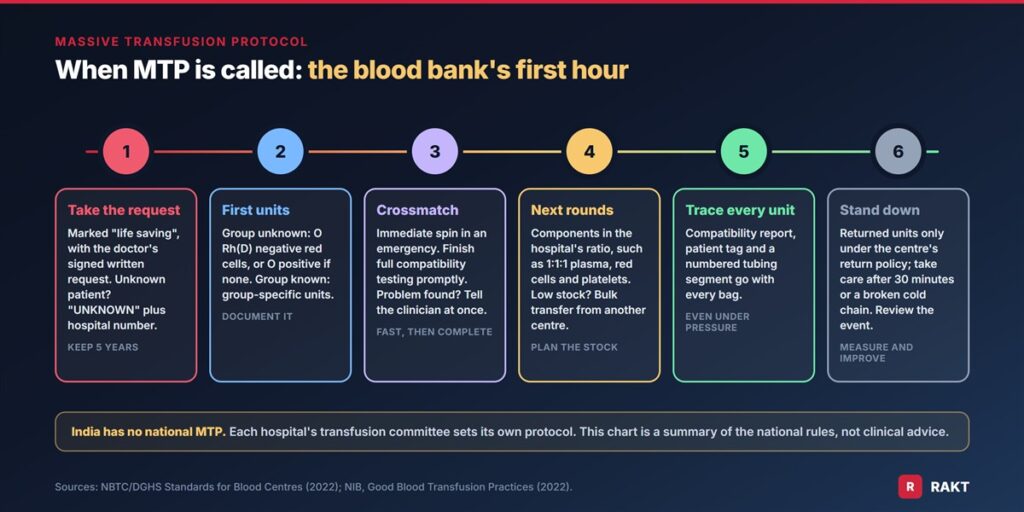
1. Take the request
The request form should be marked as routine, emergency or life saving.3 To issue blood before crossmatching is finished, the blood centre needs a signed, written request from the treating doctor stating that the patient needs blood urgently. These requests should be kept for 5 years.3
Some patients arrive unconscious and unidentified. National guidance suggests labelling them “UNKNOWN” with a unique hospital registration number, and “UNKNOWN 1”, “UNKNOWN 2” when there are several.2
2. Issue the first units
If the patient’s ABO and Rh(D) group is not known, the national standards say to give group O Rh(D) negative red cells if available. If not, O Rh(D) positive can be used as a lifesaving measure, and the event must be documented.3 National guidance, citing AABB, prefers Rh(D) negative units for women of child-bearing age.2
Once the group is known, switch to ABO and Rh(D) specific or compatible units, even before compatibility testing is complete.3
3. Crossmatch fast, then finish it
In an emergency, national guidance allows blood to be issued with an immediate spin crossmatch.2 The full compatibility test must still be completed promptly. If it shows a problem, the clinician should be told at once to stop the transfusion.3 Our crossmatch guide explains immediate spin and the other methods.
4. Prepare the next rounds
After the first units, the blood bank sends components in the ratio the hospital’s protocol sets. Plasma has to be thawed and platelets have to be on the shelf, so the protocol only works if the stock is planned for it. Our guides to fresh frozen plasma and SDP vs RDP platelets cover both components.
If stock runs low, the national standards allow a licensed blood centre to take blood and components from another licensed centre into its inventory, with proper records.3
5. Keep every unit traceable
Speed does not remove the checks. Every unit still leaves with its compatibility report, a tag with the patient’s name and identification number, and a numbered segment of the bag tubing attached.3
6. Stand down and handle returns
When the bleeding is under control, the team stands the protocol down. Units that come back unused need care. The standards recommend not taking back blood once issued, especially if the cold chain is broken and it comes back after 30 minutes. Each blood centre must have a policy for accepting and reissuing returned units.3
Complications of Massive Blood Transfusion
Massive transfusion saves lives, but it carries risks. The best known is the “lethal triad” of acidosis, low body temperature and clotting failure. Each makes the others worse, and together they carry a high death rate.2
National guidance lists these complications:2
- Acidosis: usually a sign that the blood loss is not yet fully treated, rather than an effect of the transfused blood. Routine bicarbonate is not needed.
- Clotting failure (coagulopathy): caused by blood loss and by diluting platelets and clotting factors with too much fluid and red cells.
- Low body temperature (hypothermia): national guidance lists rapid transfusion of more than 50 mL per kg an hour in adults as a reason to use a blood warmer. It should be a proper device with an alarm and temperature display.
- Low calcium (citrate toxicity): rare, but low calcium together with low temperature and acidosis can weaken the heart and disturb its rhythm.
- Potassium changes: stored blood has slightly more potassium, but low potassium is more common than high potassium.
- Air embolism.
After the first round, the guidance says the team should check temperature (above 35 °C), ionised calcium (above 1.1 mmol/L), platelets (at least 50 × 10⁹ per litre), acid and base balance, clotting tests and fibrinogen. Haemoglobin should not be used alone to decide on transfusion.2
Managing these is the clinical team’s job. For the blood bank, the lesson is the one behind ratio-based protocols: plasma and platelets have to go out early, not only red cells.2 Our guide to transfusion reactions covers the other risks of transfusion.
What to Measure After Every MTP
Every activation is a chance to check the protocol. A team at Kasturba Medical College, Manipal, reviewed 92 massive transfusion events over two years and built key performance indicators for their protocol.1
| Indicator | What Manipal found |
|---|---|
| Appropriate activation | 43.47% of events |
| Turnaround time | 16 minutes on average (plus or minus 10); 85.8% within their benchmark |
| Components used | 1,405 across 92 events |
| Components per event | 20.5 when activation was appropriate; 5.5 when it was not |
| Wastage | 3.5% |
| Duration of activation | 6.19 hours on average |
Trauma was the leading cause, followed by bleeding after childbirth and upper gut bleeding.1 The authors found these indicators easy to capture. Our guide to blood bank quality indicator records covers the indicators blood centres already keep.
Emergency Release, Flagged, not Hidden
In an MTP, the risk is that speed hides the exceptions. RAKT is built so they stay visible:
- Emergency release before crossmatch is possible, because clinically it has to be. It is flagged on the request instead of passing silently.
- Crossmatch compatibility is recorded against the bag and the request.
- Expiry is checked at allotment, and the same unit cannot be allotted to two requests.
- Turnaround time for whole blood and red cell issue is computed as a NABH performance indicator, from the issues already recorded.
See how RAKT handles emergency release, or book a demo on WhatsApp.
Frequently asked questions
What is a massive transfusion protocol?
A massive transfusion protocol (MTP) is a hospital’s pre-agreed plan for patients with life-threatening bleeding. It sets who activates it, how the blood bank is told, which components go out in each round, and when it stops.
What is considered massive transfusion?
Indian national guidance defines it as 8 to 10 red cell units in 24 hours, 4 to 5 units within one hour, replacing more than one blood volume in 24 hours, or replacing more than half the blood volume in 4 hours.
What is the 1:1:1 ratio in massive transfusion?
It means equal units of plasma, red cells and platelets. Indian national guidance recommends starting with this ratio in adult trauma patients with, or at risk of, massive bleeding.
Is there a national massive transfusion protocol in India?
No. National guidance says no massive transfusion protocol exists in India, so each hospital should write its own, usually through its hospital transfusion committee.
What blood is given before the patient’s group is known?
Group O Rh(D) negative red cells if available. If not, the national standards allow O Rh(D) positive as a lifesaving measure, with the event documented. Group-specific units are used once the group is known.
Can blood be issued without a crossmatch in an emergency?
Yes, on a signed written request from the treating doctor when delay could endanger the patient’s life. Indian guidance allows an immediate spin crossmatch, and the full compatibility test must be completed promptly afterwards.
What are the complications of massive blood transfusion?
The main ones are the lethal triad of acidosis, low body temperature and clotting failure, plus low calcium from citrate, potassium changes and air embolism.
Why is calcium given during massive transfusion?
Large volumes of stored blood can lower the patient’s calcium through citrate toxicity. Low calcium, with low temperature and acidosis, can weaken the heart and disturb its rhythm. Indian guidance aims to keep ionised calcium above 1.1 mmol/L.
Who activates a massive transfusion protocol?
The treating clinical team, following the hospital’s own protocol. The protocol should say who can activate it and how the blood bank is told.
What should a blood bank measure after an MTP?
Whether activation was appropriate, turnaround time, components used per event, wastage and how long the activation lasted. These are the indicators one Indian teaching hospital used to improve its protocol.
Sources
- Ninan A, Krishnan V, Shastry S, Mohan G, Chenna D, et al. A comprehensive approach to continuous quality improvement of massive transfusion by developing key performance indicators. Vox Sang. 2024;119(11):1183-1190 doi.org
- National Institute of Biologicals, Ministry of Health and Family Welfare. Good Blood Transfusion Practices: Guidance for Rational Use of Blood. 2022 nib.gov.in
- National Blood Transfusion Council and Directorate General of Health Services, Ministry of Health and Family Welfare. Standards for Blood Centres and Blood Transfusion Services. 2nd edition, 2022 clinicalestablishments.mohfw.gov.in
- Krishna A, Chaurasia R, Sinha TP, Subramanian A. Predicting massive transfusion and mortality in severely injured patients presenting to the emergency of a level 1 trauma center from the Indian subcontinent. Asian J Transfus Sci. 2026;20(2):365-371 pmc.ncbi.nlm.nih.gov
- Singh L, Jain K, Jain A, Suri V, Sharma RR. Massive transfusion protocol: need of the hour. A tertiary care centre experience. J Anaesthesiol Clin Pharmacol. 2022;38(3):423-427 pmc.ncbi.nlm.nih.gov
- Holcomb JB, Tilley BC, Baraniuk S, Fox EE, Wade CE, et al. Transfusion of plasma, platelets, and red blood cells in a 1:1:1 vs a 1:1:2 ratio and mortality in patients with severe trauma: the PROPPR randomized clinical trial. JAMA. 2015;313(5):471-482 pmc.ncbi.nlm.nih.gov