
Blood Bank Software · November 9, 2026 · Updated November 20, 2026
Fresh Frozen Plasma (FFP): Full Form, Storage, Thawing, Dose and Uses in India
A patient is bleeding, and the doctor orders four units of plasma. The blood centre has them, but they are frozen solid at minus 30 °C or colder. Before a single drop can go in, each bag must be thawed, and that takes time nobody planned for.
Plasma also gets wasted in both directions. National guidance says plasma products have the highest rate of inappropriate use of any blood component, up to 50%.1 And in India, thawed plasma that is not used within 24 hours is usually discarded.2
Clear rules fix most of this. This guide explains what fresh frozen plasma is, how it is prepared and stored under Indian rules, how to thaw it, the usual dose, blood group compatibility, and when it should and should not be given.
What is fresh frozen plasma (FFP)?
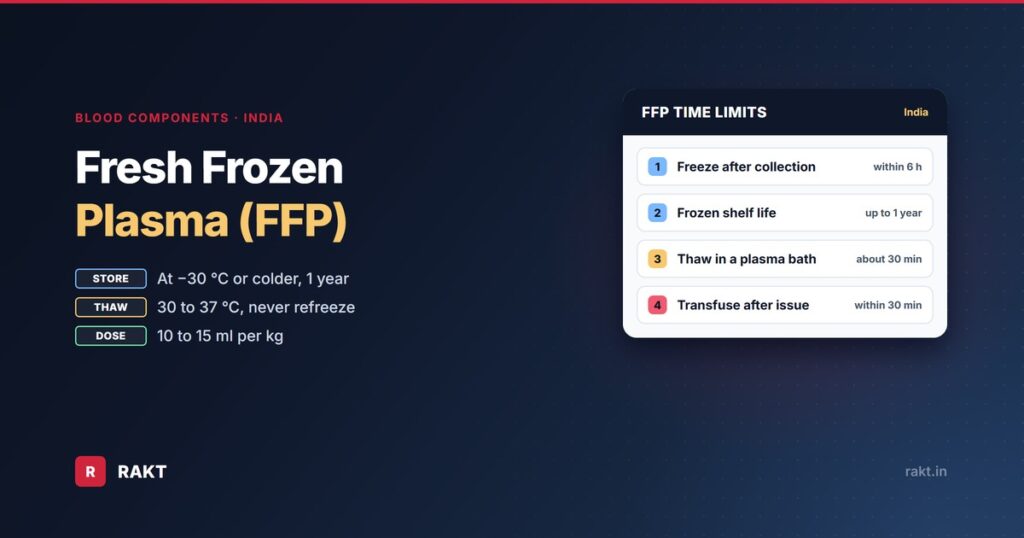
FFP stands for fresh frozen plasma. It is the liquid part of donated blood, separated and frozen quickly to preserve its clotting factors. In India, it must be frozen within 6 hours of collection and stored at minus 30 °C or colder for up to one year.3
FFP is given to replace clotting factors in patients who are bleeding, or about to have a procedure, and whose blood is not clotting normally.1 It contains no red cells or platelets, so it does not need irradiation or CMV-negative selection.4
| At a glance | Fresh frozen plasma (FFP) |
|---|---|
| Frozen within | 6 hours of collection |
| Storage | At minus 30 °C or colder |
| Shelf life (frozen) | Up to 1 year |
| Volume per bag | 180 to 220 ml (350 ml bag), 220 to 300 ml (450 ml bag) |
| Thawing | 30 to 37 °C in a plasma thawing bath |
| Usual dose | 10 to 15 ml per kg of body weight |
| After issue | Transfuse within 30 minutes |
The figures above come from the Drugs and Cosmetics Rules, national guidance and an Indian study, cited in the sections below.1, 2, 3
What FFP contains
Plasma carries the proteins that make blood clot. Some of them, such as factor VIII, break down quickly once plasma is liquid. That is why plasma is frozen fast: to keep these fragile clotting factors working.2, 4
Indian rules use factor VIII as the quality check for FFP. Each bag should contain at least 70 IU of factor VIII.3 FFP does not contain platelets, so it cannot fix bleeding caused by a low platelet count. That needs platelet concentrates.
How FFP is prepared in a blood centre
FFP can be separated from whole blood: the bag is spun in a refrigerated centrifuge, and the plasma is pressed off into a satellite bag.5 Plasma can also be collected directly from a donor by plasmapheresis.5 Our guide to blood bag types explains which bag sets give plasma.
The rules set three requirements:
- Freeze within 6 hours of collection, and store at minus 30 °C or colder.3
- Freeze faster for cryoprecipitate. A minus 80 °C deep freezer should be used when the plasma will be made into cryoprecipitate.3
- Meet the quality targets below.3
| Quality check | From a 350 ml bag | From a 450 ml bag |
|---|---|---|
| FFP volume | 180 to 220 ml | 220 to 300 ml |
| Factor VIII | At least 70 IU per bag | At least 70 IU per bag |
So “how many ml is one bag of FFP?” depends on the bag it came from: about 180 to 220 ml from a 350 ml donation, and 220 to 300 ml from a 450 ml donation.3 Our guide to the blood component yield report shows how to track these numbers.
FFP storage temperature and shelf life
| Stage | Temperature | How long |
|---|---|---|
| Frozen storage | At minus 30 °C or colder | Up to 1 year |
| Transport (frozen) | Below minus 20 °C | Keep frozen until it reaches the user |
| Thawed, waiting for use | 2 to 10 °C | Use as soon as possible; see the thawing section |
The storage rule comes from the Drugs and Cosmetics Rules.3 The transport and thawed-storage temperatures come from national guidance.1 The rules also expect a component laboratory to have deep freezers at minus 30 to minus 40 °C and minus 75 to minus 80 °C, plus a water bath for thawing plasma.3 Our blood storage temperature chart covers every other component.
How to thaw FFP, and how long it lasts after thawing
Thawing is where time is lost and plasma is wasted, so it helps to plan it.
- Thaw at 30 to 37 °C in a plasma thawing bath.2 In one Indian study, units took 30 minutes at 37 °C.2 UK guidance says to allow 20 to 30 minutes in an emergency.4
- Issue it, and transfuse within 30 minutes of issue.1 If it cannot be used straight away, keep it at 2 to 10 °C.1
- Do not refreeze it. Once thawed, FFP must not be frozen again.4
- Use it within the post-thaw limit. In India, thawed FFP is used within 24 hours and discarded after that, according to a 2025 study from Chandigarh.2 UK guidance allows 24 hours at 4 °C, or 4 hours at room temperature.4
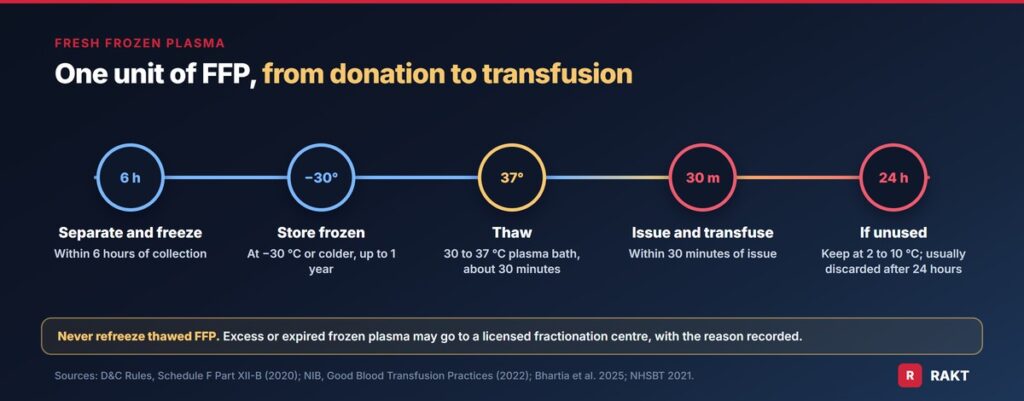
Why the 24-hour limit? Clotting factors fade once plasma is thawed. In the Chandigarh study, factor VIII fell by about 31% in the first 24 hours, then held steady. The thawed plasma also stayed sterile for 5 days at 2 to 6 °C. The authors suggest a longer post-thaw shelf life could cut waste.2 That is a research finding, not a change in the rules, so follow your centre’s SOP.
FFP dose and transfusion time
FFP is dosed by body weight: 10 to 15 ml per kg.1 In massive bleeding, it is given in a fixed ratio with red cells under the hospital’s massive transfusion protocol. In major obstetric haemorrhage, national guidance suggests 12 to 15 ml/kg for every 6 units of red cells, then follow clotting tests.1
As a rough example, a 60 kg adult at 10 to 15 ml/kg needs 600 to 900 ml, which is about 2 to 4 bags of FFP from 450 ml donations. The actual dose is always as prescribed.
How long does an FFP transfusion take? UK guidance gives a typical rate of 10 to 20 ml per kg per hour, depending on the patient’s condition.4 A full dose is a large volume of fluid, which can cause circulatory overload (TACO), so watch for breathlessness. Our guide to blood transfusion reactions covers TACO and TRALI.
FFP blood group compatibility
For plasma, the rules of blood group matching run the other way from red cells. Plasma carries antibodies, not red cell antigens, so the question is whether the donor’s antibodies will attack the patient’s red cells.4
| Patient’s group | First choice | Then |
|---|---|---|
| O | O | A, B or AB |
| A | A | AB |
| B | B | AB |
| AB | AB | None |
This order follows UK guidance for plasma that has not been tested for high-titre anti-A and anti-B. For adults in an emergency, that guidance also allows group B plasma for group A patients, group A plasma for group B patients, and group A or B plasma for group AB patients. Group identical plasma is best. Group O plasma goes only to group O patients, and group AB plasma can be given to anyone, but it is usually in short supply.4 FFP does not need RhD matching.4 Always follow your own centre’s SOP.
When FFP is used, and when it is not
National guidance, based on British guidelines, lists these uses.1
- Active bleeding: massive bleeding in trauma or childbirth, with other components; DIC with bleeding; urgent warfarin reversal or vitamin K deficiency; congenital factor deficiencies when no specific concentrate is available.
- Before a procedure: an INR above 1.5 in a patient facing an invasive procedure, after weighing the bleeding risk.
- Plasma exchange: as the replacement fluid for TTP and HUS.
- Selected cases: liver disease only with active bleeding or a high-risk procedure; cardiac bypass surgery with bleeding not caused by heparin; severe sepsis, particularly in newborns.
National guidance is just as clear on when FFP is not indicated.1
- To replace volume in a patient who is not bleeding.
- For nutrition, or to raise low protein levels.
- Before a procedure when the INR is normal or only mildly raised (below 1.5).
- For bleeding when the clotting tests are normal.
Plasma products have the highest rate of inappropriate use, up to 50%. National guidance puts this down mainly to the lack of local or national guidelines.1 A written FFP policy in each hospital tackles that cause directly.
FFP vs cryoprecipitate
Cryoprecipitate is made from FFP. When FFP is thawed slowly at 4 °C, a cold-insoluble part settles out. That is cryoprecipitate, and the plasma left behind is cryo-poor plasma.3, 5
| FFP | Cryoprecipitate | |
|---|---|---|
| Volume | 180 to 300 ml | 15 to 20 ml |
| Contains | The clotting factors of plasma, with factor VIII as the quality marker | Concentrated fibrinogen, factor VIII, von Willebrand factor, factor XIII |
| Quality target | Factor VIII at least 70 IU per bag | Fibrinogen at least 150 mg and factor VIII at least 80 IU per bag |
| Storage | At minus 30 °C or colder, 1 year | At minus 30 °C or colder, 1 year |
| Main uses | Bleeding with several factor deficiencies, warfarin reversal, plasma exchange | Low fibrinogen, haemophilia A or von Willebrand disease when concentrates are not available |
The figures come from the rules and national guidance.1, 3 National guidance gives cryoprecipitate’s volume as 10 to 20 ml; the rules set 15 to 20 ml as the quality target.1, 3
Risks of FFP transfusion
- TRALI (lung injury). Antibodies in donor plasma can trigger it. UK services collect plasma from male donors to reduce the risk.4
- TACO (fluid overload). A full dose of FFP is a large volume of fluid for a small or frail patient.
- Allergic reactions. These range from itching and hives to rare anaphylaxis.
Our guide to transfusion reactions covers the signs and what to do at the bedside.
What happens to unused plasma
Plasma does not have to be wasted. Under the rules, excess and expired plasma may be sent to a licensed fractionation centre in India, where it is made into products such as albumin and immunoglobulin. The justification must be recorded in writing.3, 5
For plasma that is discarded, recording the reason each time is what lets a centre see whether plasma is being lost to expiry, to thawed units that were never used, or to breakage.
Track every FFP unit from separation to issue
Each FFP bag carries its own volume, quality check, storage temperature and expiry date. On paper, those sit in separate registers. RAKT keeps them in one record:
- Component preparation records what each bag yielded as FFP or cryo-poor plasma, each with its own volume, storage condition and expiry taken from the parent bag.
- Quality control for FFP and CPP is captured in the register your assessor opens.
- Expiry is checked when a unit is allotted, not found later in the register.
- Where your centre has a policy against FFP from female donors, RAKT holds that unit at the counter.
- A discard needs approval from your medical officer or medical director, and carries a reason.
See how RAKT tracks component preparation and QC, or book a demo on WhatsApp.
Frequently asked questions
What is the full form of FFP?
FFP stands for fresh frozen plasma. It is the plasma from donated blood, frozen within 6 hours of collection to preserve its clotting factors, and stored at minus 30 °C or colder.
What is the storage temperature of fresh frozen plasma?
In India, FFP must be stored at minus 30 °C or colder. At that temperature, it can be kept for up to one year from collection.
How long can FFP be kept after thawing?
Thawed FFP should be transfused within 30 minutes of issue, or kept at 2 to 10 °C until then. In India, thawed FFP is usually used within 24 hours and discarded after that. It must never be refrozen.
How long does it take to thaw FFP?
FFP is thawed at 30 to 37 °C in a plasma thawing bath. It usually takes about 20 to 30 minutes, so the time should be planned for in an emergency.
How many ml is one bag of FFP?
About 180 to 220 ml from a 350 ml blood donation, and 220 to 300 ml from a 450 ml donation. These are the quality control targets in the Indian rules.
What is the dose of FFP?
The usual dose is 10 to 15 ml per kg of body weight. In massive bleeding, FFP is given in a fixed ratio with red cells under the hospital’s massive transfusion protocol.
Does FFP need to match the patient’s blood group?
Yes, FFP must be blood group compatible, but the rules run the opposite way from red cells: group O plasma goes only to group O patients, and group AB plasma can go to anyone. RhD matching is not needed.
What is the difference between FFP and cryoprecipitate?
FFP is the whole plasma, about 180 to 300 ml, with its clotting factors. Cryoprecipitate is a 15 to 20 ml concentrate made from FFP, rich in fibrinogen and factor VIII, used mainly for low fibrinogen.
Does fresh frozen plasma contain platelets?
No. FFP contains no red cells or platelets. Bleeding caused by a low platelet count needs platelet concentrates instead.
Why is plasma frozen?
Some clotting factors, especially factor VIII, break down quickly in liquid plasma. Freezing it quickly and keeping it at minus 30 °C or colder keeps those factors working for up to a year.
Sources
- National Institute of Biologicals, Ministry of Health and Family Welfare. Good Blood Transfusion Practices: Guidance for Rational Use of Blood. 2022 nib.gov.in
- Bhartia R, Kaur P, Mittal K, Tahlan A, Gupta V, Kaur R, Kaur G. Coagulation factor stability and sterility of thawed fresh frozen plasma stored at 2-6 °C for five days: towards optimizing utilization. Hematol Transfus Cell Ther. 2025;47(4):103988 pmc.ncbi.nlm.nih.gov
- Drugs and Cosmetics Rules, 1945, Schedule F, Part XII-B, as amended by G.S.R. 166(E), 11 March 2020 cdsco.gov.in
- NHS Blood and Transplant. Factsheet: Fresh Frozen Plasma (FFP). Version 5, April 2021 nhsbt.nhs.uk
- Basu D, Kulkarni R. Overview of blood components and their preparation. Indian J Anaesth. 2014;58:529-37 pmc.ncbi.nlm.nih.gov