
Inventory Management · November 20, 2026
Blood Group Compatibility Chart: Universal Donor, Universal Recipient and Who Can Give to Whom
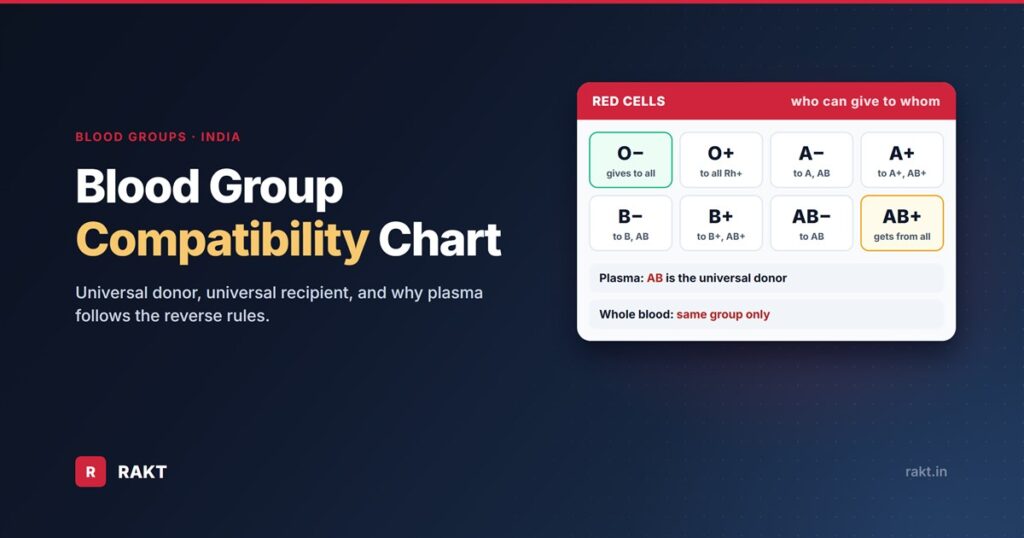
Most people learn one rule about blood groups: O negative is the universal donor. In an Indian blood centre, that rule is only partly true.
It holds for red cells. It does not hold for whole blood, for plasma, or for a patient with the rare Bombay blood group. And O negative is scarce. Only about 5 in 100 Indian blood donors are Rh negative.1
This guide gives the full blood group compatibility chart, component by component, as India’s national rules set it.
Blood Group Compatibility Chart: In Short
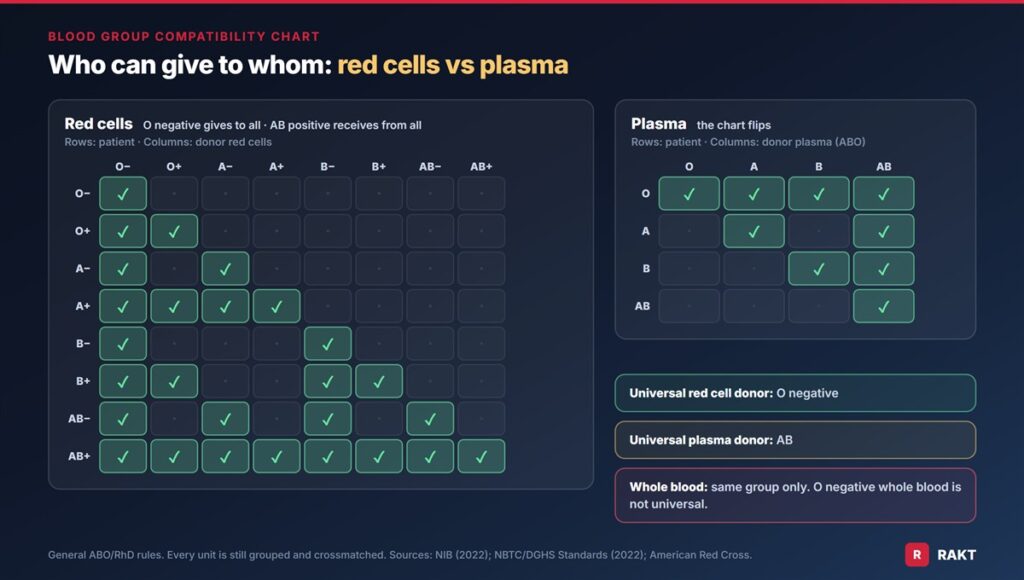
O negative is the universal red cell donor: its red cells can go to a patient of any blood group. AB positive is the universal red cell recipient: it can receive red cells from any group. For plasma, the chart flips, and AB is the universal plasma donor.2, 3
| Blood group | Can give red cells to | Can receive red cells from |
|---|---|---|
| O negative | All groups | O negative only |
| O positive | O positive, A positive, B positive, AB positive | O positive, O negative |
| A negative | A negative, A positive, AB negative, AB positive | A negative, O negative |
| A positive | A positive, AB positive | A positive, A negative, O positive, O negative |
| B negative | B negative, B positive, AB negative, AB positive | B negative, O negative |
| B positive | B positive, AB positive | B positive, B negative, O positive, O negative |
| AB negative | AB negative, AB positive | AB negative, A negative, B negative, O negative |
| AB positive | AB positive only | All groups |
This chart is for red cells only. It follows national guidance and the national standards for blood centres, and every unit is still grouped and crossmatched before it is issued.2, 4
Universal Donor Blood Group: why O Negative
Blood groups depend on antigens on the surface of red cells: A, B and the Rh factor (RhD). A patient’s immune system can attack transfused red cells that carry an antigen it lacks.3
O negative red cells carry none of the three. With nothing for the patient’s antibodies to target, they can be given to any blood group.3 That is why O negative is the blood a blood centre reaches for when there is no time to test the patient’s group. India’s national standards say: give O negative red cells if available, otherwise O positive as a lifesaving measure, and document it.4 Our guide to the massive transfusion protocol covers that emergency.
Three limits to “universal”
- Red cells only. National guidance is clear: whole blood must match the patient’s own group, and O negative whole blood cannot be used as a universal donor.2 Whole blood also carries the donor’s plasma, which follows different rules (see below).
- Not for the Bombay blood group. People with the rare Bombay group cannot receive group O blood. Our Bombay blood group guide explains why.
- A crossmatch is still needed. Blood is released before crossmatching only in a life-saving emergency, on a signed request from the treating doctor, and the full test must still be completed promptly.4
Is O positive a universal donor?
No. O positive red cells can go to any Rh-positive patient, but, as a rule, not to an Rh-negative one (the narrow exception is explained below).2 In India that still covers most patients: about 95 in 100 donors in the first multicentre Indian study were Rh positive.1
Universal Recipient Blood Group: AB Positive
AB positive red cells already carry A, B and RhD, so an AB positive patient can receive red cells from all eight groups. National guidance lists the choices for an AB positive patient in order: AB, then B, then A, then O, positive or negative.2
“Universal recipient” does not mean any bag will do. The patient’s own group comes first. And if the patient has other red cell antibodies, the standards call for units that lack the matching antigens.4
Plasma: The Chart Flips
Red cells carry antigens. Plasma carries antibodies. So for plasma, the rules are the reverse of the red cell chart, and AB is the universal plasma donor.3 India’s national standards say plasma and fresh frozen plasma should be group-specific or compatible with the patient’s red cells, and group-specific in newborns.4
| Patient’s ABO group | Can receive plasma from |
|---|---|
| O | O, A, B, AB |
| A | A, AB |
| B | B, AB |
| AB | AB only |
Group O is the universal red cell donor but can give plasma only to group O patients. Our guide to fresh frozen plasma covers how FFP is used.
Platelets, Cryoprecipitate and whole Blood
| Component | Group rule in India |
|---|---|
| Red cells | ABO and Rh compatible, as in the chart above |
| Whole blood | The patient’s own group only |
| Plasma (FFP) | Compatible with the patient’s red cells (the reverse chart) |
| Platelets | Same ABO and Rh group as far as possible |
| Cryoprecipitate | No ABO or Rh grouping required; group-specific or AB preferred for small children |
| Granulocytes | ABO and Rh specific or compatible, and irradiated |
Platelets: the standards ask for the same ABO and Rh group as far as possible. In a shortage, random donor platelets of any group may be used if there is no visible red cell contamination. For single donor platelets, the plasma should be reduced when the plasma is incompatible, for example group O platelets for a group B patient.4 Our guide to SDP vs RDP platelets explains both types.
Cryoprecipitate: the standards say it does not need ABO or Rh grouping.4 National guidance adds that group-specific cryo is preferred but not mandatory in adults, and that newborns and small children should get group-specific or AB cryo.2 See our cryoprecipitate guide.
Granulocytes must be ABO and Rh specific or compatible, and irradiated.4 Our guide to irradiated blood explains why.
The Rh Factor: Positive and Negative
The “positive” or “negative” in a blood group shows whether the RhD antigen is present. India’s standards say an Rh-negative patient should receive Rh-negative whole blood or red cells, and an Rh-positive patient can receive either.4
There is a narrow exception. National guidance allows Rh-positive red cells for an Rh-negative patient only as a life-saving measure, in post-menopausal women and elderly men, when the antibody screen is negative, and with informed consent taken by the treating doctor.2
India’s Blood Group Mix
The first multicentre study of blood groups in India grouped 9,686 donors at blood centres in five regions of the country.1
| Blood group | Share of Indian donors |
|---|---|
| O | 37.12% |
| B | 32.26% |
| A | 22.88% |
| AB | 7.74% |
| Rh positive | 94.61% |
| Rh negative | 5.39% |
Group O was the most common in every region except the North, where group B was the most common. The Rh-negative share ranged from 4.76% to 7.02% across regions.1
That explains why O negative runs short. It is the group asked for first when a patient’s group is unknown, but only about 1 in 20 Indian donors is Rh negative at all.1, 4 The very rare Bombay group is covered in our Bombay blood group guide.
A Chart is Not a Crossmatch
The chart shows which groups can work in principle. Before a unit is issued, the blood centre groups the patient’s sample, forward and reverse, and tests the unit against it.2, 4 A patient can also carry antibodies outside the ABO and Rh systems that make a “compatible” group unsafe.4
Our guides to forward and reverse blood grouping and the crossmatch test explain both steps.
Group Checked Before Crossmatch, not After
A wrong-group unit at the issue counter is exactly the kind of mistake software should stop before anyone has to notice it. RAKT is built that way:
- A unit’s blood group is checked against the patient’s own grouping before crossmatch, not after.
- Forward and reverse grouping, phenotyping, irregular antibodies and crossmatch compatibility are each recorded against the bag and the request.
- Expiry is checked at allotment, and the same unit cannot be allotted to two requests.
- Emergency release before crossmatch is possible, and it is flagged on the request instead of passing silently.
See how RAKT handles grouping and crossmatch, or book a demo on WhatsApp.
Frequently asked questions
Which blood group is the universal donor?
O negative is the universal red cell donor. Its red cells carry no A, B or RhD antigen, so they can be given to a patient of any blood group. This applies to red cells only, not to whole blood or plasma.
Is O positive a universal donor?
No. O positive red cells can go to any Rh-positive patient (O, A, B or AB positive), but not to Rh-negative patients except in a narrow life-saving exception.
Which blood group is the universal recipient?
AB positive. An AB positive patient can receive red cells from all eight blood groups, although their own group is always the first choice.
Which is the universal plasma donor?
AB. Plasma follows the reverse of the red cell rules, so AB plasma can be given to patients of any ABO group, while group O plasma can go only to group O patients.
Who can O positive donate red cells to?
O positive red cells can go to O positive, A positive, B positive and AB positive patients.
Which blood groups can B positive receive?
A B positive patient can receive red cells from B positive, B negative, O positive and O negative donors.
Can O negative whole blood be given to anyone?
No. India’s national guidance says whole blood must match the patient’s own group, and O negative whole blood cannot be used as a universal donor.
Can an Rh-negative person get Rh-positive blood?
Normally no. National guidance allows it only as a life-saving measure in post-menopausal women and elderly men, when the antibody screen is negative and with informed consent.
What is the most common blood group in India?
Group O, found in about 37% of Indian donors, followed by B (32%), A (23%) and AB (8%). About 95% of Indian donors are Rh positive. In North India, group B is the most common.
What is the rarest blood group?
Among the main groups, AB is the least common in India, at about 8% of donors. The Bombay blood group is far rarer, and its patients cannot receive group O blood.
Sources
- Agrawal A, Tiwari AK, Mehta N, Bhattacharya P, Wankhede R, Tulsiani S, Kamath S. ABO and Rh (D) group distribution and gene frequency; the first multicentric study in India. Asian J Transfus Sci. 2014;8(2):121-125 pmc.ncbi.nlm.nih.gov
- National Institute of Biologicals, Ministry of Health and Family Welfare. Good Blood Transfusion Practices: Guidance for Rational Use of Blood. 2022 nib.gov.in
- American Red Cross. Blood Types Explained. Accessed 20 November 2026 redcrossblood.org
- National Blood Transfusion Council and Directorate General of Health Services, Ministry of Health and Family Welfare. Standards for Blood Centres and Blood Transfusion Services. 2nd edition, 2022 clinicalestablishments.mohfw.gov.in