
Inventory Management · November 13, 2026 · Updated November 14, 2026
Cryoprecipitate: What It Contains, How It Is Made, Stored and Used
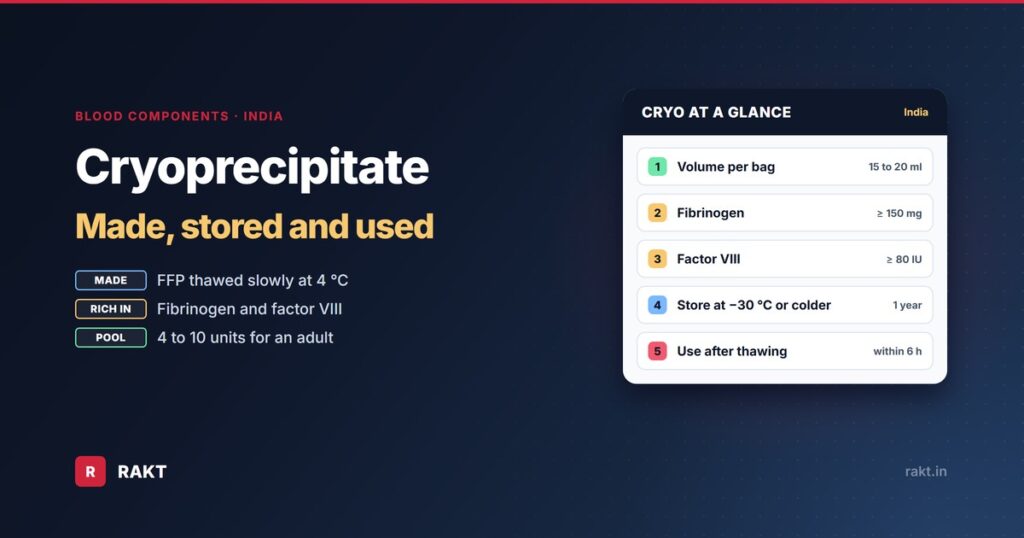
A bag of cryoprecipitate holds only 15 to 20 ml. It is one of the smallest bags in a blood centre, and one of the most misunderstood.
In a recent study at a large teaching hospital in Hyderabad, about 1 in 4 cryoprecipitate transfusions did not meet the guidelines the hospital followed.1 Getting cryo right starts with knowing what is in the bag, and when it actually helps.
This guide explains what cryoprecipitate is, how it is made and stored under Indian rules, its quality limits, how units are pooled, when it is used, and how it differs from fresh frozen plasma.
What is Cryoprecipitate?
Cryoprecipitate is a small blood component made from fresh frozen plasma (FFP). It is rich in fibrinogen, factor VIII, von Willebrand factor and factor XIII. In India, it is stored at minus 30 °C or colder for up to one year, and used mainly to replace fibrinogen.2, 3
The name explains how it is made. “Cryo” means cold. When frozen plasma is thawed slowly in the cold, part of it does not dissolve again. That cold-insoluble part is the “precipitate”, and it is collected as cryoprecipitate.3
| At a glance | Cryoprecipitate |
|---|---|
| Made from | Fresh frozen plasma, thawed slowly at 4 °C |
| Volume per bag | 15 to 20 ml (quality target) |
| Rich in | Fibrinogen, factor VIII, von Willebrand factor, factor XIII, fibronectin |
| Storage | At minus 30 °C or colder, up to 1 year |
| After thawing | Use within 6 hours |
| Crossmatch | Not required |
| Adult dose | Several units pooled together, usually 4 to 10 |
The figures above come from the national standards and national guidance, cited in the sections below.2, 3
What Cryoprecipitate Contains
Cryoprecipitate has a higher concentration, per ml, of five plasma proteins than FFP does.2 Each one has a job in stopping bleeding:
- Fibrinogen. It is turned into fibrin, the mesh that holds a clot together. This is the main reason cryo is given.
- Factor VIII. A clotting factor. People with haemophilia A lack it.
- Von Willebrand factor. It helps platelets stick to a damaged blood vessel, and carries factor VIII in the blood.
- Factor XIII. It makes the fibrin mesh stronger and more stable.
- Fibronectin. A protein that helps cells attach, with a role in wound healing.
So what does cryoprecipitate replace? Mostly fibrinogen. It can also stand in for factor VIII when factor concentrates are not available, and national guidance lists von Willebrand disease and factor XIII deficiency among its uses.2
Indian rules check two of these proteins for quality: each bag must contain at least 150 mg of fibrinogen and at least 80 IU of factor VIII.3, 4
How Cryoprecipitate is Made
Cryo is made from FFP in the blood centre’s component laboratory. The national standards set out the steps:3
- Freeze the plasma fast. A minus 80 °C deep freezer should be used for faster freezing of plasma meant for cryoprecipitate.3, 4
- Thaw it slowly in the cold. Thaw the FFP at 4 °C in a cold room or blood centre refrigerator, or at 4 to 10 °C in a cryobath.3, 4
- Spin and separate at once. Centrifuge the thawed plasma immediately, and separate the cold-insoluble material from it under sterile conditions.3
- Refreeze within 1 hour. The cryoprecipitate should be frozen within 1 hour and kept at minus 30 °C or colder.3
- Keep the plasma left over. The plasma left behind is cryo-poor plasma. It is stored at minus 30 °C or colder and, once thawed, used within 6 hours.3
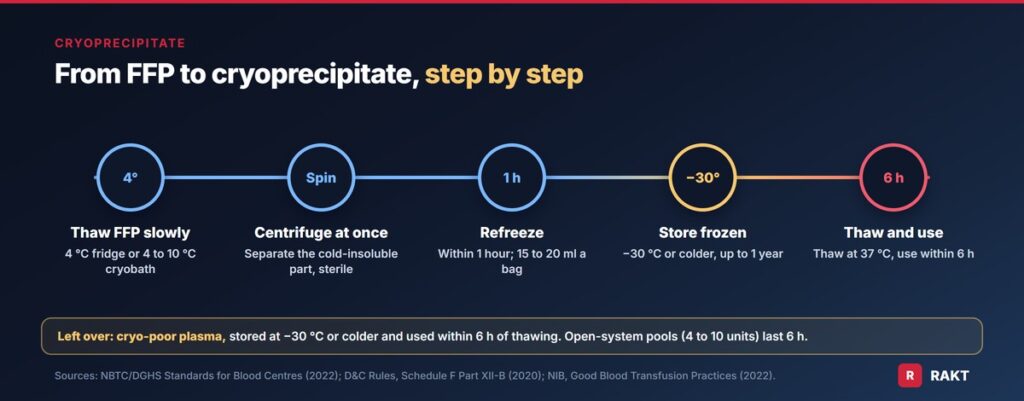
Since their 2020 amendment, the Drugs and Cosmetics Rules list a cryobath among a component laboratory’s equipment.4 Our guide to blood bag types explains which bag sets are used for component separation.
Cryoprecipitate Storage Temperature and Shelf life
| Stage | Temperature | How long |
|---|---|---|
| Frozen storage | At minus 30 °C or colder | Up to 1 year from collection |
| Transport (frozen) | Below minus 20 °C | Keep frozen until it reaches the user |
| Thawing | 37 °C | Use immediately |
| Thawed, not yet used | 2 to 6 °C (national guidance) | Up to 6 hours |
| Pooled in an open system | Room temperature | 6 hours |
The storage limit comes from the Drugs and Cosmetics Rules and the national standards.3, 4 The transport temperature and the 2 to 6 °C holding rule come from national guidance.2 The open-pool limit comes from the standards.3
The simplest rule to remember: once thawed, cryoprecipitate is used within 6 hours, and ideally straight away.2, 3 Our blood storage temperature chart covers every other component.
Pooled Cryoprecipitate
A single bag of cryo is not enough for an adult. So several units are pooled into one bag, either in advance or just before the transfusion.3 The national standards set the rules:
- Number of units: 4 to 10 units per pool.3
- Shelf life: if the pool is made in an open system, using spikes, it lasts 6 hours at room temperature.3, 4
- Label: the same as any cryo unit, plus a unique pool number or the donation numbers of every unit in the pool.3, 4
- Quality: the pool’s targets are the single-unit targets multiplied by the number of units: 80 IU of factor VIII and 150 mg of fibrinogen for each.3
As an example, a pool of 6 units should contain at least 480 IU of factor VIII (6 × 80) and at least 900 mg of fibrinogen (6 × 150).
The donation numbers matter for traceability. If one donor is later found to carry an infection, the blood centre has to find every pool that donor’s plasma went into.
Quality Control Limits for Cryoprecipitate
| Parameter | Limit |
|---|---|
| Volume | 15 to 20 ml |
| Factor VIII | At least 80 IU per bag |
| Fibrinogen | At least 150 mg per bag |
| How many to test | 1% of units made, or 4 units a month, whichever is higher |
| Pass rate | At least 75% of tested units must meet the limits |
These limits come from the national standards and the Drugs and Cosmetics Rules.3, 4 National guidance describes the volume of a cryo bag as about 10 to 20 ml; the 15 to 20 ml range is the quality target.2, 3
How do real units measure up? A blood centre in Kolkata tested 578 cryo units over five years. 93.2% had more than 150 mg of fibrinogen. But only 82.9% had more than 80 IU of factor VIII.5 So about 1 in 6 units fell short on factor VIII, while the centre still met the 75% rule.
That is why trends matter more than a single pass or fail. Factor VIII is fragile, so a falling trend is a prompt to review how the plasma was frozen and thawed. Our guide to the blood component yield report shows how to track these numbers month by month.
When Cryoprecipitate is Used
National guidance lists six uses for cryoprecipitate:2
- Haemophilia A, when factor VIII concentrates are not available.
- Von Willebrand disease.
- Congenital or acquired fibrinogen deficiency, when fibrinogen concentrate is not available or cannot be used.
- Acquired factor VIII deficiency, when factor VIII concentrates are not available.
- Factor XIII deficiency.
- As a source of fibrin glue in surgery, when fibrinogen concentrate is not available or cannot be used.
Notice the pattern. Where a pathogen-inactivated factor concentrate is available, national guidance prefers it for haemophilia A, acquired factor VIII deficiency and fibrinogen deficiency. Cryo is the option when it is not.2
In practice, a large share of cryo goes to surgery. In the Hyderabad study, cardiothoracic surgery used 47% of the units, haematology 38% and surgical gastroenterology 11%.1 About 73% of uses met the British guidelines the hospital followed, which advise cryo when fibrinogen falls below 1 g/L.1 The authors called for stricter guideline use, more training and bedside clotting tests to close the gap.1
How Cryoprecipitate is Transfused
- Thaw at 37 °C and use it at once.3
- No crossmatch is needed.2, 3
- Blood group: matching the ABO group is preferred, but it is not mandatory, especially in adults. For newborns and small children, group-specific or group AB cryo is better. The Rh type can be ignored if there is no red cell contamination.2 The standards say cryo does not need ABO or Rh grouping, and its label need not show them. Our guide to blood bank labels covers what other component labels must show.3
- Speed: transfuse as fast as the patient can tolerate.3 National guidance gives a rate of 150 to 300 ml an hour, with no more than 30 minutes for each unit.2
- No irradiation needed. Cryo is an acellular component, so it does not need irradiation.2
As with any component, watch for reactions during the transfusion. Our guide to blood transfusion reactions covers the signs and what to do at the bedside.
Cryoprecipitate Dose
There is no single number. The dose depends on the patient’s weight, the fibrinogen level and whether they are still bleeding, and it is always set by the treating doctor.
What the Indian standards do say is that one unit is not enough for an adult, and that 4 to 10 units are pooled for a dose.3 National guidance gives one example: for an adult with DIC after a transfusion reaction, 12 units of cryo.2
In the Hyderabad study, fibrinogen rose by about 25 mg/dL on average after a transfusion.1
Cryoprecipitate vs FFP
Both come from the same plasma, but they do different jobs. FFP replaces all the clotting factors, but needs a large volume. Cryo gives fibrinogen and a few other factors in a very small volume.
| FFP | Cryoprecipitate | |
|---|---|---|
| What it is | Whole plasma, frozen quickly | The cold-insoluble part of FFP |
| Volume per bag | 180 to 300 ml | 15 to 20 ml |
| Contains | All the plasma clotting factors | Concentrated fibrinogen, factor VIII, von Willebrand factor, factor XIII, fibronectin |
| Quality target | Factor VIII at least 70 IU per bag | Fibrinogen at least 150 mg and factor VIII at least 80 IU per bag |
| Storage | At minus 30 °C or colder, 1 year | At minus 30 °C or colder, 1 year |
| Blood group | ABO compatible with the patient | ABO and Rh grouping not required |
| Main uses | Bleeding with several clotting factors low, plasma exchange | Low fibrinogen; haemophilia A or von Willebrand disease when concentrates are not available |
The figures come from the rules, the standards and national guidance.2, 3, 4
So when is cryo given instead of FFP? When the main problem is low fibrinogen. Raising fibrinogen with FFP alone would take a large volume of fluid, which can overload the circulation. When several clotting factors are low together, FFP is the usual choice. Our full guide to fresh frozen plasma covers its dose, thawing and uses.
Every Cryo Bag, Traced Back to its Donation
A cryo unit has a short, strict life: refrozen within an hour, stored for a year, used within hours of thawing. Each bag also has to be traced to its donor. On paper, that story is split across separate registers. RAKT keeps it in one record:
- Component preparation records what each bag yielded as CRYO, FFP or cryo-poor plasma, each with its own volume, storage condition and expiry taken from the parent bag.
- Quality control for cryoprecipitate is captured in the register your assessor opens.
- A validated component becomes issuable at Shift To Tested Stock.
See how RAKT tracks component preparation and QC, or book a demo on WhatsApp.
Frequently asked questions
What is cryoprecipitate made from?
Cryoprecipitate is made from fresh frozen plasma. The FFP is thawed slowly at 4 °C, and the part that does not dissolve is separated by centrifuging and refrozen within 1 hour.
What does cryoprecipitate contain?
It is rich in fibrinogen, factor VIII, von Willebrand factor, factor XIII and fibronectin. Indian rules require at least 150 mg of fibrinogen and 80 IU of factor VIII in each bag.
What is the storage temperature of cryoprecipitate?
Cryoprecipitate is stored at minus 30 °C or colder. It is transported frozen, below minus 20 °C.
What is the shelf life of cryoprecipitate?
Up to one year from the date of collection, when stored at minus 30 °C or colder.
How long can thawed cryoprecipitate be kept?
It should be used straight after thawing, and within 6 hours. National guidance allows it to be held at 2 to 6 °C for up to 6 hours if it cannot be transfused at once. An open-system pool lasts 6 hours at room temperature.
Is a crossmatch needed for cryoprecipitate?
No. Cryoprecipitate does not need a crossmatch, and ABO matching is preferred but not mandatory in adults. For newborns and small children, group-specific or group AB cryo is better.
Is cryoprecipitate used for von Willebrand disease?
Yes. National guidance lists von Willebrand disease among the indications for cryoprecipitate, because it is rich in von Willebrand factor.
What is the difference between FFP and cryoprecipitate?
FFP is whole plasma, about 180 to 300 ml, with all its clotting factors. Cryoprecipitate is a 15 to 20 ml concentrate made from FFP, rich in fibrinogen and factor VIII, used mainly for low fibrinogen.
How many units of cryoprecipitate are pooled?
Between 4 and 10 units, under India’s national standards. A pool made in an open system must be used within 6 hours, and its label must carry a pool number or every unit’s donation number.
What is cryo-poor plasma?
It is the plasma left after cryoprecipitate has been removed. It is stored at minus 30 °C or colder and, once thawed, used within 6 hours.
Sources
- Ramini S, Kumar KM, Vujhini SK. From guidelines to bedside: real-world insights into cryoprecipitate utilization and appropriateness in high-volume clinical practice. Perspectives in Medical Research. 2025;13(3):195-202 pimr.org.in
- National Institute of Biologicals, Ministry of Health and Family Welfare. Good Blood Transfusion Practices: Guidance for Rational Use of Blood. 2022 nib.gov.in
- National Blood Transfusion Council and Directorate General of Health Services, Ministry of Health and Family Welfare. Standards for Blood Centres and Blood Transfusion Services. 2nd edition, 2022 clinicalestablishments.mohfw.gov.in
- Drugs and Cosmetics Rules, 1945, Schedule F, Part XII-B, as amended by G.S.R. 166(E), 11 March 2020 cdsco.gov.in
- Das SS, Biswas RN, Sardar TP, Safi M. An insight to the internal quality control of blood components separated using the latest whole blood collection and processing systems: experience from a tertiary care hospital blood transfusion service in Eastern India. Asian J Transfus Sci. 2022;16(2):194-200 pmc.ncbi.nlm.nih.gov