
Blood Bank Software · November 2, 2026 · Updated November 19, 2026
Crossmatch in Blood Bank: Major vs Minor, Procedure and Phases
A unit can be the right blood group and still be wrong for the patient. ABO and RhD grouping only check the antigens everyone talks about. They say nothing about the other antibodies a patient may have picked up from an earlier transfusion or a pregnancy.
These hidden antibodies turn up in Indian patients too. In a study at a government hospital in Chennai, 11 of 1,040 patients tested before transfusion had unexpected red cell antibodies. One of them had a negative antibody screen and was caught only by the crossmatch.1
The crossmatch is the step that catches them. This guide explains what a crossmatch is and how the major and minor crossmatch differ. It then walks through the procedure, the timing and what Indian guidance expects from your blood centre. It is written for technicians, medical officers and nurses, with tables you can use at the bench.
Crossmatch at a Glance
- What it is: the last compatibility test before a red cell transfusion, done for each donor unit.
- Major crossmatch: patient serum against donor red cells. This is the one done today.
- Minor crossmatch: donor serum against patient red cells. It is rarely done now.
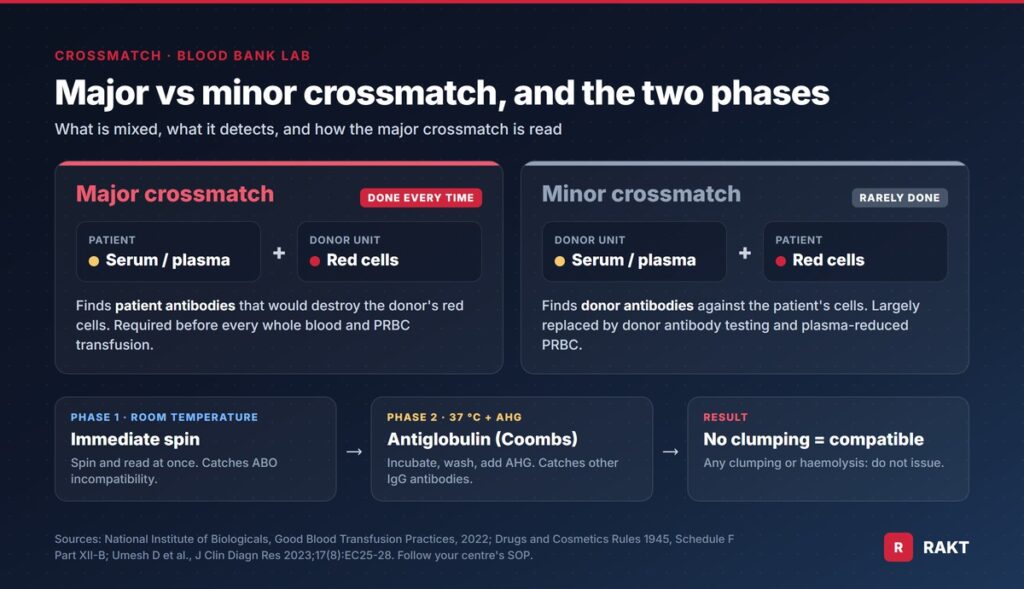
- Phases: immediate spin at room temperature for ABO, then an antiglobulin (AHG) phase at 37 °C for other antibodies.1
- Time: 45 minutes to 1 hour for an AHG crossmatch.1
- Sample validity: send a fresh sample if blood is needed more than 72 hours after collection.2
What is a Crossmatch?
A crossmatch (also called cross matching or compatibility testing) is the final test before a red cell transfusion. The patient’s serum or plasma is mixed with red cells from the donor unit. If there is no clumping (agglutination) or haemolysis, the unit is compatible and can be issued for that patient.
It works as a last check on two things. First, it confirms ABO compatibility between the donor and the patient. Second, it looks for other antibodies in the patient’s blood that would destroy the donor’s red cells.1 National guidance in India lists a crossmatch as required for every whole blood and PRBC transfusion.2
People often confuse crossmatching with blood grouping. The difference is simple:
| Blood grouping | Crossmatch | |
|---|---|---|
| Question it answers | What is the patient’s ABO and RhD group? | Is this particular donor unit safe for this patient? |
| What is tested | Patient’s red cells and serum against reagents | Patient’s serum against the donor unit’s red cells |
| Done how often | On each new sample | For every unit before it is issued |
| Catches other antibodies? | Not designed to (that is the antibody screen’s job) | Yes, in the antiglobulin phase |
One more point avoids confusion. The “HLA crossmatch” or “CDC crossmatch” done before a kidney transplant is a different test. It checks tissue compatibility, not blood compatibility, and is not covered here.
Where the Crossmatch Fits in Pretransfusion Testing
The crossmatch is the last of five pretransfusion tests.1 Each one answers a different question.
- ABO grouping, forward and reverse, on the current sample.
- RhD typing.
- Antibody detection (screening) for unexpected antibodies, using reagent screening cells.
- Antibody identification, if the screen is positive.
- Compatibility testing (crossmatch) with the actual donor unit.
Antibody screening needs reagent cells and expertise that not every Indian centre has.5 Where it is not done, the AHG crossmatch is the only test that looks for these antibodies before issue.
Major vs Minor Crossmatch
The terms major and minor describe which way round the test is done.
| Major crossmatch | Minor crossmatch | |
|---|---|---|
| What is mixed | Patient’s serum or plasma + donor’s red cells | Donor’s serum or plasma + patient’s red cells |
| What it detects | Patient antibodies that would destroy the donor red cells | Donor antibodies that could act on the patient’s red cells |
| Risk it prevents | Haemolytic transfusion reaction, which can be fatal | A smaller risk, because donor plasma is diluted in the patient’s blood |
| Used today? | Yes, before every red cell transfusion | Rarely |
So why has the minor crossmatch faded away? Two reasons. Donor blood is tested for irregular antibodies, and any found are entered on the bag’s master record.3 And most transfusions now use PRBC, which has had most of its plasma removed. The 2022 national crossmatch record format reflects this. It has columns only for the major crossmatch.2
In daily speech, when a doctor or technician says “crossmatch”, they mean the major crossmatch.
Which Blood Components Need a Crossmatch?
Only components that contain red cells need one, because the crossmatch tests red cells.
| Component | Crossmatch | What still matters |
|---|---|---|
| Whole blood | Required | Patient’s own ABO and RhD group only2 |
| Packed red blood cells (PRBC) | Required | Same group, or a compatible group in a set order of choice2 |
| Fresh frozen plasma (FFP) | Not done | ABO-compatible plasma |
| Platelets (RDP or SDP) | Not done | ABO grouping if the bag is contaminated with red cells3 |
| Cryoprecipitate | Not required2 | Group-specific preferred, especially in children |
Our guide to PRBC includes the full table of compatible blood groups for red cell transfusion.
Types of Crossmatch
Not every crossmatch is done the same way. Blood centres choose the method based on how urgent the request is and what the patient’s antibody screen shows.
| Type | What it does | What it catches | Typical use |
|---|---|---|---|
| Immediate spin (saline, room temperature) | Patient serum and donor cells are spun and read straight away | ABO incompatibility1 | Emergencies; patients with a negative antibody screen2, 6 |
| Antiglobulin (AHG or Coombs) crossmatch | Incubated at 37 °C, washed, then anti-human globulin is added | ABO incompatibility plus most clinically significant antibodies1 | Routine crossmatch in Indian centres2 |
| Electronic (computer) crossmatch | Software checks the records instead of mixing samples | ABO incompatibility, using validated rules4 | Patients with no antibodies and two matching group results on record |
| Uncrossmatched emergency issue | Blood is released before testing is complete | Nothing until testing catches up | Life-threatening bleeding, with the clinician’s written consent2 |
The electronic crossmatch needs strict safeguards. The software must block ABO-incompatible units. The patient must have no clinically significant antibodies, now or on record. There must be at least two matching ABO results, one of them from the current sample. And the system must be validated on site.4 India’s national crossmatch record is built around a serological crossmatch, done by tube or gel card.2
The Phases of Crossmatching
The major crossmatch is usually done in two phases. The first catches ABO problems quickly. The second looks for the antibodies that do not show up at room temperature.1
- Immediate spin phase (room temperature). Patient serum and donor cells are mixed in saline, centrifuged at once and read. This phase is designed to pick up ABO incompatibility.1
- Antiglobulin (AHG) phase (37 °C). The same mix is incubated at body temperature, so that warm IgG antibodies can attach to the donor cells. The cells are washed, and anti-human globulin (Coombs reagent) is added. If antibodies have attached, the cells clump. This phase detects unexpected antibodies that the immediate spin phase misses.1 Our guide to the Coombs test explains direct and indirect antiglobulin testing.
Some textbooks describe three phases: room temperature, 37 °C incubation and antiglobulin. In practice, the 37 °C incubation and the AHG reading run as one continuous step. That is why India’s national crossmatch record has two result columns: immediate spin (room temperature) and AHG (37 °C).2
Crossmatch Procedure, Step by Step
The cross matching steps below follow the conventional tube method for a major crossmatch. Gel card (column agglutination) testing follows the same logic, with the incubation and reading done in the card. You will need a calibrated centrifuge, a 37 °C incubator or water bath, normal saline, anti-human globulin reagent, IgG-coated control cells, and test tubes or gel cards. Volumes, cell concentrations and incubation times vary by reagent, so always follow your centre’s SOP and the manufacturer’s instructions.
- Check the request and sample. The requisition must carry the patient’s name, hospital number, age, sex, ward, clinician, the component and quantity needed, urgency, diagnosis, the reason for transfusion and the medical officer’s signature. The sample label must match. Reject mislabelled or haemolysed samples.2
- Group the patient on the current sample. Do ABO forward and reverse grouping and RhD typing.2 Compare the result with any earlier record. If they differ, stop and resolve the discrepancy first. Our guide to blood group discrepancy records covers what to document.
- Screen for antibodies where your centre does so. If the screen is positive, identify the antibody and choose antigen-negative units before crossmatching.
- Select the donor unit. Choose a unit that is ABO and RhD identical or compatible, fully tested, released to tested stock and within its expiry date.
- Prepare the donor cells. Take red cells from the unit’s attached pilot tube or segment and make a weak suspension in normal saline, at the strength your SOP specifies.
- Do the immediate spin. Mix patient serum with the donor cell suspension, centrifuge at once and read for haemolysis or clumping.
- Incubate at 37 °C. Add any enhancement medium your SOP uses, such as LISS, and incubate for the time the manufacturer states.
- Wash and add AHG. Wash the cells several times with saline to remove unbound antibodies. Add anti-human globulin, centrifuge and read.
- Confirm negative results. Add IgG-coated control cells (Coombs control cells) to every negative AHG tube. They should now clump. If they do not, the test is invalid and must be repeated.
- Run an autocontrol. Test the patient’s serum against the patient’s own cells. The national crossmatch record includes this result.2
- Record, label and report. Enter the result in the crossmatch register, label the unit for the named patient and issue a compatibility report with it. Indian rules require the issue register to carry the crossmatch details for every unit issued.3
If your team still copies each result from the crossmatch register into the issue register by hand, that copy is where errors creep in. See how RAKT fills the Crossmatch Register and Issue Register as the work happens.
How to Read Crossmatch Results
| What you see | Meaning | Action |
|---|---|---|
| No clumping, no haemolysis, Coombs control cells clump | Compatible | Unit can be issued for this patient |
| Clumping or haemolysis at immediate spin | Likely ABO incompatibility or a cold antibody | Do not issue. Recheck patient identity and group |
| Clumping only in the AHG phase | An unexpected IgG antibody | Do not issue. Identify the antibody |
| Autocontrol also positive | Patient’s own cells are coated, for example in autoimmune haemolytic anaemia | Further workup by the medical officer |
| Coombs control cells do not clump | Invalid test (for example, poor washing or inactive AHG reagent) | Repeat the test |
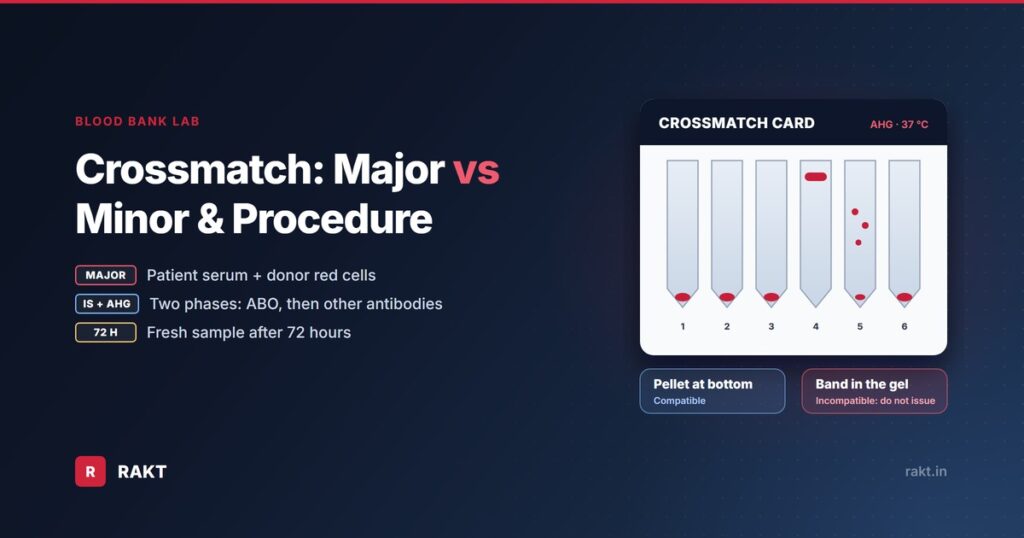
Reactions are graded from 0 (negative) to 4+ (strongest). In a gel card, a negative result shows all the red cells as a pellet at the bottom of the column. A 4+ reaction is a solid band of red cells on top of the gel, and weaker reactions leave clumps spread lower down the column.1 Treat haemolysis as a positive result, even if there is no visible clumping.
How Long Does a Crossmatch Take?
It depends on the method. In the Chennai study:1
- An AHG crossmatch took 45 minutes to 1 hour.
- After a type and screen, blood could be issued in 5 minutes with an electronic check, or 15 minutes with an immediate spin crossmatch.
Real turnaround is longer, because it includes sample transport, grouping and paperwork. Medanta in Gurgaon replaced the full AHG crossmatch with an immediate spin crossmatch after type and screen. Its average time to issue a red cell unit fell from about 80 minutes to about 66 minutes.6
For planned surgery, sending the sample well before the operation avoids this wait. In an emergency, the national guidance allows blood to be issued with an immediate spin crossmatch, with the rest of the testing completed afterwards.2
What to Do When a Crossmatch is Incompatible
An incompatible crossmatch is a stop sign, not a reason to try the next bag at random. Work through it in this order:
- Rule out clerical errors first. Check the patient’s name and number on the form, sample and register. A sample from the wrong patient puts every unit tested against it at risk.
- Repeat the patient’s grouping on the same sample, and on a fresh one if anything looks inconsistent.
- Run the further workup. National guidance lists phenotyping, an antibody screen and identification of the antibody causing the incompatibility.2
- Find antigen-negative units once the antibody is known, and crossmatch them.
- Tell the treating doctor how long compatible blood will take, so that the clinical plan can be adjusted.
- Record everything: the units tested, the reactions, the antibody found and the unit finally issued.
Patients with autoimmune haemolytic anaemia may need a larger sample, 5 to 10 ml, for special techniques such as adsorption and elution.2
Type and Screen vs Crossmatch
Type and screen means grouping the patient and screening their serum for unexpected antibodies, without crossmatching a unit in advance. National guidance describes it as a policy where repeated crossmatches are not needed once the antibody screen shows no irregular antibodies.2 If blood is needed later, it is issued after a quick immediate spin or electronic check.
| Type and screen | Full AHG crossmatch | |
|---|---|---|
| Done before need? | Group and antibody screen only | Specific units tested and reserved |
| Time to issue | 5 to 15 minutes after screening1 | 45 minutes to 1 hour1 |
| Units held back | None | Every crossmatched unit, until it is used or released |
| Main risk in India | Screening cells are imported and may miss antibodies common in Indian patients5 | Slower, and ties up stock |
Indian evidence is mixed, so adopt it carefully. A study at SGPGI Lucknow found unexpected antibodies in roughly 1 in 100 of 2,026 patient requests. Its authors advised caution with type and screen, because the reagent cells are not made from Indian donors.5 The Chennai study found type and screen acceptable, but one patient with a negative screen was still incompatible by AHG crossmatch.1 A centre moving to type and screen should validate it on its own population first.
Rules Indian Blood Centres Must Follow
- The 72-hour rule. If a transfusion is needed more than 72 hours after the sample was taken, send a fresh sample. A recent transfusion or pregnancy can produce new antibodies.2
- Keep the samples. Store patient samples at 4 to 6 °C for seven days after transfusion, so that any reaction can be investigated.2 Our guide to blood transfusion inquiry records covers what to retrieve when a reaction is reported. For the bedside steps and how to report a reaction to the Haemovigilance Programme of India, see our guide to blood transfusion reactions.
- Newborns need the mother’s sample. Blood for a neonate should also be checked against the mother’s serum. If the mother is not available, record that on the requisition.2
- Pilot tubes stay with the unit. One or more pilot sample tubes must stay attached to every PRBC unit in a tamper-proof way.3 Crossmatch from these tubes, so the cells you test come from the unit you issue.
- The issue register carries the crossmatch. The issue register must show the details of the crossmatching report for each unit. Records of components supplied must include the compatibility report.3
- The bedside check uses the compatibility report. Before transfusion, staff must tally the blood unit, the compatibility report and the patient’s details. Any mismatch should be treated as an emergency.2
- Emergency release needs written consent. If blood is issued before full testing, the clinician must sign for it, and every hospital should have an SOP for such cases.2
Reduce Over-Crossmatching with the C:T Ratio
Every crossmatched unit is held for one patient until it is used or released. When doctors order more than they need, good stock sits idle, and other patients wait.
The crossmatch to transfusion (C:T) ratio shows how big the problem is. It is the number of units crossmatched divided by the number actually transfused. A ratio above 2 suggests excessive ordering.7 At a teaching hospital in Chennai, 1,861 red cell units were crossmatched over three months, but only 797 were issued, a C:T ratio of 2.33. Obstetrics and gynaecology had the highest ratio, at 5.14.7
Three practical steps help:
- Calculate the ratio by department every month, alongside your other quality indicator records. It shows where the extra work comes from.
- Agree a maximum surgical blood ordering schedule (MSBOS) with your surgeons. National guidance gives the formula as MSBOS = 1.5 × transfusion index, where the transfusion index is the number of units transfused per patient transfused.2
- Use group and screen for low-risk surgery, where blood is rarely used, once your centre has validated it.
The effect can be large. After Medanta stopped reserving crossmatched units in advance, its C:T ratio fell from 1.94 to about 1.0.6
How RAKT Supports the Crossmatch
On paper, the crossmatch register, the issue register and the compatibility report are written separately. That is where a unit gets issued against the wrong request, or issued before anyone records a crossmatch. RAKT closes those gaps:
- The unit’s blood group is checked against the patient’s own grouping before the crossmatch, not after.
- A unit with no recorded crossmatch cannot be issued. A unit already allotted to one request cannot be allotted to another.
- Grouping and crossmatch results can come straight from analysers such as the Matrix AutoMax-80, landing against the right bag instead of being copied from a printout.
- Emergency release before crossmatch is still possible, because clinically it has to be, but it is flagged on the request instead of passing silently.
- The Crossmatch Register fills itself as the work happens, and the compatibility report prints with the invoice at issue.
See how RAKT handles grouping and crossmatch, or book a demo on WhatsApp to see it on your own registers.
Frequently asked questions
What is a crossmatch test?
A crossmatch, or cross match blood test, is the final compatibility test before a red cell transfusion. The patient’s serum is mixed with red cells from the donor unit. If there is no clumping or haemolysis, the unit is compatible and can be issued for that patient.
What is the difference between a major and a minor crossmatch?
A major crossmatch mixes the patient’s serum with the donor’s red cells, to find patient antibodies against the donor cells. A minor crossmatch mixes the donor’s serum with the patient’s red cells. Today, only the major crossmatch is done routinely.
What are the phases of crossmatching?
The major crossmatch has an immediate spin phase at room temperature, which detects ABO incompatibility, and an antiglobulin (AHG) phase at 37 °C, which detects other clinically significant antibodies. Some textbooks split the 37 °C incubation into a separate third phase.
How long does a crossmatch take?
An AHG crossmatch usually takes 45 minutes to 1 hour in the lab. After a type and screen, blood can be issued in about 5 to 15 minutes. Total turnaround is longer, because it includes sample transport and grouping.
How long is a crossmatch sample valid?
Under Indian guidance, if a transfusion is needed more than 72 hours after the sample was collected, a fresh sample must be sent for crossmatch. A recent transfusion or pregnancy can produce new antibodies.
Is a crossmatch needed for platelets or plasma?
No. A crossmatch is needed only for components that contain red cells, such as whole blood and PRBC. Plasma, platelets and cryoprecipitate are not crossmatched, but ABO compatibility is still considered.
What are the 5 tests before a blood transfusion?
The five pretransfusion tests are ABO grouping, RhD typing, antibody screening, antibody identification when the screen is positive, and the crossmatch with the donor unit.
What is the difference between blood grouping and crossmatching?
Blood grouping finds the patient’s ABO and RhD group. Crossmatching checks whether one specific donor unit is safe for that patient, including antibodies that grouping cannot detect.
What is type and screen?
Type and screen means grouping the patient and screening for unexpected antibodies, without crossmatching units in advance. If the screen is negative, blood can be issued quickly after an immediate spin or electronic check.
Sources
- Umesh D, Sivaramakrishnan A, Naveen Kumar V, Pothipillai A. Type and screen method versus antihuman globulin crossmatch in pretransfusion testing: a cross-sectional study. J Clin Diagn Res. 2023;17(8):EC25-EC28 jcdr.net
- National Institute of Biologicals, Ministry of Health and Family Welfare. Good Blood Transfusion Practices: Guidance for Rational Use of Blood. 2022 nib.gov.in
- Drugs and Cosmetics Rules, 1945, Schedule F, Part XII-B, as amended by G.S.R. 166(E), 11 March 2020 cdsco.gov.in
- Judd WJ. Requirements for the electronic crossmatch. Vox Sang. 1998;74(Suppl 2):409-17 pubmed.ncbi.nlm.nih.gov
- Chaudhary R, Agarwal N. Safety of type and screen method compared to conventional antiglobulin crossmatch procedures for compatibility testing in Indian setting. Asian J Transfus Sci. 2011;5(2):157-159 pmc.ncbi.nlm.nih.gov
- Aggarwal G, Tiwari AK, Arora D, et al. Advantages of type and screen policy: perspective from a developing country. Asian J Transfus Sci. 2018;12(1):42-45 pmc.ncbi.nlm.nih.gov
- Joon V, Robins RDL, Haran AH, Kumar IS, James S. Evaluating the crossmatch-to-transfusion ratio as a tool for analyzing and optimizing blood bank resource utilization. Cureus. 2024;16(9):e69862 pmc.ncbi.nlm.nih.gov