
Blood Bank Software · November 19, 2026
NAT Test in Blood Bank: Full Form, Window Period, ID-NAT vs MP-NAT and Cost in India
A donor gives blood a few days after picking up hepatitis C. He feels fine. His body hasn’t made antibodies yet, so the ELISA test comes back non-reactive. On serology alone, the unit looks safe.
A NAT test on the same sample finds the virus’s genetic material and flags it. The bag, and everything made from it, never reaches a patient.
That gap between infection and a positive antibody test is called the window period. NAT exists to shrink it. This guide explains the NAT test in blood bank screening: what it is, how it works in a blood centre, ID-NAT vs MP-NAT, what it has found in Indian donors, and what it costs.
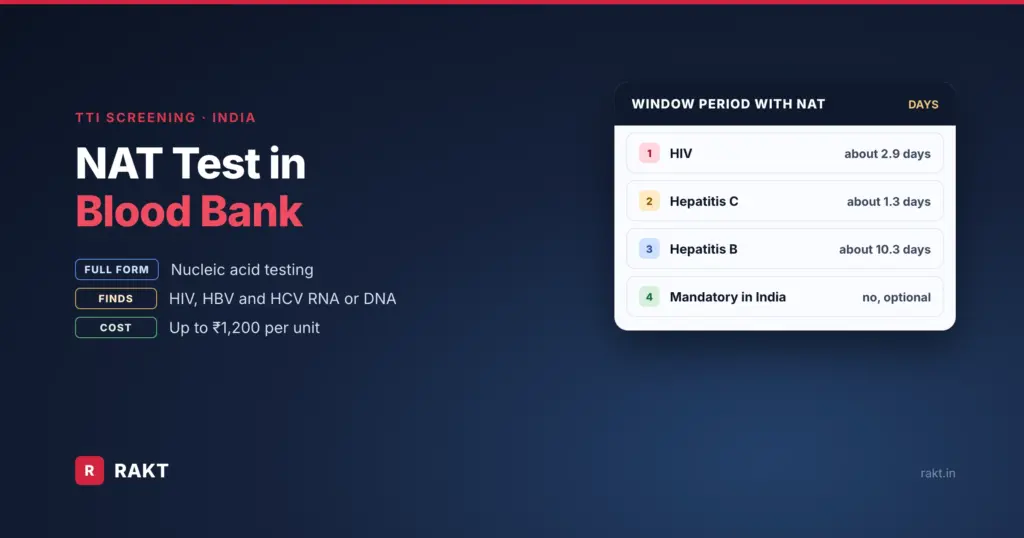
Quick answer: NAT stands for nucleic acid testing. In a blood bank, it screens donated blood for the genetic material (RNA or DNA) of HIV, hepatitis B and hepatitis C. Because it detects the virus itself rather than the body’s response to it, NAT picks up infections earlier than ELISA or CLIA, cutting the window period to about 2.9 days for HIV, 1.3 days for HCV, and 10.3 days for HBV. In India, NAT is optional, not mandatory, and centres may charge up to ₹1,200 per unit for it.
In this guide: NAT full form · Window period · NAT vs ELISA · How it works · ID-NAT vs MP-NAT · NAT yield in India · Is it mandatory? · Cost · FAQs
NAT test full form and what it detects

NAT is short for nucleic acid testing. Nucleic acids are RNA and DNA, the genetic material of a virus.1
A NAT test copies (amplifies) a small, specific part of a virus’s RNA or DNA millions of times, then detects it. If the virus is in the sample, even in tiny amounts, the test finds it.
In blood banks, NAT is used for three viruses:
- HIV-1
- Hepatitis B virus (HBV)
- Hepatitis C virus (HCV)
Tests (assays) that check for all three in one run are called triplex or multiplex NAT.
Why NAT matters: the window period
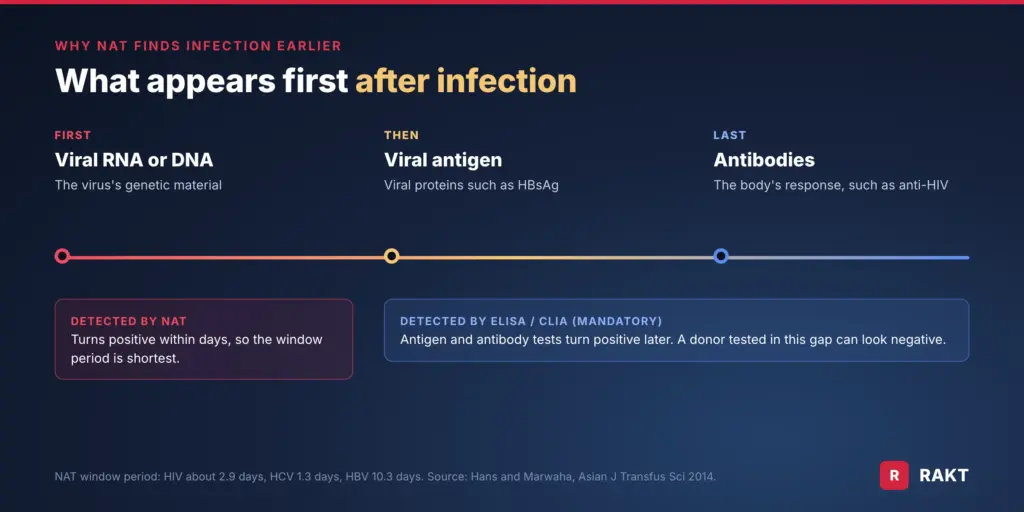
The standard screening tests, called serology (ELISA or CLIA), look for the body’s response to a virus, such as antibodies, or for viral proteins (antigens). Both take time to reach a detectable level after infection. During that time, a donor can be infected while their screening test is still non-reactive. That is the window period.
NAT looks for the virus itself, so it turns positive much sooner. With NAT, the window period drops to:1
| Virus | Window period with NAT |
|---|---|
| HIV | About 2.9 days |
| Hepatitis C (HCV) | About 1.3 days |
| Hepatitis B (HBV) | About 10.3 days |
A shorter window means fewer infected units slip through. That matters most for patients who need blood again and again, such as those with thalassaemia.
NAT vs ELISA and CLIA: the difference
NAT does not replace serology. It adds a layer on top of it.1 Here is the difference between NAT and ELISA at a glance.
| Serology (ELISA, CLIA) | NAT | |
|---|---|---|
| What it detects | Antibodies (anti-HIV, anti-HCV) or antigens (HBsAg) | Viral RNA or DNA |
| How early | After the body responds | Days after infection |
| Mandatory in India | Yes | No |
| Equipment and skills | Standard lab setup | Dedicated lab, instruments and trained staff |
| Cost | Included in the processing charge3 | Up to ₹1,200 extra per unit3 |
NAT also helps with false reactive serology results. A Malaysian study found 1.37% of donor samples reactive on serology but negative on NAT, and confirmatory tests showed they were false reactives.1 That matters when a centre has to notify and counsel the donor.
How the NAT test works in a blood bank
- Sample. A sample tube is collected with the donation, labelled with the same donation number as the bag.
- Extraction. The instrument pulls out the RNA and DNA from the plasma.
- Amplification. A target region of the viral genetic material is copied many times, using methods such as PCR (polymerase chain reaction) or TMA (transcription-mediated amplification).
- Detection. The instrument reads whether the target is present and reports reactive or non-reactive.
- Identify the virus. If a triplex test is reactive, a follow-up (discriminatory) test shows which virus it is.
- Action. A reactive unit, and every component made from it, is quarantined and kept out of stock. The donor is called for notification and counselling as per the centre’s SOP.
The serology results for the same unit are still done and recorded. Our guide to TTI testing records covers what an auditor expects to see for each unit.
ID-NAT vs MP-NAT
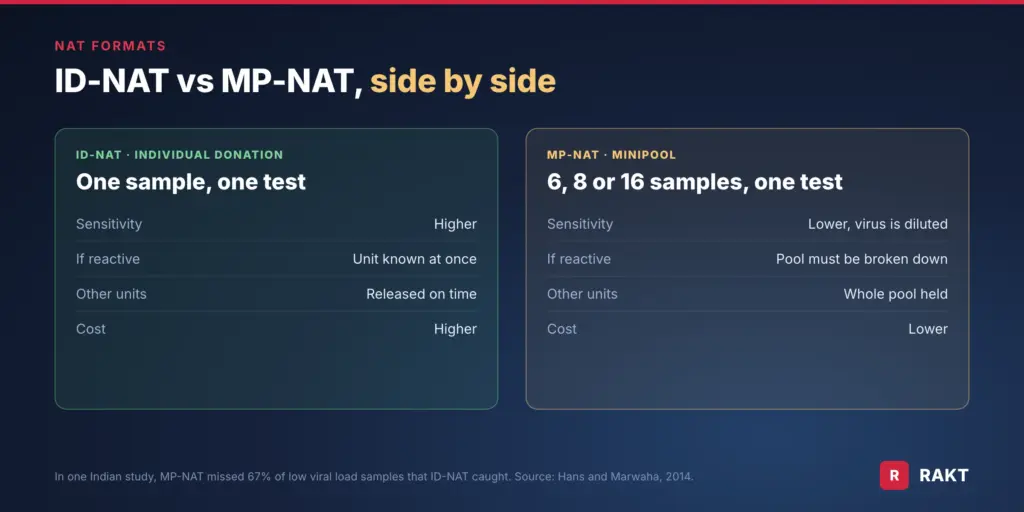
NAT can test each donation on its own, or pool several samples into one test.1
| ID-NAT (individual donation) | MP-NAT (minipool) | |
|---|---|---|
| How it works | Each donation tested on its own | Samples from 6, 8 or 16 donations pooled and tested together |
| Sensitivity | Higher | Lower, because the virus is diluted in the pool |
| If reactive | The unit is known straight away | The pool has to be broken down to find the unit |
| Effect on stock | Other units are released on time | The whole pool is held until the result is clear |
| Cost | Higher | Lower |
The difference is real. In one Indian study, 67% of samples with a low viral load (only a small amount of virus in the blood) were missed by MP-NAT but caught by ID-NAT.1 Most of the Indian studies below used ID-NAT.
Run a blood centre? RAKT records NAT alongside HIV, HBsAg, HCV, VDRL and malaria results for every unit, and a reactive result quarantines the bag and all its components automatically. Book a 30-minute demo on WhatsApp.
NAT yield in India: what NAT has found in donors
“NAT yield” means donations that were negative on serology but positive on NAT. These are the units NAT stopped that serology alone would have let through.
| Study | Donations tested | NAT yield |
|---|---|---|
| SMS Hospital, Jaipur (2019–2021) | 18,313 | 1 in 1,017 |
| Tertiary care centre, New Delhi (published 2013) | 73,898 | 1 in 610 |
| Tertiary care hospital, north India (published 2012) | 18,354 | 1 in 2,622 |
Sources: Sharma et al. 2023 for Jaipur;2 other studies as summarised by Hans and Marwaha, 2014.1
A 2012 study from western India found a combined yield of 1 in 2,972.1
Two patterns stand out. Most NAT yield in India is hepatitis B. In the Jaipur study, HBV yield was 1 in 1,077, HCV 1 in 18,313, and there was no HIV yield.2 And Indian yield is far higher than in countries with lower infection rates. A 10-year US study found an HIV NAT yield of about 1 in 2 million donations.1
Is NAT mandatory in India?
No. Under the Drugs and Cosmetics Act, 1940 and its rules, Indian blood centres must screen every unit for HIV, hepatitis B and hepatitis C using serological tests. NAT is not a mandatory test.12
A growing number of Indian blood centres have added NAT on top of mandatory serology. The main barriers to wider use are cost and the need for a dedicated lab, instruments and trained staff.1
NAT test cost in a blood bank
Under the national guidelines revised in June 2022, a blood centre may add up to ₹1,200 per unit for NAT on top of the standard processing charge.3
The same guidelines say the cost of special tests on a unit of blood can be divided among the components made from it. NAT is run once per donation, so if one donation becomes red cells, plasma and platelets, the ₹1,200 can be split across all three. Each of those components is stored differently, but they share one NAT result.3
So when a hospital offers “NAT tested blood”, it means the unit was screened by NAT in addition to the mandatory tests, and the bill may include a NAT charge.
Limitations of NAT
- It doesn’t close the window to zero. A donor infected a day or two before donating can still test negative.
- It covers three viruses. Syphilis and malaria are still screened by other methods.
- It needs serious setup. Dedicated space, instruments, consumables and trained staff.1
- It is only as good as the system around it. Good donor selection, self-deferral, quality-assured serology and donor counselling come first.1 Our guide to quality control in blood bank covers the checks that sit underneath every screening result.
For blood centres: keep NAT results tied to the unit
Adding NAT adds a second result for every donation. The risk is not the test. It is a NAT result that sits on an instrument printout while the unit has already moved to tested stock, or a reactive donation whose plasma and platelets were never traced.
RAKT keeps every screening result on the unit record:
- NAT in the TTI record. HIV, HBsAg, HCV, VDRL, malaria and NAT results are captured against each bag, with kit lots attached.
- Analyser results read directly. Results posted by the analyser are matched to the bag ID, so nothing is retyped from a printout.
- No release before testing. A unit can’t be allotted until screening is complete. A reactive unit can’t be allotted at all.
- One reactive result, every component quarantined. A reactive result quarantines the bag and every component made from it.
- Two-way traceability. From any component back to the donor, and from the donor to every component.
- TTI Register generated. The register your inspector asks for comes from the same entries.
More than 200 blood centres across 24 states run on RAKT.
See TTI screening in RAKT
Book a 30-minute demo and we will run a unit from bag entry through screening to issue on your own workflow.
Book a demo on WhatsApp, or see lab automation.
Frequently asked questions
What is the full form of NAT in a blood bank?
NAT stands for nucleic acid testing. It screens donated blood for the RNA or DNA of HIV, hepatitis B and hepatitis C.
What is NAT tested blood?
Blood that has been screened by NAT in addition to the mandatory serology tests. It lowers the chance of a window-period infection reaching the patient.
Is NAT better than ELISA?
NAT detects HIV, HBV and HCV earlier than ELISA because it finds the virus itself. But it doesn’t replace ELISA or CLIA. Serology is still mandatory in India, and NAT is added on top.
What is the window period for NAT?
About 2.9 days for HIV, 1.3 days for HCV and 10.3 days for HBV, according to published modelling.
Is NAT testing mandatory in India?
No. Serological screening for HIV, HBV and HCV is mandatory under the Drugs and Cosmetics Rules. NAT is optional and is used by a growing number of centres.
What is the cost of NAT test in a blood bank?
Under the 2022 national guidelines, blood centres may charge up to ₹1,200 per unit for NAT. The charge can be split across the components made from the same donation.
What is the difference between ID-NAT and MP-NAT?
ID-NAT tests each donation separately and is more sensitive. MP-NAT pools 6 to 16 samples to save cost, but dilutes the virus and needs extra testing to find the reactive unit.
What is NAT yield?
The share of donations that are negative on serology but positive on NAT. In Indian studies it ranges from about 1 in 600 to 1 in 3,000 donations, mostly hepatitis B.
Is NAT done on every blood unit in India?
No. NAT is optional in India, so it depends on the blood centre. Every unit must still be screened by serology for HIV, hepatitis B and hepatitis C. Ask the centre if you need NAT tested blood.
Does NAT test for syphilis and malaria?
No. Blood bank NAT covers HIV, HBV and HCV. Syphilis and malaria are screened with other mandatory tests.
What happens if a donation is NAT reactive?
The unit and all its components are quarantined and kept out of stock. The donor is notified and counselled as per the centre’s SOP.
Sources
- Hans R, Marwaha N. Nucleic acid testing: benefits and constraints. Asian J Transfus Sci. 2014;8(1):2–3 pmc.ncbi.nlm.nih.gov
- Sharma A, Bundas S, Parashar R. NAT yield in blood donors: an observational study. J Family Med Prim Care. 2023;12(11):2763–2767 pmc.ncbi.nlm.nih.gov
- Directorate General of Health Services, Ministry of Health and Family Welfare. Revised Guidelines-2022 for Recovery of Processing Charges for Blood and Blood Components, F.No. IM 11012/07/2022/NBTC, 14 June 2022 eraktkosh.mohfw.gov.in