
Compliance & Accreditation · November 16, 2026 · Updated November 18, 2026
Blood Price in India: 1 Unit Cost and Processing Charges for Every Component
A family is told the patient needs two units of blood. The counter asks for ₹3,100. The first question is usually the same: wasn’t this blood donated for free?
It was. Blood is not sold in India. What you pay is a processing charge, the cost of collecting, testing, separating and storing each unit, and the government caps it.
This guide explains blood bank charges in India: the national rate for every component, the extras a blood centre can add, and who gets blood at no charge.
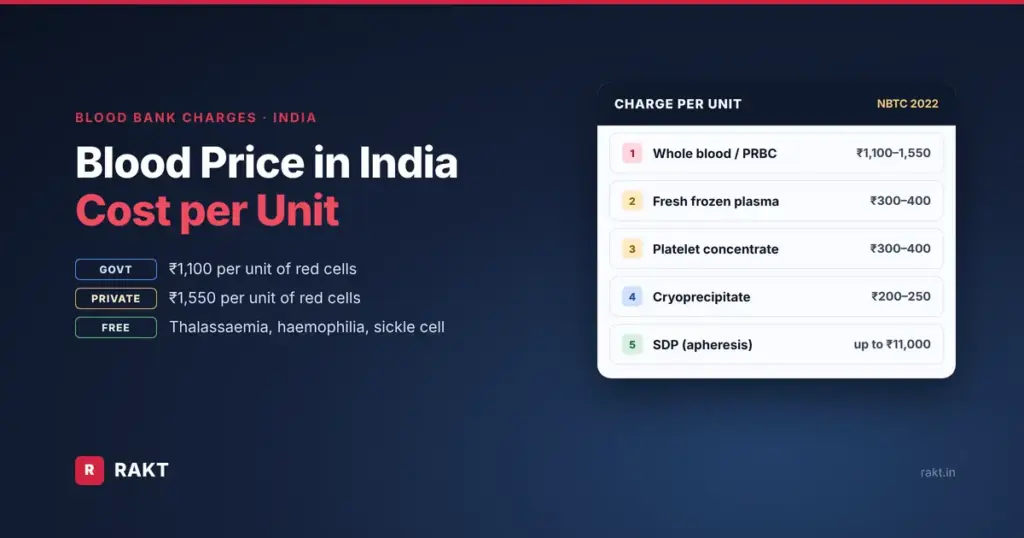
Quick answer: Under the national guidelines revised in June 2022, one unit of whole blood or packed red cells costs ₹1,100 at a government blood centre and ₹1,550 at a non-government blood centre. Fresh frozen plasma and platelet concentrate cost ₹300 (government) or ₹400 (non-government). Cryoprecipitate costs ₹200 or ₹250. Single donor platelets (SDP) can cost up to ₹11,000. Patients with thalassaemia, haemophilia, sickle cell anaemia and other blood disorders that need repeated transfusions pay no processing charge.
In this guide: Rate list by component · 2, 3 or 4 units · Allowed extras · Already included · Platelet price · Who gets blood free · How to check your bill · FAQs
Why you pay for blood that was donated free
A donor gives blood without payment. Turning that donation into a safe unit is what costs money.
Every unit has to be collected in a sterile bag, screened for HIV, hepatitis B, hepatitis C, syphilis and malaria, grouped, often separated into components, and stored at the right temperature until it is issued. Reagents, test kits, blood bags, equipment and trained staff all go into it.
The Drugs Controller General of India put it plainly in a December 2023 letter to state regulators: blood is “not for sale”, and a blood centre may only recover processing cost.3 The amount it can recover is set by the National Blood Transfusion Council (NBTC) and the Directorate General of Health Services (DGHS).
1 unit blood price in India: blood bank rate list by component
The current national rates come from the DGHS letter dated 14 June 2022, “Revised Guidelines-2022 for Recovery of Processing Charges for Blood and Blood Components”.1 They replaced the first guidelines issued in February 2014.
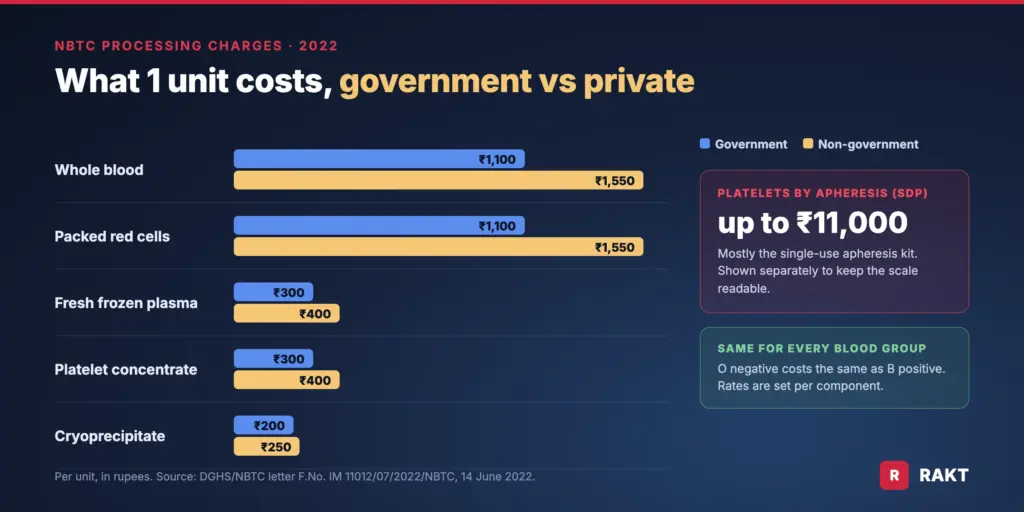
The rates differ by who runs the blood centre, not by blood group.
| Blood or component | Government blood centre | Non-government blood centre |
|---|---|---|
| Whole blood | ₹1,100 | ₹1,550 |
| Packed red cells (PRBC) | ₹1,100 | ₹1,550 |
| Fresh frozen plasma (FFP) | ₹300 | ₹400 |
| Platelet concentrate (RDP) | ₹300 | ₹400 |
| Cryoprecipitate | ₹200 | ₹250 |
| Platelets by apheresis (SDP) | Up to ₹11,000 | |
Per unit. Source: DGHS/NBTC letter F.No. IM 11012/07/2022/NBTC, 14 June 2022.1 Non-government centres include private, charitable and trust-run blood centres.
Some states issue their own orders on top of the national guidelines, so a state rate list can differ. If a centre’s rate looks off, ask which notification it follows.
Run a blood centre? RAKT reconciles processing charges, concessions and refunds against the units you actually issue, so billing and your Issue Register come from the same record. Book a 30-minute demo on WhatsApp.
What 2, 3 or 4 units of blood cost
Multiply the unit rate. For red cells or whole blood:
| Units | Government blood centre | Non-government blood centre |
|---|---|---|
| 1 unit | ₹1,100 | ₹1,550 |
| 2 units | ₹2,200 | ₹3,100 |
| 3 units | ₹3,300 | ₹4,650 |
| 4 units | ₹4,400 | ₹6,200 |
These are base charges. Special tests or processing, covered below, are added per unit.
Does the blood group change the price?
No. O negative, B positive and AB positive all carry the same processing charge. The guidelines set rates by component, not by group.
A rare group can be harder to find, and that can mean calling more blood centres. It does not make the unit more expensive.
Extra charges a blood centre is allowed to add
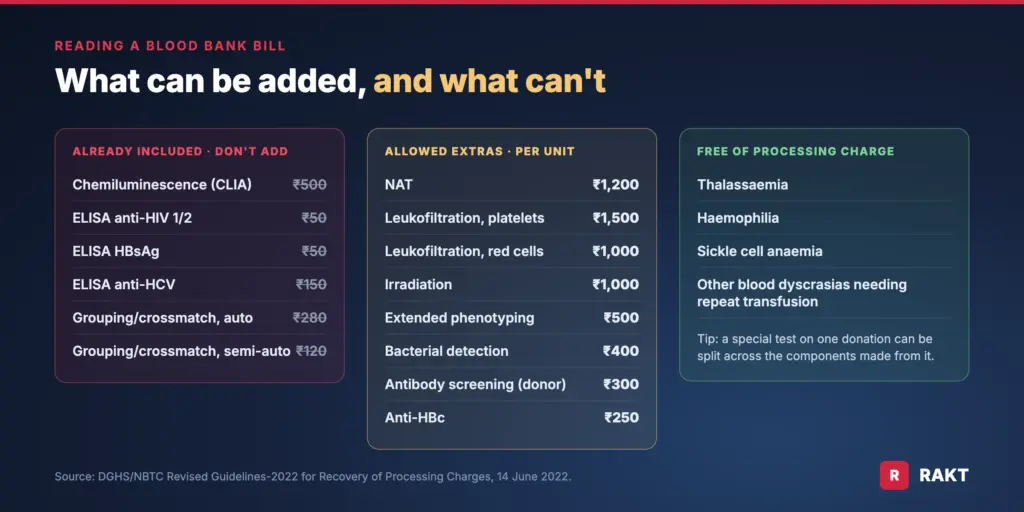
The guidelines list some tests and processes as specialised, not part of routine processing. If a unit goes through one of them, the blood centre can add its charge:1
| Test or process | Charge per unit | What it does |
|---|---|---|
| NAT (nucleic acid testing) | ₹1,200 | Detects viral genetic material, shortening the window period for HIV, HBV and HCV |
| Anti-HBc | ₹250 | Extra hepatitis B marker |
| Antibody screening (donor) | ₹300 | Checks donor plasma for unexpected red cell antibodies |
| Leukofiltration, red cells | ₹1,000 | Removes white cells to reduce some reactions |
| Leukofiltration, platelets | ₹1,500 | Same, for platelets |
| Phenotyping for extended serology | ₹500 | Matches more antigens, used for patients on regular transfusion |
| Irradiation | ₹1,000 | Prevents transfusion-associated graft-versus-host disease in at-risk patients |
| Bacterial detection | ₹400 | Screens platelets for bacterial contamination |
| Platelets (apheresis) | ₹11,000 | Single donor platelets collected on a cell separator |
One rule matters here. The guidelines say the cost of special tests on a unit of blood can be divided among the components made from that unit. NAT is run once per donation, not once per bag. If one donation becomes red cells, plasma and platelets, the ₹1,200 can be split across all three.
Charges that are already included
The same table lists some items with an asterisk and a note: no charge should be added for them, because they are already factored into the processing charge.1
- Chemiluminescence (CLIA) screening, listed at ₹500
- ELISA for anti-HIV 1/2, HBsAg and anti-HCV (4th generation), listed at ₹50 to ₹150
- Grouping and crossmatching, automated or semi-automated, listed at ₹120 to ₹280
If a bill shows any of these as a separate line on top of ₹1,100 or ₹1,550, ask why.
Platelet price: RDP vs SDP
Platelets cause the most confusion, because the two types are priced very differently.
- Random donor platelets (RDP) are separated from a whole blood donation. One unit costs ₹300 or ₹400. An adult dose usually needs several units pooled together.
- Single donor platelets (SDP) are collected from one donor on an apheresis machine. One SDP is roughly equal to a pool of several RDPs. It can cost up to ₹11,000, largely because of the single-use apheresis kit.
During dengue season, SDP requests rise sharply. We cover when each is used, and the dose, in SDP vs RDP platelets.
Who gets blood free
All blood centres, government and non-government, must provide blood and components without processing charges to patients with:24
- Thalassaemia
- Haemophilia
- Sickle cell anaemia
- Other blood dyscrasias (disorders of the blood) that need repeated transfusions
Keep the patient’s diagnosis papers or registration card with the blood request. Government schemes can add to this list. Janani Shishu Suraksha Karyakram (JSSK), for example, covers free blood for pregnant women at public health facilities. Check your state’s order or ask the blood centre.
A worked example: reading a ₹2,950 bill
A patient at a private hospital needs one unit of leukofiltered, NAT-tested red cells. The non-government blood centre makes red cells, plasma and platelets from each donation.
| Line | Amount |
|---|---|
| Packed red cells, processing charge | ₹1,550 |
| NAT, ₹1,200 split across 3 components | ₹400 |
| Leukofiltration, red cells | ₹1,000 |
| Grouping and crossmatch | ₹0 (already included) |
| Total | ₹2,950 |
If the centre charged the full ₹1,200 for NAT on the red cells alone, the total would be ₹3,750. The guidelines allow the split, which is why two centres can charge different amounts for the same bag.
Why the hospital bill can show more
The processing charge is what the blood centre bills for the unit. A hospital bill can carry other lines, such as the transfusion set, bedside monitoring or room charges. Those are hospital charges, not blood charges.
If you are unsure, ask for the blood centre’s own receipt. It should show the component, the unit number and the processing charge.
How to check you were charged correctly
- Ask whether the centre is government or non-government. That decides ₹1,100 or ₹1,550 for red cells.
- Match each line to a component. Whole blood, PRBC, FFP, platelets and cryo each have their own rate.
- Look for extras. NAT, leukofiltration, irradiation and phenotyping are allowed, but each should be named.
- Look for included items. Screening tests and grouping or crossmatch should not be added on top.
- Check for exemptions. Thalassaemia, haemophilia, sickle cell anaemia and other blood dyscrasias mean no processing charge.
- Escalate if needed. Raise it with the blood centre’s medical officer first. If it isn’t resolved, contact your State Blood Transfusion Council or the state drugs control department.
For blood centres: charge the right amount on every unit
Overcharging complaints usually start with a mismatch. The rate card says one thing, the receipt says another, and nobody can show which unit the charge was for.
RAKT ties billing to the unit record, so the charge comes from the same entry as the issue.
- Processing charges on every issue. The charge is recorded against the unit and component issued, not typed into a separate ledger.
- Concessions and waivers. Record a waiver for a thalassaemia or haemophilia patient against the request, under a named user.
- Replacement donor accounting. Track replacement donations against the patient they were given for.
- Reconciled financial summaries. Processing charges, concessions, refunds and outstanding amounts, matched to units actually issued.
- Hospital Wise Consumption. See what each requesting hospital took, returned and still owes.
- Audit trail. Every change to a record is logged with the old value, the new value, who changed it and when.
The same record feeds your Issue Register, your eRaktKosh submission and your MIS reports, so finance and the lab never work from different numbers. More than 200 blood centres across 24 states run on RAKT.
See RAKT billing on your own rate card
Book a 30-minute demo and we will run it on your own workflow, from blood request to issue and receipt.
Book a demo on WhatsApp, or talk to us.
Frequently asked questions
What is the price of 1 unit of blood in India?
Blood is not sold, but there is a processing charge. Under the 2022 national guidelines it is ₹1,100 per unit of whole blood or packed red cells at government blood centres and ₹1,550 at non-government centres.
What is the cost of 2 units of blood?
₹2,200 at a government blood centre and ₹3,100 at a non-government centre, for whole blood or packed red cells. Special tests such as NAT or leukofiltration are added per unit.
What is the price of 1 unit of platelets?
A random donor platelet unit costs ₹300 at government and ₹400 at non-government centres. A single donor platelet (SDP) unit collected by apheresis can cost up to ₹11,000.
What is the price of fresh frozen plasma?
₹300 per unit at government blood centres and ₹400 at non-government centres. Cryoprecipitate costs ₹200 and ₹250.
Is O negative blood more expensive?
No. The processing charge is the same for every blood group. Rare groups can be harder to find, but the rate does not change.
Can a blood bank charge extra for NAT testing?
Yes. The guidelines allow ₹1,200 per unit for NAT. The cost can be divided among the components made from the same donation.
Who gets blood free of cost in India?
Patients with thalassaemia, haemophilia, sickle cell anaemia and other blood dyscrasias that need repeated transfusions must get blood and components without processing charges at every blood centre.
Is selling blood legal in India?
No. Blood is for supply, not for sale. Blood centres can recover only the processing charge, and the Drugs Controller General of India reminded states of this in December 2023.
What is the price of 1 unit of blood in a private hospital?
If the blood comes from a non-government blood centre, the processing charge cap is ₹1,550 per unit of whole blood or red cells, against ₹1,100 at government centres. A hospital bill may also include transfusion sets, monitoring and room charges, which are not blood charges.
Where can I complain about overcharging for blood?
Start with the blood centre’s medical officer. If that doesn’t resolve it, contact your State Blood Transfusion Council or the state drugs control department, which is the licensing authority for blood centres.
Sources
- Directorate General of Health Services, Ministry of Health and Family Welfare. Revised Guidelines-2022 for Recovery of Processing Charges for Blood and Blood Components, F.No. IM 11012/07/2022/NBTC, 14 June 2022 eraktkosh.mohfw.gov.in
- The Tribune. “Union Govt revises processing charges for blood components.” 22 June 2022 tribuneindia.com
- Blitz India Media. “Hospitals, blood banks can only charge processing fees for blood: Govt.” 4 January 2024 blitzindiamedia.com
- The Health Master. “DCGI to blood centres: comply with revised guidelines for recovery of processing charges.” 6 January 2024 thehealthmaster.com