
Blood Bank Software · November 4, 2026 · Updated November 13, 2026
How to Organise Blood Donation Camp in India: Permissions, Staff and Checklist
Someone in your office or college says, “Let’s hold or organise blood donation camp.” Everyone agrees. Then the questions start. Do we need government permission? Who brings the beds and the bags? What if only fifteen people turn up on the day?
These questions have well-worn answers, because camps are routine work for licensed blood centres. In 2025-26, Punjab alone held 6,583 blood donation camps, and the state collected 5,44,167 units of blood, about 92% of it from voluntary donors.1
The good news: as the host, you do not run the medical side. A licensed blood centre does that. Your job is the venue, the donors and the publicity. This guide shows who does what, the rules that apply, a three-week plan, and free letter templates you can copy.
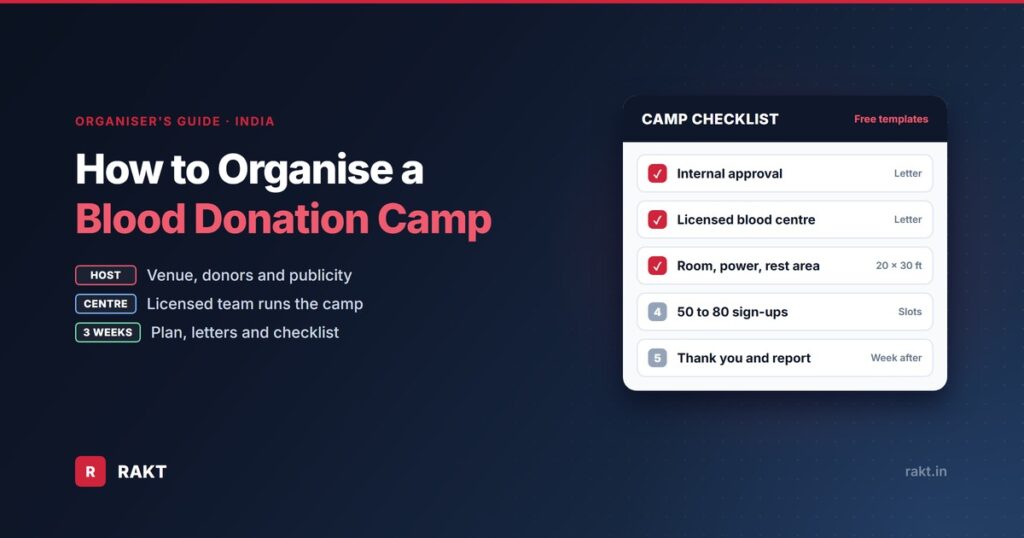
How to Organise a Blood Donation Camp: Short Answer
To organise a blood donation camp in India, partner with a licensed blood centre. The centre runs the camp: its medical officer, nurses and technicians screen donors and collect the blood. You, the host, provide a clean, well-lit room, gather 50 or more willing donors and handle the publicity. Plan for about three weeks.
The five steps, in order:
- Get approval from your management, principal or committee.
- Book a licensed blood centre for your date, three to four weeks ahead.
- Prepare the venue: space, power, furniture and a rest area.
- Bring in donors with a sign-up form, time slots and reminders.
- Follow up: thank donors and report the results.
Who Can Legally Run a Blood Donation Camp?
A company, college, housing society or club cannot collect blood itself. Under the Drugs and Cosmetics Rules, a blood donation camp may be organised by:2
- a licensed designated Regional Blood Transfusion Centre;
- a licensed government blood centre;
- the Indian Red Cross Society; or
- a licensed blood centre run by a registered voluntary or charitable organisation recognised by the State or Union Territory Blood Transfusion Council.
CDSCO’s own FAQs add hospital blood centres, including those of private hospitals.3 In practice, this means you host the camp, and a licensed blood centre runs it.
Host vs Blood Centre: Who Does What
| Task | You, the host | The blood centre |
|---|---|---|
| Approval | Internal approval from your management, principal or committee | Its licence, and any reporting to regulators |
| Venue | A clean, well-lit room with power, water and a rest area | Confirms the space suits its team |
| Donors | Publicity, sign-ups and reminders | Screening and the final decision on who can donate |
| Staff | Volunteers for the help desk and refreshment area | Medical officer, nurses or phlebotomists, technicians, counsellors and attendants |
| Equipment | Tables, chairs and power points | Donor beds, blood bags, testing kits, emergency kit and cold chain |
| After the camp | Thank-you messages and your internal or CSR report | Testing and processing the blood, and donor records |
Permissions You Need to Organise a Blood Donation Camp
Most hosts need fewer permissions than they expect, because the regulated part belongs to the blood centre.
- Your own organisation’s approval. Get a written yes from your management, principal or society committee before you fix a date. A template is below.
- A request to the blood centre. Write to the centre with your proposed date, venue and expected number of donors. A template is below.
- Regulatory steps belong to the centre. Government blood centres, Regional Blood Transfusion Centres and the Red Cross must tell the licensing authorities the camp venue and the group-wise units collected within seven days.2 If your state has its own camp registration process, the centre handles that too.
- Public spaces. If the camp is in a market, park or other public place rather than your own premises, ask the local authority whether you need permission to use the space.
Donors can search upcoming camps by state and district on the eRaktKosh camp schedule, and many camps accept online pre-registration.4 Ask your blood centre whether it will list your camp there. Our eRaktKosh guide explains the rest of the portal.
What the Blood Centre Brings
The rules fix the minimum team for an outdoor camp. To collect blood from 50 to 70 donors in about 3 hours, or 100 to 120 donors in about 5 hours, the centre needs:2
| Role | Number |
|---|---|
| Medical officer | 1 |
| Nurses or phlebotomists, for 6 to 8 donor tables | 2 |
| Counsellors or medical social workers | 2 |
| Blood centre technicians | 3 |
| Attendants | 2 |
| Vehicle seating 8 to 10 people, with space for camp supplies | 1 |
The centre also brings the equipment: blood pressure apparatus, blood bags, a haemoglobin meter, weighing scales for donors and bags, blood grouping reagents, an emergency medical kit and insulated containers that keep the bags between 2 and 10 °C.2 You do not need to buy or arrange any of it.
Blood Donation Camp Venue Requirements: Complete Checklist
The rules list what a camp site must have.2 Walk through your venue with this list before you confirm the date:
- enough space, in a clean and hygienic location;
- continuous power for the centre’s equipment, so ask for generator or inverter backup;
- good lighting for every activity;
- hand-washing facilities for staff;
- a reliable phone or mobile network link to the blood centre;
- furniture arranged within the space;
- refreshment facilities for donors and staff;
- a private corner for the medical examination;
- a plan for waste disposal, agreed with the centre.
Each blood centre also sets its own practical minimums, so ask for its list. As an example, Rashtrotthana Blood Centre in Bengaluru asks organisers for a room of at least 20 by 30 feet, with 3 to 4 tables and 20 to 25 chairs. It also asks for at least one power point for its equipment, drinking water, and at least 200 ml of drink for each donor.5 Confirm early who provides the refreshments, you or the centre.
A ground-floor room, or one with a lift, makes it easier for the team to carry equipment in. Blood centres check sites against a similar list, which our guide to blood donation camp site assessment covers in detail.
Set up the room in donor order
Arrange the space so donors move one way, without doubling back:
- Registration at the entrance, with your sign-up list and the donor questionnaire.
- Screening: a private corner where the team checks haemoglobin, weight and blood pressure, and the medical officer talks to each donor.
- Donation beds, placed near power points.
- Rest and refreshments, where donors sit for a while before leaving.
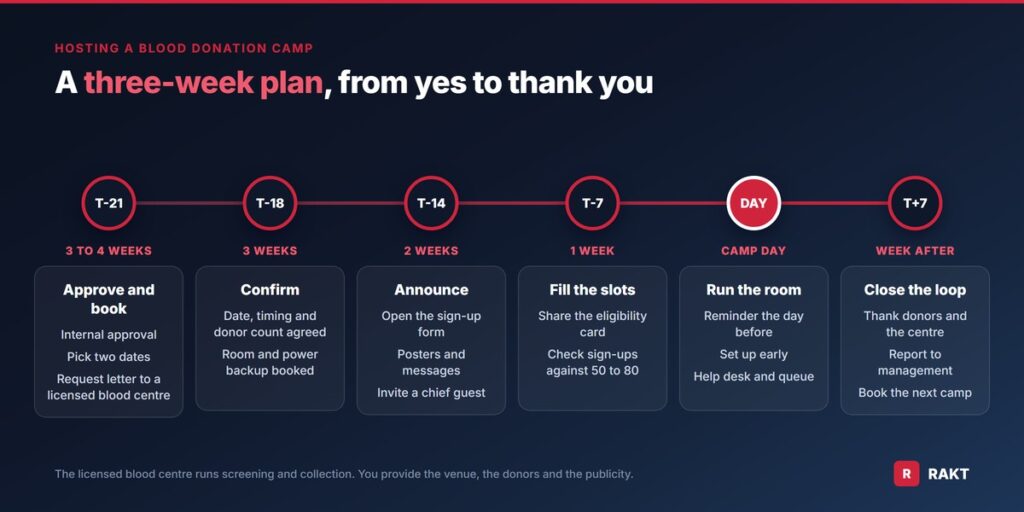
A Three-Week Plan For Your Camp
| When | What to do |
|---|---|
| 3 to 4 weeks before | Get internal approval. Pick two possible dates. Contact a licensed blood centre and send the request letter. |
| 3 weeks before | Confirm the date, timing and expected donor count with the centre. Book the room and the power backup. |
| 2 weeks before | Announce the camp. Open a sign-up sheet or form. Invite your chief guest, if you want one. |
| 1 week before | Share the donor eligibility card. Check sign-ups against your target and push harder if you are short. |
| 1 day before | Send a reminder with the time, venue and “eat a proper meal” tip. Arrange refreshments and volunteers. |
| Camp day | Set up the room before the team arrives. Run the help desk and the queue. |
| Within a week after | Thank donors and the centre. Share the results with your management. |
Three to four weeks matters because a blood centre schedules its mobile team in advance. Shorter notice is sometimes possible, but nearby teams may already be booked for your date.
No blood centre contact yet? RAKT can match you with a licensed centre near you, at no cost to your organisation.
How to Get 50 or More Donors
In RAKT’s experience arranging camps, most licensed centres want 50 to 80 likely donors before they commit a mobile team. If you are short, combine two floors, two nearby offices or two housing societies into one camp. Not everyone who signs up will be able to donate, because the medical officer screens each person on the day. So aim higher than the number you need.
- Use a sign-up form, not a show of hands. Names and phone numbers let you send reminders and spread people across time slots.
- Remind twice. Once the day before and once on the morning of the camp.
- Book time slots. Sixty people arriving in the same ten minutes means long waits and early walk-outs.
- Ask leaders to donate first. A head of department or principal in the donor chair is the best poster you will make.
- Share the eligibility card early, so people who cannot donate do not take a slot.
Donor eligibility card
Share these basics with your sign-ups. The medical officer makes the final decision at the camp.2
- Age: 18 to 65 years. First-time donors should not be over 60.
- Weight: at least 45 kg.
- Haemoglobin: 12.5 g/dL or more. The camp team checks this on the spot.
- Food: do not come fasting. Eat a meal at least 4 hours before donating.
- Alcohol: no signs of intoxication on the day.
- Night shift: do not donate after a night shift without adequate sleep.
- Drivers and heavy work: this covers long-distance drivers, air crew, emergency services and strenuous jobs. These donors should not donate within 24 hours before their next shift.
- Gap since last donation: at least 3 months (90 days) for men and 4 months (120 days) for women.
Free Letter Templates for Blood Donation Camps
Copy these, replace the parts in square brackets, and print them on your letterhead.
1. Letter to blood bank for blood donation camp
To,
The Medical Officer In-charge,
[Name of blood centre],
[Address]
Subject: Request to conduct a voluntary blood donation camp on [date]
Dear Sir or Madam,
[Organisation name] would like to host a voluntary blood donation camp at [venue address] on [date], between [start time] and [end time]. We expect about [number] willing donors from our [employees / students / residents].
We will provide a clean, well-lit hall of about [size], with power backup, drinking water, a rest area and volunteers. We request your team to conduct the camp, including donor screening and blood collection.
Please confirm whether this date suits your team, and let us know anything else you need from us. Our contact person is [name], [phone], [email].
Yours sincerely,
[Name]
[Designation], [Organisation name]
2. Permission letter (application) to organise a blood donation camp
Use this to ask your principal, HR head or society secretary. In a school, students under 18 cannot donate, so plan the camp around staff, parents and alumni.
To,
The [Principal / HR Head / Secretary],
[Organisation name]
Subject: Permission to organise a voluntary blood donation camp
Respected Sir or Madam,
We request your permission to organise a voluntary blood donation camp on [date] in [room or hall], from [start time] to [end time]. A licensed blood centre, [name of centre], has agreed to conduct the camp with its own medical team and equipment.
We need the hall, power backup and about [number] volunteers for the day. Donation is voluntary, and the blood centre’s medical officer will screen every donor.
We would be grateful for your approval, and for your support in encouraging participation.
Yours sincerely,
[Name]
[Designation / Department / Class]
3. Invitation letter for chief guest
Dear [Name],
[Organisation name] is holding a voluntary blood donation camp on [date] at [venue], in partnership with [name of blood centre]. We would be honoured if you could join us as chief guest at [time] to open the camp and meet our donors.
Your presence will encourage more people to donate. Please let us know if you can attend. Our contact is [name], [phone].
With regards,
[Name]
[Designation], [Organisation name]
4. Blood donation camp invitation (WhatsApp or email)
🩸 Blood donation camp on [date], [time], at [venue].
Run by [name of blood centre].
One donation can help save lives. Keep about [time] free for registration, screening, donation and rest.
Before you come: eat a proper meal at least 4 hours before, and do not come after a night shift without sleep.
Book your slot: [form link]
Ask the blood centre how long its process takes from registration to rest, and fill in the time to match.
5. Blood donation camp banner text
- Main line: Voluntary Blood Donation Camp
- Second line: [Organisation name] with [name of blood centre]
- Details: [Date] · [Time] · [Venue]
- Short slogan: “Your blood can save a life today.”
Keep the banner short enough to read from across a corridor. Put the date and time in the largest text after the title.
Camp-Day Checklist
- Room open, cleaned and set up at least 30 minutes before the team arrives.
- Power backup tested, and enough sockets near the donor tables.
- A help desk at the entrance with the sign-up list, so donors are called in their slots.
- Drinking water and refreshments ready for donors after donation.
- Volunteers to guide donors, and one person who stays with the blood centre’s team lead all day.
- A quiet corner where a donor who feels faint can lie down. The centre’s staff manage any reaction.
- Photos only with each donor’s consent.
To-dos After the Camp
- Thank people within two days: donors, volunteers, the blood centre team and your management.
- Certificates: ask the centre how donor certificates will be issued.
- Your report: note the date, the number who registered, the number who donated and any feedback. That is the report your management or CSR team will ask for.
- Book the next one: donors can give whole blood again after 90 days (men) or 120 days (women),2 so a quarterly camp works well for the same group.
Want RAKT to Arrange The Camp For You?
Finding a centre with a free team on your date is usually the hardest part. RAKT is blood bank software used by 200+ blood centres across India, and it can do that coordination for you:
- It matches you with a licensed blood centre near you that has capacity on your date.
- It agrees the setup with you and the centre, so nothing is discovered on the morning.
- It runs pre-registration and the queue on the day.
- It sends you a report afterwards: who registered, who attended, and a certificate for each donor.
What RAKT does not do: it does not collect, test or store blood. The licensed blood centre does all of that, and its medical team alone decides who can donate. Coverage is best in cities where RAKT’s blood centres are. If no centre is free for your city and date, RAKT will tell you quickly.
Hosting is free for your organisation. Tell us your city, venue and headcount in a 2-minute form, and RAKT will come back within one working day.
Run a blood centre? 5,883 camps have been run on RAKT to date. Donors are registered on a tablet, bags are labelled on site, and every collection is reconciled into stock the same day. See how RAKT runs camps, and read our guides to camp documentation and camp adverse reaction records.
Frequently asked questions
Can a company or college organise a blood donation camp?
Yes, as the host. The camp itself must be run by a licensed blood centre, such as a government or Red Cross blood centre, a recognised charitable centre or a hospital blood centre. The host provides the venue and the donors.
Do we need government permission to hold a blood donation camp?
The host usually needs only its own organisation’s approval. The licensed blood centre handles the regulatory side, including any reporting to licensing authorities or the State Blood Transfusion Council. For a public venue, check with the local authority.
How many donors are needed for a blood donation camp?
Most licensed blood centres want 50 to 80 likely donors before they send a mobile team. Sign up more people than you need, because some will not pass screening on the day.
Does it cost anything to host a blood donation camp?
When RAKT arranges the camp, hosting is free for your organisation, and donating is free for donors. Some blood centres ask the host to provide tables, chairs and drinks for donors, so confirm this with the centre in advance.
Can a school organise a blood donation camp?
Yes, as the host, with a licensed blood centre running it. Students under 18 cannot donate, so the donors are usually teachers, staff, parents and alumni.
How long does a blood donation camp take?
A standard camp team can collect blood from 50 to 70 donors in about 3 hours, or from 100 to 120 donors in about 5 hours.
How much space is needed for a blood donation camp?
Many blood centres ask for a room of at least 20 by 30 feet, with power, good lighting, hand-washing facilities and space for registration, screening, donation and rest. Ask your centre for its exact requirements.
How do I write a letter to a blood bank for a blood donation camp?
Address it to the medical officer in charge. Give the proposed date and time, the venue, the expected number of donors, what you will provide, and a contact person. A ready template is in this guide.
Who can donate blood at a camp?
Donors should be 18 to 65 years old, or up to 60 for a first donation. They need to weigh at least 45 kg, have haemoglobin of 12.5 g/dL or more, and have eaten a meal at least 4 hours before. The camp’s medical officer makes the final decision.
How often can someone donate blood?
Whole blood can be donated once every three months (90 days) by men and once every four months (120 days) by women.
Sources
- Punjab blood donation ranks third nationally. UNI, 2 October 2026 uniindia.com
- Drugs and Cosmetics Rules, 1945, Schedule F, Part XII-B, section II (Blood Donation Camps) and criteria for blood donation, as amended by G.S.R. 166(E), 11 March 2020 cdsco.gov.in
- Central Drugs Standard Control Organisation. Blood Centre Division: frequently asked questions cdsco.gov.in
- Ministry of Health and Family Welfare, C-DAC. eRaktKosh FAQs and camp schedule. eRaktKosh portal, accessed 4 November 2026 eraktkosh.mohfw.gov.in
- Rashtrotthana Blood Centre, Bengaluru. Minimum requirements for blood donation camp bloodcentre.rashtrotthana.org