
Blood Bank Software · November 17, 2026
Blood Donation Eligibility Criteria in India: Age, Weight, Haemoglobin, Gap and Deferrals
A 19-year-old walks up to the desk at a college blood donation camp. He is healthy and keen. Ten minutes later he is turned away, because he got a tattoo eight months ago.
That rule isn’t the camp being strict. It comes from the national donor selection criteria, and every licensed blood centre in India follows the same list.
This guide walks through the blood donation eligibility criteria in India in plain language: who can donate, how often, and how long to wait after a tattoo, a vaccine, an illness or a pregnancy.
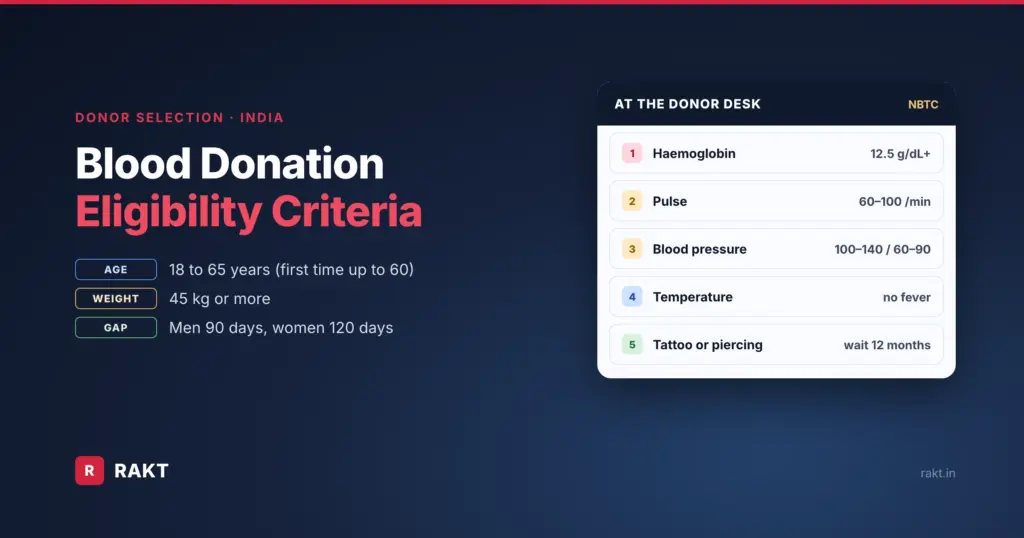
Quick answer: In India, you can donate blood if you are 18 to 65 years old (up to 60 for a first donation), weigh at least 45 kg, have haemoglobin of at least 12.5 g/dL, a pulse of 60 to 100, and blood pressure between 100–140 systolic and 60–90 diastolic. Men can donate whole blood every 90 days and women every 120 days. A tattoo or piercing means a 12-month wait.
In this guide: Basic criteria · Age limit · Weight · Haemoglobin · Donation gap · How long to wait · Rules for women · Medicines · Permanent deferrals · FAQs
Where these rules come from
Donor selection in India is set by the Drugs and Cosmetics Rules, 1945, Schedule F Part XII-B, as amended in March 2020.2 The Directorate General of Health Services (DGHS) publishes them in its Guidelines for Voluntary Blood Donation, with criteria revised by its Technical Resource Group and approved by the National Blood Transfusion Council (NBTC) in December 2024.1
The rules protect two people. The donor, who should not be harmed by giving blood. And the patient, who should not get an infection or a reaction from it.
The final call is always made by the blood centre’s medical officer after a short check-up.
Blood donation eligibility criteria in India: who can donate blood
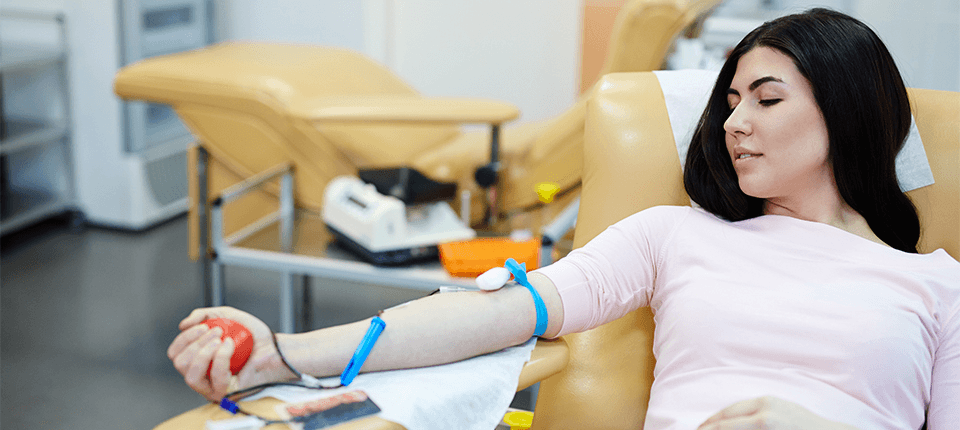
Every donor goes through the same checks at the desk.1
| Check | What you need |
|---|---|
| Age | 18 to 65 years. First-time donors up to 60. |
| Weight | At least 45 kg (for 350 ml). 55 kg or more for 450 ml. |
| Haemoglobin | At least 12.5 g/dL |
| Pulse | 60 to 100 beats per minute, regular |
| Blood pressure | Systolic 100 to 140 mm Hg, diastolic 60 to 90 mm Hg |
| Temperature | No fever. Oral temperature not above 37°C |
| General health | In good health, mentally alert and physically fit |
| Gap since last donation | 90 days for men, 120 days for women (whole blood) |
Pass these, answer the donor questionnaire, sign the consent form, and the medical officer clears you.
Blood donation age limit
The minimum age is 18. The maximum is 65.1
There is one catch. If you have never donated before, the upper limit is 60. A regular donor can keep going until 65, but a first donation after 60 is not accepted.
For apheresis (platelet or plasma donation on a machine), the age range is 18 to 60. Our guide to SDP vs RDP platelets explains how single donor platelets are collected.
The limits are the same for men and women.
Weight: 45 kg for 350 ml, 55 kg for 450 ml
Blood bags come in two common sizes, and your weight decides which one you can fill.1
- 45 kg or more: you can give 350 ml.
- 55 kg or more: you can give 450 ml.
- Apheresis: at least 50 kg.
Below 45 kg, you can’t donate whole blood. The amount taken would be too large a share of your total blood volume.
Minimum haemoglobin to donate blood
Haemoglobin is the protein in red cells that carries oxygen. Before you donate, the centre checks it, usually with a drop of blood from a finger prick. It must be at least 12.5 g/dL, for men and women alike.1
Low haemoglobin is a common reason donors are turned away, especially women. It is a temporary deferral. Once your level is back up, you can donate.
People with thalassaemia trait (carriers, not thalassaemia major) can donate if their haemoglobin meets the limit.
Blood donation gap: how often you can donate
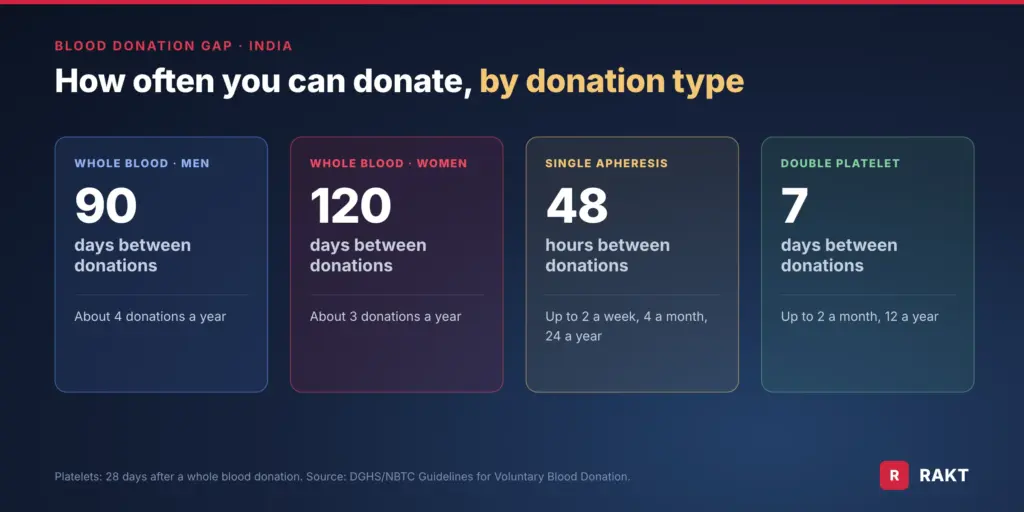
Your body needs time to rebuild what you gave. The minimum gap depends on what you donated.1
| Donation type | Minimum gap | Limits |
|---|---|---|
| Whole blood, men | 90 days | About 4 times a year |
| Whole blood, women | 120 days | About 3 times a year |
| Single platelet or plasma apheresis | 48 hours | Up to 2 a week, 4 a month, 24 a year |
| Double plateletpheresis | 7 days | Up to 2 a month, 12 a year |
| Platelets after a whole blood donation | 28 days | None |
| Whole blood after platelet apheresis | 7 days | 90 days if your red cells were not returned |
Run a blood centre? RAKT flags a donor who gave blood too recently before the bag is collected, so the gap rule is checked every time. Book a 30-minute demo on WhatsApp.
Temporary deferrals: how long to wait
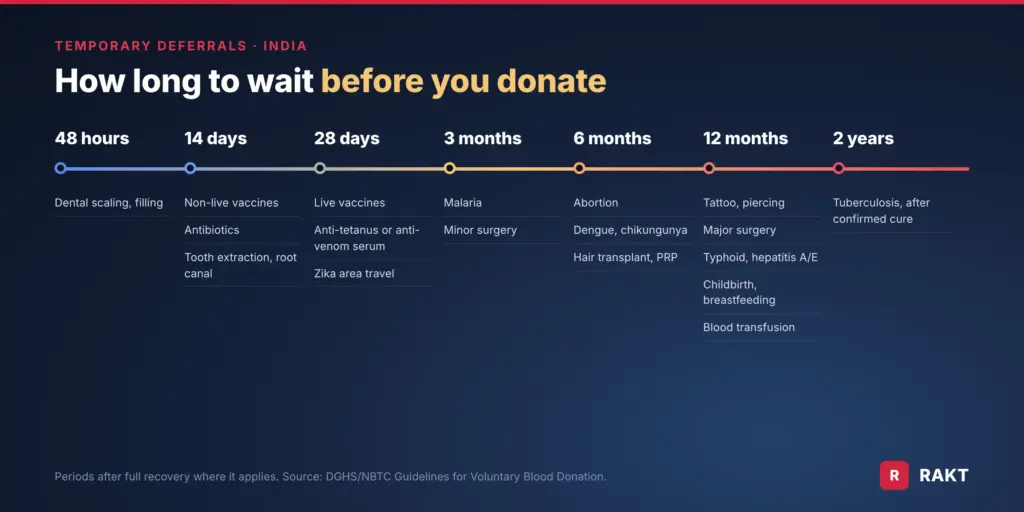
A deferral means “not today”. Most are temporary. Here are the waiting periods for the common ones.1
Tattoos, piercing and procedures
| Reason | Wait |
|---|---|
| Tattoo, piercing, acupuncture, scarification or invasive cosmetic procedure (you or your partner) | 12 months |
| Hair transplant, PRP therapy or skin grafting | 6 months after recovery |
| Minor surgery | 3 months after recovery |
| Major surgery | 12 months after recovery |
| Received a blood transfusion (or your partner did) | 12 months |
| Dental scaling or filling | 48 hours |
| Tooth extraction or root canal | 14 days |
| Dental bone graft or reconstruction | 12 months |
Vaccines
| Vaccine | Wait |
|---|---|
| Non-live vaccines and toxoids (including non-live COVID-19 vaccines) | 14 days |
| Live attenuated (weakened live) vaccines | 28 days |
| Anti-tetanus, anti-venom, anti-diphtheria or anti-gas gangrene serum | 28 days |
| Rabies vaccine after an animal bite, hepatitis B immunoglobulin, other immunoglobulins | 1 year |
Illness and infections
| Illness | Wait |
|---|---|
| Cold, flu, cough or sore throat | Until symptoms clear and there is no fever |
| Diarrhoea in the past week | 2 weeks after full recovery and last medicine |
| Measles, mumps or chickenpox | 2 weeks after full recovery |
| Malaria | 3 months after full recovery |
| Dengue, chikungunya or Zika | 6 months after full recovery |
| Travel to a Zika outbreak area | 28 days |
| Typhoid | 12 months after full recovery |
| Hepatitis A or E | 12 months |
| Jaundice from an acute cause | 1 year after the cause is treated |
| Tuberculosis | 2 years after confirmed cure |
Blood donation rules for women
The basic criteria are the same for women. A few rules apply only to women:1
- Gap between donations: 120 days, not 90.
- Periods: you can’t donate while menstruating. You can donate once your period is over.
- Pregnancy: not during pregnancy, and not for 12 months after delivery.
- Breastfeeding: not for 12 months after delivery.
- Abortion or miscarriage: wait 6 months.
Haemoglobin is the main hurdle for many women donors. Eating well in the weeks before a camp helps.
Medicines, blood pressure and diabetes
Many common medicines are fine. Oral contraceptives, painkillers, vitamins, mild sedatives, allopurinol and cholesterol-lowering drugs do not stop you from donating.1
Some need a wait:
- Antibiotics: 2 weeks after the last dose, if you are well.
- Aspirin or other NSAIDs: 3 days, if your blood will be used for platelets.
- Clopidogrel, ticlopidine, piroxicam or dipyridamole: 2 weeks after the last dose.
- Isotretinoin (for acne) or finasteride: 1 month after the last dose.
- Dutasteride: 6 months after the last dose.
High blood pressure: you can donate if your reading is within 100–140 / 60–90, with or without medicine, and your medicine or dose hasn’t changed in the last 28 days.
Diabetes: you can donate if it is well controlled with diet or tablets and your dose hasn’t changed in the last 4 weeks. Diabetics on insulin cannot donate.
Thyroid: you can donate if you have a benign thyroid condition, have no symptoms on medicine, and your dose hasn’t changed in 8 weeks.
Asthma: you can donate if you have no symptoms and take a non-steroid maintenance dose. Not during a flare-up or while on oral or injected steroids.
Permanent deferrals: who cannot donate blood

Some conditions rule out blood donation for good, to protect either the donor or the patient. The national criteria list these, among others:1
- Heart attack, coronary artery disease, hypertensive heart disease, or open-heart or bypass surgery
- Cancer, including past cancer surgery
- Hepatitis B or C, or being the partner or close contact of someone with it
- HIV, syphilis or gonorrhoea, or being the partner of a person living with HIV
- Chronic kidney disease or kidney failure, chronic liver disease or liver failure
- Bleeding disorders or an unexplained bleeding tendency
- Diabetes treated with insulin
- Severe chronic lung disease
- Autoimmune disorders such as lupus or scleroderma
- Epilepsy with an organic cause (others can donate after 3 years seizure-free and off medicine)
- Schizophrenia
- Organ, stem cell or tissue transplant recipients
- Leprosy and leishmaniasis
- Groups the guidelines treat as high risk for HIV, and people who inject drugs
If you are unsure about a condition, tell the medical officer at the desk. They decide, not the form.
Food, sleep and alcohol before donating
- Eat first. Don’t donate on an empty stomach. Have your last meal about 4 hours before.
- Sleep. Night-shift workers who haven’t slept enough should not donate.
- No alcohol. You must not have been drinking or show signs of intoxication. The rule doesn’t set a fixed number of hours, so if you drank the night before, tell the medical officer.
- After donating: drink plenty of fluids, avoid heavy work, and don’t smoke or drive straight away.
What happens at the donation desk
- Registration. Your details are recorded and checked against your past donations.
- Questionnaire. You answer the donor questionnaire about health, medicines, travel and recent procedures.
- Check-up. Weight, pulse, blood pressure, temperature and haemoglobin.
- Consent. You sign, or give a thumb impression, on the written consent.
- Medical officer’s decision. Accepted, or deferred with a reason and a date you can come back.
If you are deferred, ask for the reason and the date. A temporary deferral is not a “no” for life.
For blood centres: apply the same rules at every desk
The criteria are national. The hard part is applying them the same way at a busy counter and at a camp with 200 donors in a day. A missed tattoo question or a donor who gave blood six weeks ago at another centre is easy to miss on paper.
RAKT Pass puts the donor desk on a tablet:
- Questionnaire and deferral reasons. The Annexure questionnaire and deferral reasons are on screen, so every donor gets the same questions.
- Vitals recorded at the desk. Weight, pulse, blood pressure and haemoglobin, with the medical officer’s sign-off.
- Too-recent donors flagged. A donor inside the 90 or 120 day gap is flagged before collection.
- Deferrals across centres. With ABHA, a donor’s past deferrals and donation history show up across centres in your network.
- Next-eligibility reminders. Donors get a thank-you, a certificate and a reminder when they can donate again.
- Labels on site. Bag labels print at the camp, and collections reconcile into centre stock the same day.
Each deferral is recorded against the donor with its reason, so it is there when the donor comes back. We cover what a complete deferral record needs in donor deferral records.
More than 200 blood centres across 24 states run on RAKT, with 5,883 camps run through it.
See RAKT Pass at your next camp
Book a 30-minute demo and we will run donor registration and screening on your own workflow.
Book a demo on WhatsApp, or see camp management.
Frequently asked questions
Who can donate blood in India?
Anyone aged 18 to 65 (up to 60 for a first donation) who weighs at least 45 kg, has haemoglobin of at least 12.5 g/dL, normal pulse and blood pressure, no fever, and passes the donor questionnaire and medical officer’s check.
What is the age limit for blood donation in India?
18 to 65 years. First-time donors are accepted only up to 60. For platelet or plasma apheresis, the range is 18 to 60.
What is the minimum weight to donate blood?
45 kg to give 350 ml, and 55 kg to give 450 ml. Apheresis donors need to weigh at least 50 kg.
What is the gap between two blood donations?
90 days for men and 120 days for women for whole blood. Platelet or plasma apheresis can be repeated after 48 hours, up to 24 times a year.
Can I donate blood after a tattoo?
Yes, 12 months after the tattoo. The same 12-month wait applies to piercing, acupuncture and invasive cosmetic procedures, for you or your partner.
Can I donate blood during periods?
No. Women are deferred while menstruating and can donate once the period is over, if they meet the other criteria.
Can I donate blood after drinking alcohol?
Not if you have been drinking or show any sign of intoxication. The rules don’t set a fixed number of hours, so tell the medical officer when you last drank.
Can I donate blood if I have high blood pressure?
Yes, if your reading is between 100–140 systolic and 60–90 diastolic on the day, with or without medicine, and your medicine or dose hasn’t changed in the last 28 days.
Can diabetics donate blood?
Yes, if diabetes is well controlled with diet or tablets and the dose hasn’t changed in the last 4 weeks. People on insulin cannot donate.
Can I donate blood after the COVID-19 vaccine?
Yes. Wait 14 days after a non-live vaccine and 28 days after a live attenuated vaccine.
What is the minimum haemoglobin to donate blood?
12.5 g/dL for both men and women. The centre checks it before you donate, usually with a finger-prick test.
Sources
- Directorate General of Health Services, Ministry of Health and Family Welfare, with the National Blood Transfusion Council. Guidelines for Voluntary Blood Donation (donor selection criteria approved by NBTC, December 2024) mohfw-dohfw.gov.in
- Drugs and Cosmetics Rules, 1945, Schedule F, Part XII-B, as amended by G.S.R. 166(E), 11 March 2020 cdsco.gov.in