
Blood Bank Software · October 31, 2026 · Updated November 20, 2026
PRBC Full Form: Packed Red Blood Cells, Storage, Shelf Life and Uses
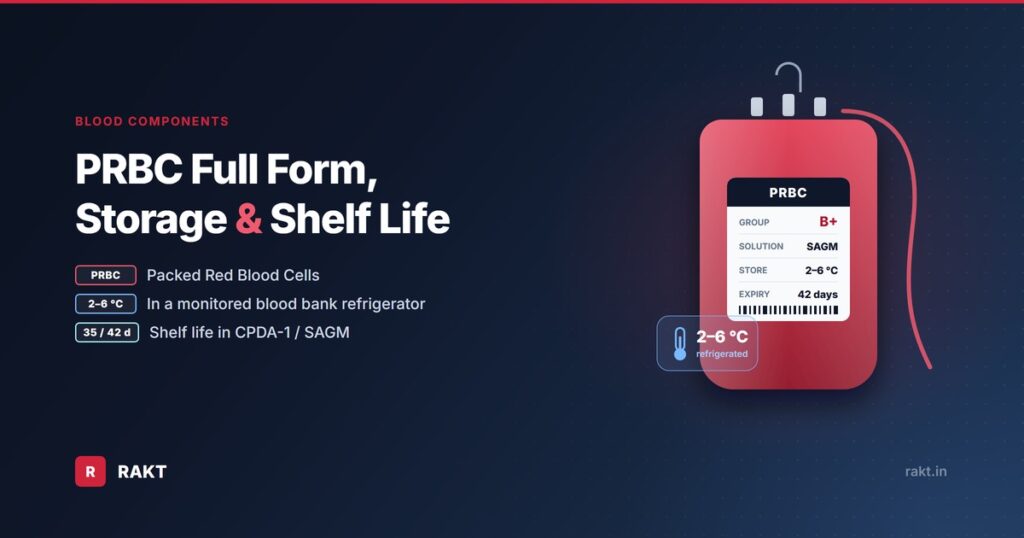
A doctor writes “2 units PRBC” on a blood requisition form. The patient’s family rushes to the blood centre, and the first question at the counter is often simple: what does PRBC mean? New technicians and nurses ask the same thing about the bag in their hands.
It is worth knowing well, because red cells are the blood component India needs most. A 2022 national study estimated India’s yearly clinical demand at 6.61 million units of red cell concentrates. That is more than the 6.35 million units of whole blood, and about three times the demand for plasma or platelets.1
This guide explains the PRBC full form in plain words, and everything that follows from it: how PRBC is made, how it is stored, how long it lasts and how much one unit helps a patient. Every number comes from Indian rules and national guidance, so you can rely on it at the counter, on the ward or during an inspection.
PRBC Full Form and Meaning
The full form of PRBC is Packed Red Blood Cells. It is the red cell part of donated blood, left behind after most of the plasma is removed. India’s Drugs and Cosmetics Rules define it as the packed red blood cells “remaining after separating plasma from human blood”.2
You will see other names for the same component on forms and labels:
- PRC: packed red cells
- RCC: red cell concentrate
- Packed cells or simply red cells
All of these mean the same thing. Because the plasma is removed, PRBC gives the patient the oxygen-carrying red cells they need in a smaller volume than whole blood.
How PRBC is Made From Whole Blood
PRBC starts as a normal whole blood donation, usually collected into a double, triple or quadruple blood bag. The bag is spun in a centrifuge. The heavy red cells settle at the bottom, and the plasma on top is pressed into a connected satellite bag. Indian rules require blood components to be made in a closed system like this, so the blood is never exposed to air. For red cells alone, a single bag with a transfer bag is also allowed.2
The rules also set a deadline. PRBC must be separated within 21 days of collection if the blood is in ACD solution, and within 35 days if it is in CPDA-1. A small amount of plasma is left with the red cells to keep them healthy.2 If the bag has an additive solution such as SAGM, it is mixed into the red cells after separation.
The same donation can then give plasma and platelets as separate components. That is why one donor can help more than one patient. Our guide to SDP vs RDP platelets explains the platelet side. Our guide to component separation records shows what a centre must log at this step.
PRBC at a Glance
These are the standard values for a PRBC unit in India.
| Feature | PRBC standard |
|---|---|
| Full form | Packed Red Blood Cells |
| Volume | About 250 ml (±10%) from a 450 ml bag; about 150 ml (±10%) from a 350 ml bag2 |
| Haematocrit | 65 to 70% in CPDA-1; 50 to 60% in SAGM2 |
| Storage temperature | 2 to 6 °C in a monitored blood bank refrigerator2 |
| Shelf life | 35 days in CPDA-1; up to 42 days in SAGM3 |
| Crossmatch | Required before every transfusion3 |
| Time to transfuse | Start within 30 minutes of issue; finish within 4 hours3 |
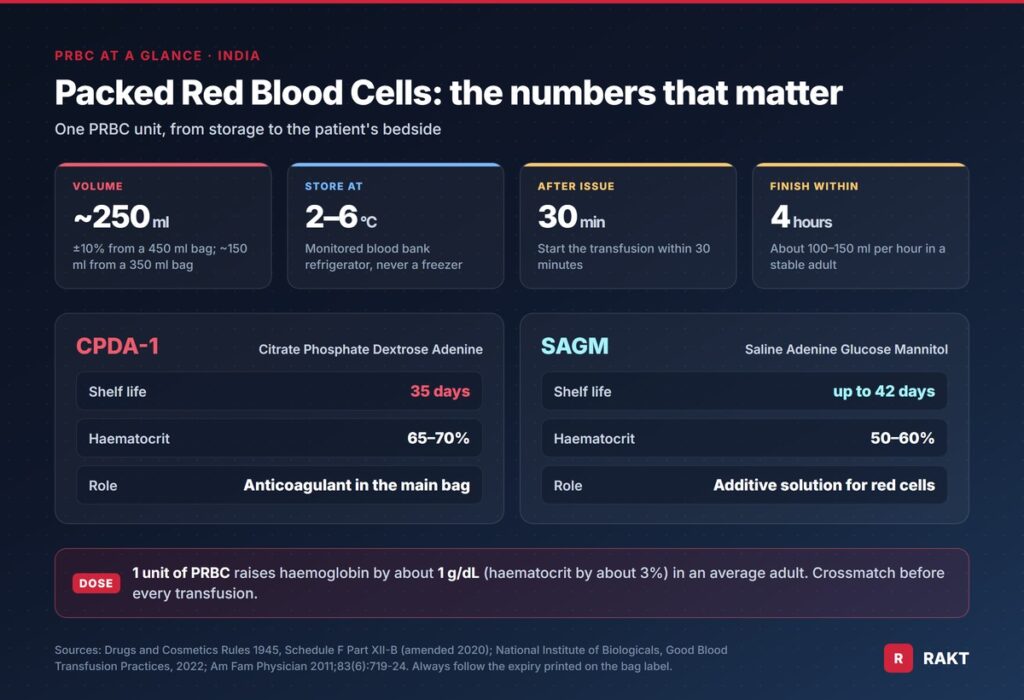
Two of these numbers cause the most confusion: the storage temperature and the shelf life. Both are worth understanding in a little more detail.
PRBC Storage Temperature and Shelf Life
PRBC must be kept at 2 to 6 °C as soon as it is processed.2 The cold slows down the red cells’ use of sugar, so they stay alive for weeks. It also slows the growth of any bacteria in the bag. Never put PRBC in a freezer compartment or the chill tray of a fridge. Frozen red cells burst (haemolyse) unless a special cryoprotective is added first.2, 3
The shelf life depends on the solution in the bag:
- CPDA-1: 35 days from collection
- SAGM or similar additive solutions: up to 42 days2
Always go by the expiry date printed on the label, because it reflects the exact bag used. The rules also require staff to inspect PRBC at separation, during storage and again at issue. A unit with abnormal colour or any sign of contamination must not be issued.2 For every other component, see our full blood storage temperature and shelf life chart.
CPDA-1 vs SAGM: Full Forms and Why the Shelf Life Differs
CPDA-1 and SAGM are the two solutions you will see most often on PRBC labels in India. They do different jobs. For every anticoagulant and bag type, from single to quadruple bags, see our guide to blood bag types and anticoagulants.
| CPDA-1 | SAGM | |
|---|---|---|
| Full form | Citrate Phosphate Dextrose Adenine | Saline Adenine Glucose Mannitol |
| What it is | Anticoagulant in the main collection bag | Additive solution in a satellite bag |
| When it is added | At collection, 14 ml for every 100 ml of blood2 | To the red cells, after the plasma is removed |
| PRBC shelf life | 35 days | Up to 42 days2 |
| PRBC haematocrit | 65 to 70% | 50 to 60%2 |
Each part of the name has a role. Citrate stops the blood from clotting. Phosphate keeps the pH steady. Dextrose (in CPDA-1) and glucose (in SAGM) are both sugar, which feeds the red cells. Adenine helps them keep making energy, which is what extends their life. In SAGM, saline keeps the cells suspended in fluid, and mannitol protects the red cell walls from breaking.
The practical difference is simple. SAGM units last a week longer and flow more easily, because they are less thick. That extra week gives a centre more time to find a patient before the unit expires.
Most centres stock both types, so two expiry clocks run side by side in the same refrigerator. RAKT records the anticoagulant and bag type when each bag is entered, gives every component its own expiry, and shows near-expiry stock on the home dashboard each morning. See how RAKT tracks stock and expiry.
PRBC vs Whole Blood: What is the Difference?
Whole blood is the donation as it was collected, with red cells, plasma and platelets together. PRBC is only the red cells.
| Whole blood | PRBC | |
|---|---|---|
| Volume | 365 to 560 ml | About 150 to 250 ml |
| Haematocrit | 30 to 40% | 50 to 70% |
| Blood group options | Patient’s own group only | Compatible alternate groups allowed |
| Main use | Neonatal exchange transfusion; acute bleeding when PRBC is not available | Most red cell transfusions |
Source: National Institute of Biologicals, 2022.3
National guidance is clear that routine use of whole blood should be discouraged. Platelets in stored whole blood lose their function within 24 hours of cold storage. So the patient gets extra fluid without any real platelet benefit.3 PRBC gives the red cells without the extra volume, which matters for elderly patients and those with heart problems. It also frees the plasma and platelets for other patients.
When is a PRBC Transfusion Given?
A PRBC transfusion, often called a packed cell transfusion, replaces red cells lost to bleeding or severe anaemia. The decision always belongs to the treating doctor. Indian national guidance follows a “restrictive” approach, which means transfusing only when it is really needed.3
- Stable adult patients: PRBC is usually not indicated until haemoglobin falls to 7 g/dL, including in critically ill patients.
- Orthopaedic or cardiac surgery, or existing heart disease: a threshold of 8 g/dL is recommended.
- Adults who are not bleeding: give one unit at a time, then check the patient and the haemoglobin again before the next unit.
These thresholds do not apply to everyone. Patients with acute coronary syndrome, severe low platelets or long-term transfusion needs, such as thalassaemia, follow separate rules.3 The same guidance also says patients do not need “fresh” units. PRBC of any age within its shelf life can be used.3
How Much Does 1 Unit of PRBC Raise Haemoglobin?
In an average adult, one unit of PRBC raises haemoglobin by about 1 g/dL and haematocrit by about 3%.4 The actual rise depends on the patient’s weight and on any ongoing bleeding.
Children, and patients on regular transfusions such as those with thalassaemia, are dosed by body weight instead. With PRBC of 65% haematocrit, about 3 to 4 ml per kg raises haemoglobin by 1 g/dL.3
How Long Does a PRBC Transfusion Take?
Timing matters as much as storage. Once PRBC leaves the blood centre, the transfusion should start within 30 minutes. The whole unit should be finished within 4 hours.3 For a stable adult who is not bleeding, the usual rate is 100 to 150 ml per hour.3
A few bedside rules keep the transfusion safe:3
- Use a blood transfusion set with a 170 to 200 micron filter.
- Use only normal saline in the same line. Dextrose solutions are not compatible with PRBC.
- If the unit is not used, return it to the blood centre straight away, with confirmation that it was kept cold.
- Avoid keeping PRBC in a domestic fridge on the ward. Return it to the blood centre’s refrigerator instead.
Compatible Blood Groups for PRBC
Unlike whole blood, PRBC can be given from a compatible group when the patient’s own group is not available. The national guidance sets this order of choice.3
| Patient’s group | PRBC groups that can be given (in order of choice) |
|---|---|
| A positive | A positive or negative, then O positive or negative |
| B positive | B positive or negative, then O positive or negative |
| AB positive | AB, then B, then A, then O (positive or negative) |
| O positive | O positive or negative |
| A negative | A negative, then O negative |
| B negative | B negative, then O negative |
| AB negative | AB negative, then B negative, then A negative, then O negative |
| O negative | O negative only |
A crossmatch is still required before every PRBC transfusion. Rh positive PRBC may be given to an Rh negative patient only as a life-saving measure. This applies to limited groups, such as elderly men and women past menopause, after a negative antibody screen and with informed consent.3
At a busy counter, the crossmatch result is easy to lose between the register and the issue slip. In RAKT, the crossmatch result is recorded for each unit, and the compatibility report prints with the invoice at issue.
Special Types of PRBC
Some patients need red cells that have been processed further. Indian rules recognise these modified types:2
- Leucodepleted red cells: white cells are filtered out to prevent fever reactions, antibody formation or CMV infection.
- Washed red cells: washed with sterile saline to remove plasma, for patients with allergic reactions.
- Irradiated red cells: treated with 25 Gy of radiation to prevent graft versus host disease in high-risk patients.
- Frozen red cells: stored at -80 to -196 °C with a cryoprotective, mainly for rare blood groups.
- Paediatric aliquots: one unit split into smaller sterile portions for babies.
PRBC Price in India
Blood itself is not sold in India. Patients pay a processing charge that covers collection, testing, separation and storage. In 2022, the Directorate General of Health Services revised these charges to ₹1,100 per unit at government blood centres and ₹1,550 per unit at non-government centres, for both whole blood and PRBC.5
Rates can vary by state, and extra processing such as leucodepletion or irradiation may cost more. Ask the blood centre for its current rate list before paying.
What Blood Centres Must Track for Every PRBC Unit
Behind each PRBC bag, a licensed centre has to keep a clear trail. The rules ask for pilot sample tubes attached to every unit in a tamper-proof way. They also ask for records of every ACD, CPD, CPDA and SAGM bag, with the manufacturer, batch number and test results.2 Every unit’s expiry must then be watched until it is issued or discarded.
On paper, this is where mistakes creep in. A unit near expiry gets missed, or a bag is issued before its tests are entered. Our guide to blood component expiry records shows what inspectors check.
RAKT closes these gaps. A component cannot be allotted until grouping and TTI screening are complete. Expiry is checked again at allotment, so an expired unit is refused at the counter rather than found later in the register. Untested stock is held apart from released stock, and every discard is linked to the approval behind it. Book a demo on WhatsApp to see it on your own registers, or see everything RAKT tracks.
Frequently asked questions
What is the full form of PRBC?
PRBC stands for Packed Red Blood Cells. It is the red cell part of donated blood, left after most of the plasma is removed. It is also called PRC, packed cells or red cell concentrate.
What is the storage temperature of PRBC?
PRBC is stored at 2 to 6 °C in a monitored blood bank refrigerator. It must never be frozen without a cryoprotective, because the red cells would burst.
What is the shelf life of PRBC?
PRBC lasts 35 days in CPDA-1 and up to 42 days in an additive solution such as SAGM. Always follow the expiry date on the label.
What is the difference between PRBC and whole blood?
Whole blood contains red cells, plasma and platelets together. PRBC contains mainly red cells, so it gives the same oxygen-carrying benefit in a smaller volume and leaves the plasma and platelets for other patients.
How much does 1 unit of PRBC increase haemoglobin?
In an average adult, one unit of PRBC raises haemoglobin by about 1 g/dL and haematocrit by about 3%. When dosing by weight, about 3 to 4 ml per kg of PRBC raises haemoglobin by 1 g/dL.
How long does it take to transfuse 1 unit of PRBC?
The transfusion should start within 30 minutes of the unit leaving the blood centre and finish within 4 hours. A usual rate for a stable adult is 100 to 150 ml per hour.
What are the full forms of CPDA and SAGM?
CPDA stands for Citrate Phosphate Dextrose Adenine, the anticoagulant in the collection bag. SAGM stands for Saline Adenine Glucose Mannitol, an additive solution that lets red cells last up to 42 days.
What is the price of 1 unit of PRBC in India?
After the 2022 revision, the processing charge is ₹1,100 per unit at government blood centres and ₹1,550 at non-government centres. Rates can vary by state and for specially processed units.
Sources
- Mammen JJ, Asirvatham ES, Lakshmanan J, et al. The clinical demand and supply of blood in India: A national level estimation study. PLoS One. 2022;17(4):e0265951 pmc.ncbi.nlm.nih.gov
- Drugs and Cosmetics Rules, 1945, Schedule F, Part XII-B, as amended by G.S.R. 166(E), 11 March 2020 cdsco.gov.in
- National Institute of Biologicals, Ministry of Health and Family Welfare. Good Blood Transfusion Practices: Guidance for Rational Use of Blood. 2022 nib.gov.in
- Sharma S, Sharma P, Tyler LN. Transfusion of blood and blood products: indications and complications. Am Fam Physician. 2011;83(6):719-724 aafp.org
- “Union Govt revises processing charges for blood components”, The Tribune, 22 June 2022 tribuneindia.com