
Compliance & Accreditation · November 17, 2026
NAT Test Blood: How Nucleic Acid Testing Works in Indian Blood Centres
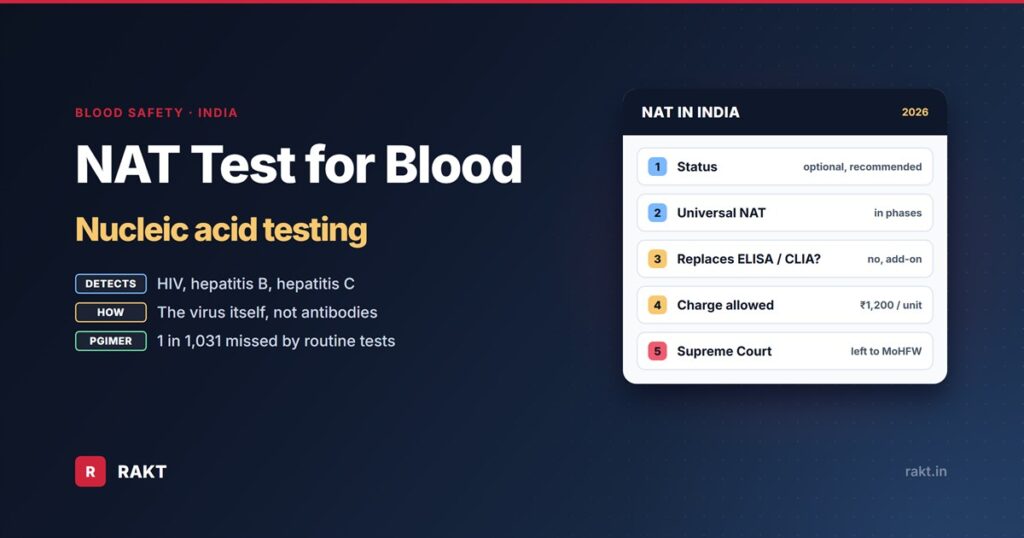
A donation can pass every mandatory test and still carry a virus. The tests looked for the body’s response to infection, and the body had not responded yet.
It happens more often than most people expect. At PGIMER Chandigarh, 1 in every 1,031 donations that had passed routine screening was NAT reactive.1
This guide explains what a NAT test blood is, why routine tests miss some infections, what India’s rules say about NAT, and what adding it means for a blood centre.
What is a NAT Test Blood?
NAT stands for nucleic acid testing. It screens donated blood by looking directly for the genetic material of HIV, hepatitis B and hepatitis C, rather than for antibodies or antigens. In India, it is an optional but recommended test, added on top of routine screening.2
| At a glance | NAT for donated blood |
|---|---|
| Full form | Nucleic acid testing (also nucleic acid amplification testing) |
| What it looks for | HIV-1/2 RNA, hepatitis C RNA and hepatitis B DNA |
| How | Real-time PCR or transcription-mediated amplification (TMA) |
| Status in India | Optional but recommended; universal NAT recommended in phases |
| Replaces routine tests? | No. It is added on top of ELISA or CLIA |
| Charge allowed | ₹1,200 per unit under the 2022 processing charge guidelines |
The figures come from the national standards for blood centres; the charge is covered under “Adding NAT to a blood centre” below.2
Why Routine Tests Miss Some Infections
Every unit of blood in India is tested for HIV I and II, hepatitis B, hepatitis C, syphilis and malaria.3 For HIV and hepatitis, the routine tests (ELISA or CLIA) look for antibodies or antigens: signs that the body is reacting to an infection.2
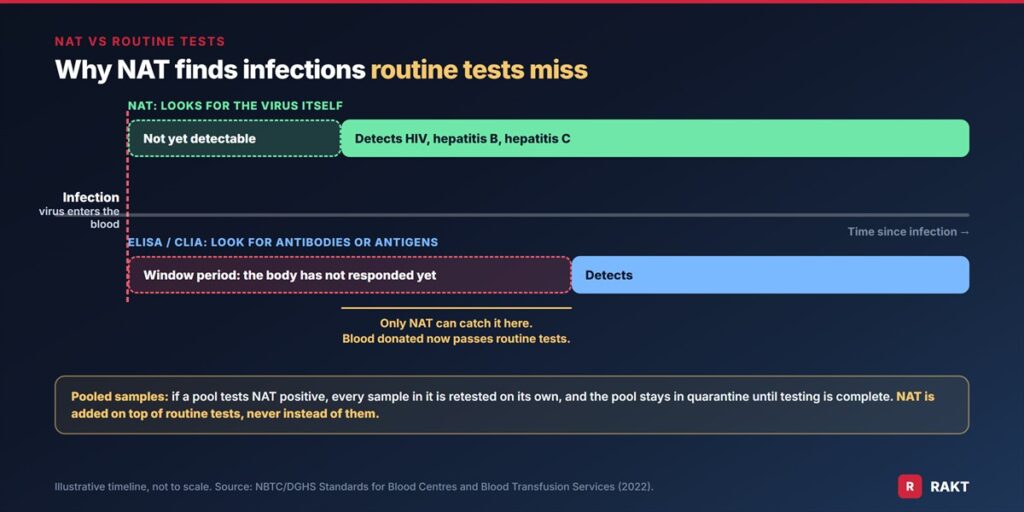
That reaction takes time. Early in an infection, a donor can carry the virus before any antibody or antigen can be detected. This gap is called the window period, and blood donated during it can pass routine tests.2
The national standards list four causes of this remaining risk:2
- The window period: an early infection that serology cannot yet detect.
- Low-level carriers: donors with a chronic infection who keep testing negative.
- Non-seroconverters: people who never develop detectable antibodies.
- Errors: laboratory, human, mechanical or technical mistakes.
The standards add that this residual risk may be significant in areas where infection is common in the general population.2
How NAT works
NAT finds a short stretch of the virus’s own genetic code in the blood sample, copies it many times over, and then detects it.2 Because it looks for the virus itself, it can find an infection earlier than a test that waits for the body’s response. That is how NAT shortens the window period.2
Two techniques are in use: real-time polymerase chain reaction (PCR) with fluorescence detection, and transcription-mediated amplification (TMA) with chemiluminescence detection.2
Individual donation NAT vs minipool NAT
- Individual donation NAT (ID-NAT): each donation’s sample is tested on its own.
- Minipool NAT (MP-NAT): samples from several donations are mixed and tested together.
If a pool tests positive, every sample in it must be retested individually, and the pool stays in quarantine until that testing is complete.2
Is NAT Mandatory in India?
No. The national standards call NAT “an optional but recommended test” for reducing the residual risk of infection.2 Three points from the standards matter most:
- Universal NAT is the goal. The standards say universal NAT testing in blood centres is recommended, and may be brought in step by step.2
- It is an add-on, not a replacement. Blood centres should not replace routine screening with NAT, but use it as an additional test.2
- Routine tests stay mandatory. Every unit still needs its HIV, hepatitis B, hepatitis C, syphilis and malaria tests.2, 3
The 2026 Supreme Court case
In February 2026, a public interest petition asked the Supreme Court to make NAT compulsory in every blood bank in India. The bench asked for details of NAT availability in state hospitals and what it would cost.4
On 13 March 2026, the Court declined to hear the petition. It said deciding whether to mandate a new medical technology needs specialised medical and policy judgement, and that a mandate would add a financial burden on states. The petitioner was allowed to take the matter to the Ministry of Health and Family Welfare instead.5
So, for now, NAT remains a choice each blood centre or state makes, guided by the national standards.
What NAT Finds: Data From India
Detailed Indian figures come from the Postgraduate Institute of Medical Education and Research (PGIMER), Chandigarh. Over three years, from 2013 to 2015, it tested 168,433 donations by individual donation NAT.1
| Finding (PGIMER, 2013 to 2015) | NAT yield |
|---|---|
| All infections, among donations that passed routine tests | 1 in 1,031 |
| Hepatitis B | 1 in 1,465 |
| Hepatitis C | 1 in 3,885 |
| HIV-1 | 1 in 167,069 |
| Replacement donors | 1 in 498 |
| Voluntary donors | 1 in 1,320 |
“NAT yield” means infections that NAT caught after routine tests had passed the donation. In this study, most were hepatitis B. The authors estimated that NAT prevented about 150 transfusion-transmissible infections a year at their centre.1 The gap between replacement and voluntary donors is one more argument for voluntary donation.
These are one centre’s figures, not national ones. But they show why NAT is recommended: even a careful blood centre can still issue some infected units if it relies on routine tests alone.
A shared model: Madhya Pradesh
NAT costs more than routine testing, a point the Supreme Court itself noted.5 Not every centre needs its own equipment. In Madhya Pradesh, samples from 24 satellite blood centres are sent to NAT hubs in Indore and Bhopal, with results reported within 48 hours of collection.6 A hub-and-spoke model like this lets smaller centres offer NAT without buying an analyser.
Adding NAT to a Blood Centre
A centre that starts NAT needs a few things in writing before the first sample runs.
1. A release policy
NAT results can arrive after routine results. The standards require centres doing NAT to have a policy for releasing blood once ELISA or CLIA is complete but NAT is still pending, especially in urgent cases.2
2. A pooling rule
If the centre pools samples, its procedure must say that every positive pool is retested individually and quarantined until testing is complete.2
3. A donor recall process
Some donors will be NAT reactive while their routine tests are negative. The standards say these “NAT yield” donors should be recalled and advised to go for clinical consultation.2 Our guide to TTI testing records covers the records behind recall and referral.
4. A charge on the bill
The 2022 processing charge guidelines allow ₹1,200 per unit for NAT.7 NAT is run once per donation, and our guide to blood price in India shows how that charge appears on a real bill.
NAT vs ELISA and CLIA
| ELISA or CLIA | NAT | |
|---|---|---|
| What it detects | Antibodies or antigens: the body’s response | The virus’s own genetic material |
| Window period | Longer | Shorter |
| Status in India | Mandatory on every unit | Optional but recommended |
| Can it replace the other? | No | No |
The comparison follows the national standards.2 The two work together: routine tests on every unit, with NAT as an extra layer of safety.
NAT Results Against the Right Bag
A NAT result is only useful if it lands against the right bag, before that bag is issued. RAKT keeps NAT in the same screening record as every other infection test:
- TTI screening records HIV, HBsAg, HCV, VDRL, MP and NAT, read off the analyser or keyed in.
- A reactive TTI result moves the bag to the lab on its own, out of stock.
- A component cannot reach tested stock until both TTI screening and blood grouping are complete.
See how RAKT captures TTI and NAT results, or book a demo on WhatsApp.
Frequently asked questions
What is the NAT test in a blood bank?
It is a screening test that looks directly for the genetic material of HIV, hepatitis B and hepatitis C in donated blood. It can find infections that routine antibody and antigen tests miss early in an infection.
What is the full form of NAT in blood banks?
Nucleic acid testing. It is also called nucleic acid amplification testing, because the test copies the virus’s genetic material many times so it can be detected.
Is NAT testing mandatory in India?
No. The national standards call it optional but recommended, and recommend bringing in universal NAT in phases. In March 2026, the Supreme Court declined a petition to make it mandatory and left the matter to the Health Ministry.
What does NAT detect?
NAT assays used in blood centres detect HIV-1/2 RNA, hepatitis C RNA and hepatitis B DNA.
What is the difference between NAT and ELISA?
ELISA looks for the body’s response to an infection, such as antibodies or antigens. NAT looks for the virus itself, so it can detect infection earlier and shorten the window period.
Does NAT replace ELISA?
No. The national standards say blood centres should not replace routine screening with NAT. NAT is used as an additional test on top of ELISA or CLIA.
What is NAT yield?
NAT yield is the number of infections NAT finds in donations that had already passed routine tests. At PGIMER Chandigarh, it was 1 in 1,031 donations, mostly hepatitis B.
How much can a blood centre charge for NAT?
The 2022 processing charge guidelines allow ₹1,200 per unit for NAT, on top of the processing charge for the component.
What happens if a donor’s NAT is reactive but routine tests are negative?
The unit should not be issued. Under the national standards, the donor should be recalled and advised to go for clinical consultation.
What did the Supreme Court say about NAT?
On 13 March 2026, it declined to order mandatory NAT in all blood banks. It said this was a medical and policy decision, and allowed the petitioner to approach the Health Ministry.
Sources
- Hans R, Marwaha N, Sharma S, Sachdev S, Sharma RR. Initial trends of individual donation nucleic acid testing in voluntary & replacement donors from a tertiary care centre in north India. Indian J Med Res. 2019;149(5):633-640 pmc.ncbi.nlm.nih.gov
- National Blood Transfusion Council and Directorate General of Health Services, Ministry of Health and Family Welfare. Standards for Blood Centres and Blood Transfusion Services. 2nd edition, 2022 clinicalestablishments.mohfw.gov.in
- Drugs and Cosmetics Rules, 1945, Schedule F, Part XII-B, as amended by G.S.R. 166(E), 11 March 2020 cdsco.gov.in
- LiveLaw. PIL in Supreme Court seeks compulsory NAT testing in all blood banks across India. 25 February 2026 livelaw.in
- LiveLaw. Supreme Court refuses to entertain plea for mandatory NAT test in blood banks. 13 March 2026 livelaw.in
- Yadav A, Khan R, Tripathi A, Bhadauria RS, Tandon P, Choudhary R. Blood safety: the Madhya Pradesh centralized nucleic acid testing (NAT) model for blood donor screening. Cureus. 2026;18(1):e100798 pmc.ncbi.nlm.nih.gov
- Directorate General of Health Services, Ministry of Health and Family Welfare. Revised Guidelines-2022 for Recovery of Processing Charges for Blood and Blood Components. 14 June 2022 eraktkosh.mohfw.gov.in