
Blood Bank Software · October 30, 2026
e-BloodBank vs RAKT: Which Blood Bank Software Fits Your Centre?
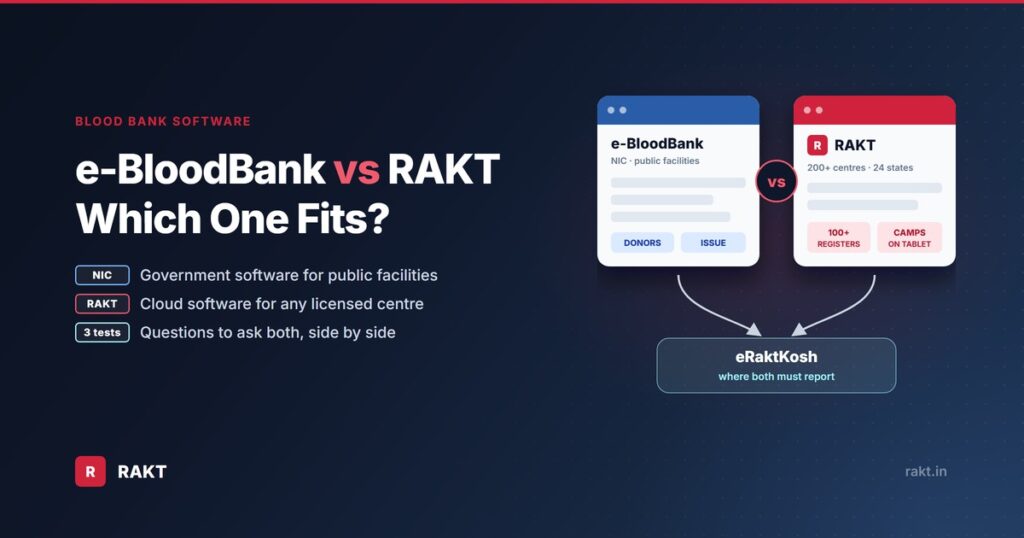
When a government blood centre looks at paid software, the same question usually comes up. Why pay for a system when the government already offers e-BloodBank?
It is a fair question, because e-BloodBank is real and in use. In April 2022, NIC reported that e-BloodBank was running in 65 blood banks, with more than 2 lakh donors registered and 2,522 blood camps organised through it.2. Its users include large centres such as AIIMS (CNC) New Delhi and NIMHANS Bengaluru.1
So the honest answer is not “RAKT is better”. It depends on who you are and how your centre works. This guide explains the difference between eBloodBank vs RAKT and what e-BloodBank does, who can use it, where it may suit you better than RAKT, and where RAKT may suit you better. It ends with three questions that settle the choice on facts rather than brochures, including ours.
What is e-BloodBank?
e-BloodBank is blood centre software built and run by the National Informatics Centre (NIC). NIC calls it “An end to end Solution for managing Blood Transfusion Center or Storage Unit”.1 It is part of NIC’s e-Hospital suite, alongside the e-Hospital hospital management system and the Online Registration System (ORS) patient portal.2
It runs as Software-as-a-Service on cloud infrastructure. One version of the application is shared by many blood banks across states, which NIC describes as a multi-tenant setup.1 According to NIC, it covers these areas:1, 2
- Donor management: pre-screening, registration, vitals and blood group capture.
- Bleeding and screening: collection entry, TTI screening and adverse reaction entry.
- Components and apheresis: component preparation, quality checks and apheresis records.
- Transfusion: requests from the hospital system, crossmatching, issue and transfusion reactions.
- Camps: camp registration, donor entry and e-Donor Cards.
- Transfers: stock moving between a mother blood bank and its storage centres.
NIC also lists a mobile app for citizens and blood banks, dashboards, and links to biometric devices, lab analysers and RFID. It says the system follows NACO, Drugs and Cosmetics Act and NABH guidelines.1 NIC also lists a State Blood Transfusion Monitoring application among its access points. For help, NIC runs a 24×7 helpdesk on +91-7859939940 and ehospital@gov.in.1
Difference between e-BloodBank, eRaktKosh and e-Hospital
People who search for “ebloodbanking” or “e blood bank” often mean one of three different government systems. The names sound alike, but each does a different job.
| System | Built by | What it does |
|---|---|---|
| e-BloodBank | NIC | Runs the daily work inside a blood centre: donors, testing, components, issue and camps |
| eRaktKosh | C-DAC, for the Health Ministry | The national portal for blood availability, donors and camps, which every licensed blood centre reports into3 |
| e-Hospital | NIC | Hospital management software for public hospitals, which can send blood requests to e-BloodBank2 |
| RAKT | RAKT Innovations | Runs the daily work inside a licensed blood centre and submits returns to eRaktKosh |
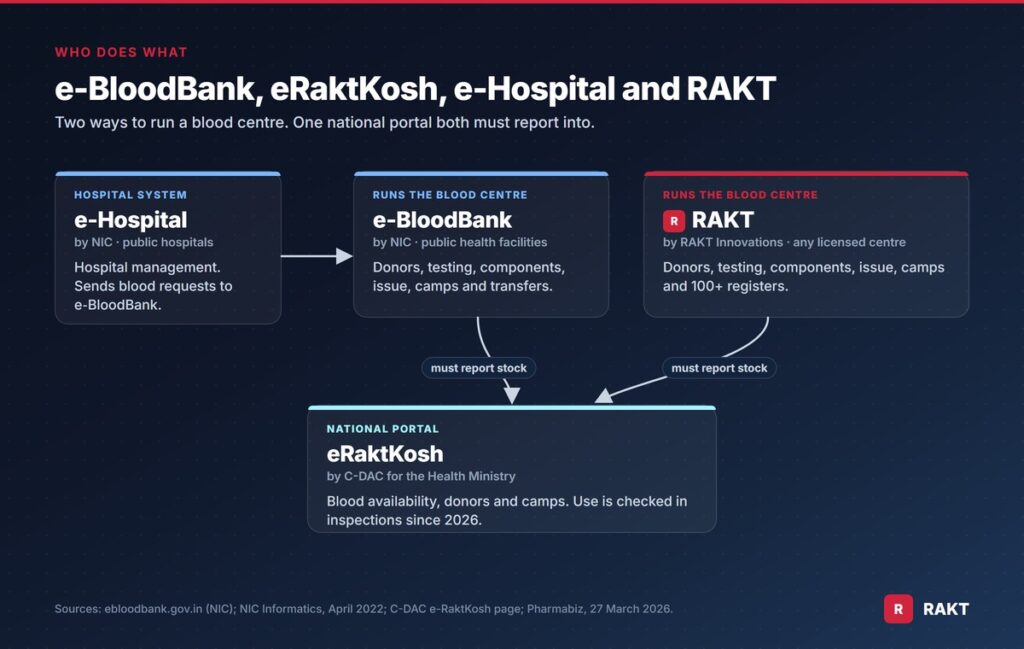
The difference that matters most is this. eRaktKosh is where your data must end up. e-BloodBank and RAKT are two ways of producing that data from the work your staff does every day. You can see how RAKT builds and sends the return on our eRaktKosh reporting page.
Who can use e-BloodBank?
NIC offers its e-Hospital suite, which includes e-BloodBank, to public health facilities.2 That makes it a natural fit for government hospital blood centres, especially those whose hospital already runs e-Hospital.
NIC’s public pages do not publish a price list or say how private, trust-run or voluntary blood centres can join. If your centre is not a public facility, ask the NIC helpdesk whether you can onboard before you plan around it.
Why you might choose e-BloodBank over RAKT
There are good reasons to pick e-BloodBank, and you should weigh them honestly.
- Your hospital already runs e-Hospital. Blood requests can come straight from the hospital system, without a separate integration.1, 2
- Your state has rolled it out. In states where e-BloodBank is the standard, your SBTC may already monitor centres through it.1
- Procurement is hard. A government application avoids buying from a private vendor, which can be slow for a public facility.
If all three apply to you, e-BloodBank may be the simpler path. If they do not, the next section is what to test.
What RAKT does, stated so you can test it
We will not tell you what e-BloodBank can or cannot do inside a live centre. We cannot see that from its website. Instead, here is what RAKT does. Each point can be checked in a demo.
- The release checks cannot be skipped. A unit cannot be allotted until grouping and TTI screening are complete. A reactive result moves the bag out of issuable stock on its own.
- Registers fill themselves. Over a hundred registers and returns, including the Donor, TTI, Grouping, Crossmatch and Issue registers, are generated from the work as it happens.
- eRaktKosh is submitted, not retyped. The return is built from bags already entered, checked against the national format, and sent to the Health Ministry’s API in one step. The portal’s reply appears on the same screen.
- Every entry has a name. Staff sign in with passkeys on their own devices, so every record shows who changed it and when.
- Camps run on a tablet. RAKT Pass registers donors at the camp, and camp bags reconcile with the centre the same day.
- Leaving costs nothing. You can export your data as CSV whenever you want.
RAKT is used by more than 200 blood centres in 24 states, including private, charitable and hospital-run centres. It is sold per centre, with a quote based on licences, bags a month, and modules. Ask us to fail any of these points in a live demo.
Three questions to ask e-BloodBank, and to us
Brochures from both sides will sound similar. These three questions show the real difference in under an hour.
- “Show me last month’s eRaktKosh return being produced.” Ask how it is built, how it is sent, and where the acknowledgement is stored. Since March 2026, eRaktKosh registration and use are checked during inspections, so this matters for every centre.4
- “Try to issue an untested unit.” Ask what stops the counter, and whether anyone can override it.
- “Register five donors at a camp with weak internet.” Ask how the camp bags reach your stock, and how long it takes.
Put the same questions to both, and compare the answers you see rather than the ones you are told. If e-BloodBank answers one better than we do, it may be the right choice for you. Our other blood bank software comparisons follow the same approach.
Moving from e-BloodBank to RAKT
If you decide to switch, the move is shorter than most centres expect. A single centre usually goes live in two to three days. Day one sets up your licence, register formats and users. Day two imports donors, donation history, deferrals and existing stock. Day three trains staff on their own shifts.
You can keep your current system running alongside RAKT for as long as you want. Nobody is asked to switch anything off on day three. To see this on your own registers, book a demo on WhatsApp or read our 11-test guide to choosing blood bank software.
Frequently asked questions
What is e-BloodBank?
e-BloodBank is blood centre software built by the National Informatics Centre (NIC). It manages donors, testing, components, issue, camps and stock transfers, and runs as a cloud service shared by many blood banks.
Is e-BloodBank the same as eRaktKosh?
No. e-BloodBank runs the daily work inside a blood centre. eRaktKosh is the national portal, built by C-DAC for the Health Ministry, where blood centres report stock and where the public checks blood availability.
Is e-BloodBank free?
NIC offers its e-Hospital suite, including e-BloodBank, to public health facilities as a cloud service. Its public pages do not publish a price, so confirm terms with the NIC helpdesk.
Can a private blood centre use e-BloodBank?
NIC’s public material describes the suite as offered to public health facilities. Private, trust-run and voluntary centres should ask NIC directly whether they can onboard.
How do I log in to e-BloodBank or get support?
Staff use the e-BloodBank web application, and NIC also offers an Android app. For login problems, NIC lists a 24×7 helpdesk on +91-7859939940 and the email ehospital@gov.in.
Can I move my data from e-BloodBank to RAKT?
Yes. RAKT imports donor records, donation history, deferrals and existing stock during go-live. You can keep e-BloodBank running alongside until you are ready to stop.
Sources
- e-BloodBank, National Informatics Centre (page last updated 6 January 2022) ebloodbank.gov.in
- “e-Hospital Suite: Augmenting the Public Healthcare System Digitally”, Informatics, NIC, April 2022 informatics.nic.in
- e-RaktKosh (Centralized Blood Bank Management System), C-DAC cdac.in
- “CDSCO goes for strict implementation of registration of blood centres in e-RaktKosh portal”, Pharmabiz, 27 March 2026 pharmabiz.com