
Blood Bank Software · October 29, 2026
Blood Storage Temperature and Shelf Life Chart for Every Blood Component (India)
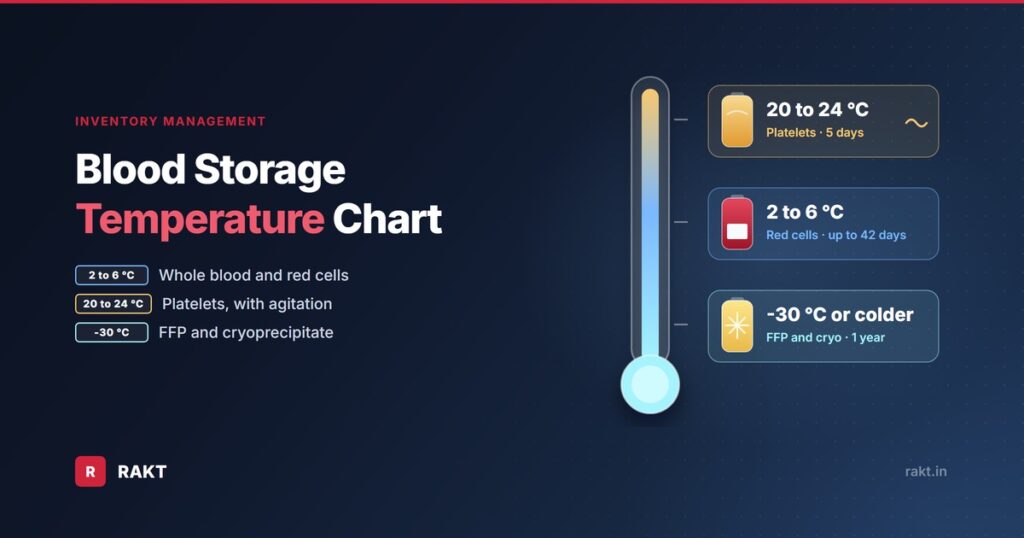
A blood unit can be perfectly matched and fully tested, and still be unusable. This happens when it is stored at the wrong temperature or kept on the shelf too long. Of the two, expiry is usually the bigger loss for Indian blood centres.
At one tertiary care hospital in Maharashtra, 4,026 blood components were discarded over three years. Expiry caused 86% of those discards.1 Each of those units came from a donor who gave their time, and from staff who tested and processed it.
The good news is that the storage rules are fixed and clear. India’s Drugs and Cosmetics Rules set the temperature and maximum storage period for every component. This guide puts the correct blood storage temperature and shelf life for each component in one chart, and explains why each one is stored differently. It also covers the daily checks that keep units usable until a patient needs them.
Blood Storage Temperature and Shelf Life Chart
Each value below comes from Schedule F, Part XII-B of the Drugs and Cosmetics Rules, 1945, as amended in 2020, unless marked otherwise.2
| Component | Storage temperature | Maximum shelf life | Key condition |
|---|---|---|---|
| Whole blood | 2 to 6 °C | 21 days in ACD or CPD bags; 35 days in CPDA-1 bags3 | Keep tested and untested units in separate refrigerators |
| Packed red blood cells (PRBC) | 2 to 6 °C | 35 days in CPDA-1; up to 42 days in SAGM3 | Inspect at separation, during storage and at issue |
| Frozen red cells | -80 to -196 °C | As validated by the manufacturer | A cryoprotective agent is added before freezing |
| Platelets (RDP and SDP) | 20 to 24 °C | 5 days | Continuous gentle agitation; never refrigerate |
| Pooled platelets (open system) | 20 to 24 °C | 6 hours | A closed-system pool takes the earliest expiry of its units |
| Granulocytes | 20 to 24 °C | 24 hours | Use as soon as possible |
| Fresh frozen plasma (FFP) | -30 °C or colder | 1 year | Freeze within 6 hours of collection |
| Cryoprecipitate | -30 °C or colder | 1 year from collection | An open-system pool lasts only 6 hours |
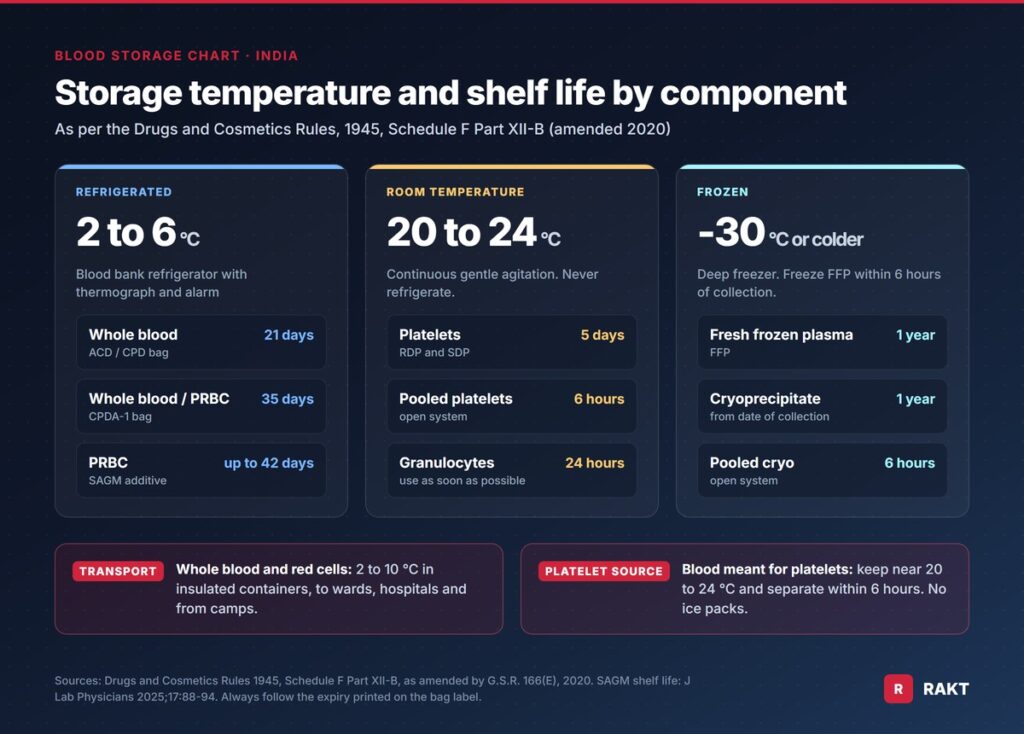
The chart shows three very different temperature zones. That is not an accident. Each component survives best under different conditions, and knowing why makes the rules easier to follow on a busy shift.
Why Each Blood Component Needs a Different Temperature
Red cells are kept cold, at 2 to 6 °C. Cooling slows down their metabolism, so they use up their nutrients slowly and stay healthy for weeks. The cold also slows the growth of any bacteria in the bag.
Platelets work the other way. If they are chilled, they change shape and the body clears them quickly after transfusion. So they are stored at room temperature, 20 to 24 °C, and kept moving on an agitator. Room temperature also lets bacteria grow faster, which is why platelets last only 5 days.
Plasma is frozen because its clotting factors break down quickly in liquid form. Factor VIII is especially fragile. Freezing plasma within 6 hours of collection, at -30 °C or colder, locks these proteins in for up to a year.2
With the reasons clear, the rules for each component follow naturally.
Whole Blood and Red Cells: 2 to 6 °C
Whole blood and packed red cells share the same refrigerator range of 2 to 6 °C. What changes their shelf life is the solution in the bag.3
- ACD or CPD: up to 21 days
- CPDA-1: up to 35 days
- SAGM (additive solution): up to 42 days
The rules link these limits to processing too. Packed red cells must be separated within 21 days of collection if the blood is in ACD, and within 35 days if it is in CPDA-1.2 Always follow the expiry printed on the label, because it reflects the exact bag and solution used.
Two further rules matter every day. Tested and untested blood must be stored in separate refrigerators.2 And packed red cells must be inspected at separation, during storage and again at issue. A unit with abnormal colour, haemolysis or signs of contamination must not be issued.2
Platelets: 20 to 24 °C with Constant Agitation
Platelets are the component most likely to expire on your shelf, because they last only 5 days. Store them at 20 to 24 °C with continuous gentle agitation for the whole storage period.2 Never put platelets in a refrigerator, even for a short time.
Pooling changes the clock. If you pool random donor platelets in an open system, using spikes, the pool expires 6 hours later. If you pool in a closed system, with a sterile connecting device, the pool takes the expiry date of the unit that expires first.2 Our guide to SDP vs RDP platelets covers dose and preparation in more detail.
Fresh Frozen Plasma and Cryoprecipitate: -30 °C or Colder
Fresh frozen plasma must be frozen within 6 hours of collection. It is then stored at -30 °C or colder for up to one year.2 A -80 °C deep freezer helps freeze plasma faster, which the rules recommend when the plasma will be used to make cryoprecipitate.2
Cryoprecipitate is made by thawing FFP slowly, at 4 °C in a blood bank refrigerator or cold room, or at 4 to 10 °C in a cryobath. Once prepared, it is stored at -30 °C or colder for up to one year from the date of collection. An open-system pool of cryoprecipitate lasts only 6 hours.2
Once plasma is thawed for transfusion, do not refreeze it. Issue it as soon as possible, within the time limit set in your centre’s SOP.
Equipment the Rules Require for Blood Storage
Holding these temperatures is not possible with ordinary appliances. The rules list the equipment a licensed blood centre must have.2
- Blood bank refrigerators that hold 2 to 6 °C, with a digital dial thermometer, a recording thermograph, an alarm and a continuous power supply.
- Deep freezers that hold -30 to -40 °C, and -75 to -80 °C.
- A platelet agitator with incubator, where platelets are prepared.
- A cryobath or refrigerated water bath for thawing plasma.
- Insulated containers that keep blood between 2 and 10 °C during transport.
A domestic fridge does not meet these requirements. It has no recording thermograph or alarm, so a failure overnight would go unnoticed until morning.
How to Transport Blood and Components Safely
Storage rules do not stop at the refrigerator door. Whole blood and red cells sent to wards, hospitals or back from a camp must travel in insulated containers at 2 to 10 °C.2
Whole blood that will be used to make platelets is different. Keep it as close as possible to 20 to 24 °C from collection until processing. The platelets must then be separated within 6 hours.2 Packing these bags with ice at a camp ruins the platelets before they are made. Frozen plasma and cryoprecipitate should stay frozen until they reach the user.
What to Do When the Temperature Goes out of Range
Even good equipment fails sometimes. A power cut, a door left open or a faulty compressor can push a refrigerator outside 2 to 6 °C. When the alarm sounds, act in this order:
- Move the units to a working backup refrigerator or freezer and keep them in quarantine.
- Record the time the excursion started, the highest or lowest temperature reached, and how long it lasted.
- Ask the medical officer to decide, unit by unit, whether each one can be released or must be discarded.
- Record the decision, the reason and the corrective action taken on the equipment.
Write it down while the details are fresh, because an inspector will ask for this trail. Our guide to cold-chain excursion records shows exactly what to keep.
How to Stop Blood Components Expiring on the Shelf
Correct temperatures keep units safe, but they do not stop expiry. That needs a daily routine.
- Issue the earliest expiry first. Place stock so that the unit expiring soonest is the easiest to reach.
- Review near-expiry stock every morning. Flag platelets a day or two before they expire, and red cells about a week before.
- Keep eRaktKosh stock current. Hospitals and patients’ families search eRaktKosh for available units. If your stock is up to date, a unit near expiry can still reach a patient. See our guide to eRaktKosh stock reconciliation.
- Move surplus early. If a nearby licensed centre needs a group you have in excess, transfer it before it expires, following the bulk transfer rules.
- Track your discard rate. Outdated units are one of the quality indicators NABH assessors review. Our guide to NABH quality indicator records explains how to calculate it.
Doing this on paper takes time, and a busy counter makes it easy to miss a unit. RAKT shows near-expiry components on the home dashboard each morning. It checks expiry again at allotment and links every discard to its bag and to the medical officer’s approval. See how RAKT tracks stock and expiry, or book a demo on WhatsApp to see it running on your own workflow.
Frequently asked questions
How long can blood be stored?
It depends on the bag. Whole blood lasts up to 21 days in ACD or CPD, and up to 35 days in CPDA-1. Red cells in SAGM can last up to 42 days. Platelets last 5 days, while FFP and cryoprecipitate last up to one year when frozen.
Why are platelets not stored in a refrigerator?
Cold makes platelets change shape, and the body then clears them quickly after transfusion. Storing them at 20 to 24 °C with agitation keeps them working.
What is the storage temperature of fresh frozen plasma?
FFP must be stored at -30 °C or colder. It must be frozen within 6 hours of collection and can be kept for up to one year.
Can blood be stored in a normal fridge?
No. The rules require a blood bank refrigerator that holds 2 to 6 °C, with a digital thermometer, a recording thermograph, an alarm and a continuous power supply.
At what temperature should blood be transported?
Whole blood and red cells should travel at 2 to 10 °C in insulated containers. Blood meant for platelet preparation should stay close to 20 to 24 °C until it is processed.
What temperature is blood stored at in a blood bank?
The right blood storage temperature depends on the component. Whole blood and red cells are stored at 2 to 6 °C. Platelets are kept at 20 to 24 °C with gentle agitation. Fresh frozen plasma and cryoprecipitate are stored at -30 °C or colder.
Sources
- Chavan SK. Determination of rate and analysis of reasons for discarding blood and blood components in a blood bank of tertiary care hospital: a retrospective study. Int J Res Med Sci. 2017;5(3):1111-1115. msjonline.org
- Drugs and Cosmetics Rules, 1945, Schedule F, Part XII-B, as amended by G.S.R. 166(E), 11 March 2020. cdsco.gov.in
- Changes in hematological and biochemical parameters and rate of hemolysis during the storage of packed RBC units: a prospective study. J Lab Physicians. 2025;17:88-94. jlabphy.org