
Blood Bank Software · October 27, 2026
SDP vs RDP in Blood Banking: A Complete Guide to Platelet Transfusion
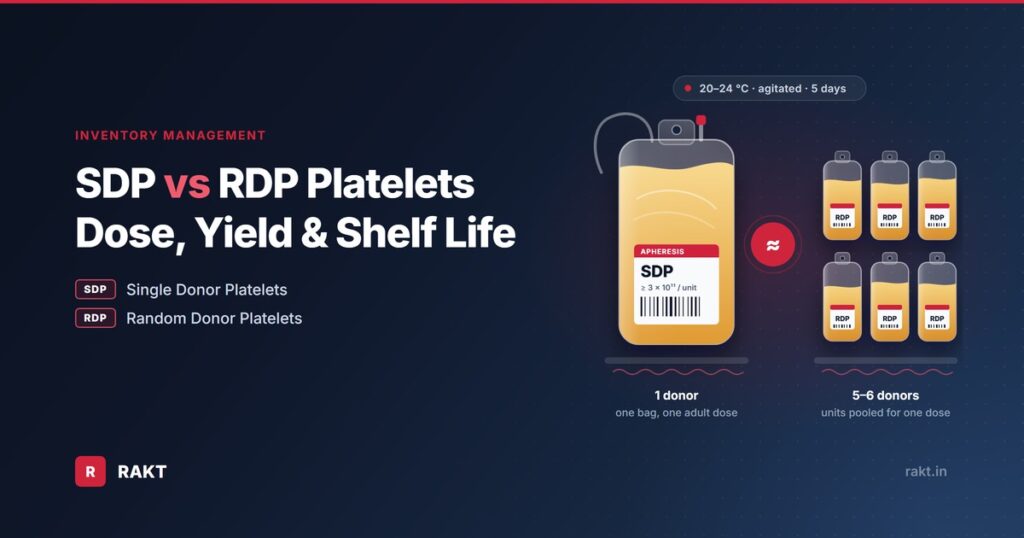
SDP stands for single donor platelets: platelets collected from one donor on a cell separator (apheresis), with the rest of the blood returned to the donor. RDP stands for random donor platelets: the platelet concentrate separated from one ordinary whole blood donation. One SDP bag is an adult dose on its own. An RDP unit is not, so an adult usually needs five or six RDP units, which means platelets from five or six different donors.
The differences of SDP vs RDP that matter on your shelf are dose, donor exposure, how each product is made, and what each costs the patient. The rules that govern both in India are in Schedule F, Part XII-B of the Drugs and Cosmetics Rules, as amended in 2020. 1
SDP vs RDP Difference at a Glance
| RDP (random donor platelets) | SDP (single donor platelets) | |
| Source | One whole blood donation, by the platelet-rich plasma or buffy coat method | One donor on a cell separator (plateletpheresis) |
| Donors per adult dose | 5–6 | 1 |
| Typical volume | 40–50 ml2 | 200–300 ml2 |
| Minimum platelet content (India) | 3.5 × 10¹⁰ from a 350 ml bag; 4.5 × 10¹⁰ from a 450 ml bag1 | 3 × 10¹¹ per unit1 |
| Expected rise in an adult | About 5,000–7,000/µL per unit2 | About 30,000–50,000/µL per bag2 |
| Storage | 20–24 °C, continuous gentle agitation1 | 20–24 °C, continuous agitation1 |
| Shelf life | Up to 5 days1 | Up to 5 days1 |
| Leucocyte reduction | Not by default; needs a filter | Built into most apheresis systems2 |
| Availability | Made from routine donations, so usually on the shelf | Needs a willing, eligible donor and a machine slot |
SDP and RDP full forms in Medical Use
In a blood centre, SDP full form is single donor platelets and RDP full form is random donor platelets. Outside medicine, SDP and RDP have unrelated meanings (in networking, for example), which is why a search for the abbreviation alone gives mixed results.
The 2020 amendment to Schedule F names the platelet products a licensed blood centre can prepare:1
- Platelet-rich plasma: plasma rich in platelets, separated from whole blood.
- Random donor platelet concentrate: prepared from platelet-rich plasma or from buffy coat.
- Pooled platelets: up to six random donor units pooled into one bag.
- Single donor platelets: collected by plateletpheresis. This includes washed, leucoreduced, plasma-replaced and “double” SDP from one donor.
Your component register should use the same names. That keeps your stock, your issue register and your eRaktKosh return consistent.
How RDP is Prepared
An RDP unit comes from a whole blood bag you have already collected. Under Schedule F, you must:1
- Hold the whole blood as close to 20–24 °C as possible from collection to processing, including during transport.
- Separate the platelets within 6 hours of collecting the whole blood.
- Separate them in a closed system by centrifugation, from platelet-rich plasma or buffy coat.
- Resuspend the platelets in enough of the original plasma to keep the pH at 6 or above until the end of storage.
For quality control, test 1% of the platelet units you prepare. At least 75% of the units tested must meet the minimum count: 3.5 × 10¹⁰ per unit from a 350 ml bag, or 4.5 × 10¹⁰ from a 450 ml bag. Check platelet count, pH, plasma volume and sterility at the end of the storage period.1
The 6-hour limit is where most RDP losses start. A camp bag that reaches the centre late can still give you red cells and plasma, but not platelets. Your component separation record should show collection time and separation time side by side, so an inspector can see the limit was met.
How SDP is Collected
SDP is collected on a cell separator in an air-conditioned apheresis area of at least 10 square metres.1 The 2020 donor selection criteria for plateletpheresis are:1
- Age 18–60 years and weight at least 50 kg.
- Haemoglobin at least 12.5 g/dL, the same as for whole blood donors.
- At least 48 hours between apheresis procedures, no more than twice a week, and no more than 24 times a year.
- At least 28 days since the donor last gave whole blood.
- No aspirin in the 3 days before donation.
After an SDP donation, the donor can give whole blood 28 days later if the red cells were fully returned. If they were not, the donor must wait 90 days.1 A collection takes much longer than a whole blood donation, so SDP donors are booked rather than walk-ins.
For quality control, at least 75% of tested apheresis units must contain 3 × 10¹¹ platelets or more. Test 1% of monthly production or 4 units a month, whichever is higher. The pH must be 6 or above at the end of the permitted storage period.1
Dose: How Much Does One Unit Raise the Count?
India’s national dengue guideline, which has a section on platelet products, gives these working figures:2
- Adult dose: 5–6 units of RDP or one unit of SDP.
- One RDP unit: raises the count by about 5,000–7,000/µL in an adult and about 20,000/µL in a child.
- One SDP unit: raises the count by about 30,000–50,000/µL. One SDP holds about 3 × 10¹¹ platelets, equal to 5–6 RDP, which is why it is called the “jumbo pack”.
- Neonates and infants: 10–15 ml/kg body weight.
These are averages. The actual rise is lower in heavier patients and in patients who are febrile, bleeding, or refractory after repeated transfusions. That is why clinicians check a post-transfusion count instead of assuming the increment.
Pooled RDP: The Shelf-Life Rule People Miss
A single RDP unit is not a therapeutic adult dose. Schedule F therefore allows up to six RDP units, preferably ABO and RhD matched, to be pooled into one bag. The pooled product should contain more than 2 × 10¹¹ platelets.1
Shelf life depends on how you pool: 1
- Open system (pooling with spikes): the pool expires 6 hours after pooling.
- Closed system (sterile connecting device): the pool takes the expiry of the contributing unit that expires first.
Label the pooled bag like any other platelet product, plus a unique pool number or the donation numbers of every contributing unit. Without that, you cannot trace a reaction back to the five or six donors behind one bag.
Storage and shelf life
Store SDP and RDP at 20–24 °C with continuous gentle agitation, for up to 5 days.1 Platelets are never refrigerated, which is the main way they differ from red cells and plasma. Because they are kept at room temperature, bacterial contamination is a bigger risk with platelets than with refrigerated or frozen components. This is one reason the storage period is short and sterility testing is part of quality control.
Before issue, check each unit for functional viability by its swirling appearance.1 With a 5-day expiry, platelets are the component most likely to expire on your shelf, so your daily stock review should flag platelets a day or two before expiry, not on the day. Our guide to component expiry records covers the trail from flag to disposal.
ABO and RhD for Platelets
Crossmatching is not required for platelet concentrates. ABO-identical platelets are preferred where available, but non-identical ABO platelets are acceptable when stock is short.2 If a platelet concentrate is contaminated with red cells, Schedule F requires ABO grouping for a compatible transfusion.1
RhD-negative patients, especially women who have not reached menopause, should get RhD-negative platelets where possible. If a woman of childbearing potential receives RhD-positive platelets, anti-D is recommended. A 300 IU dose covers six SDP or 30 RDP RhD-positive units over 6 weeks.2
When SDP is Chosen over RDP
The choice belongs to the treating clinician, but the reasoning usually runs like this:
- SDP is preferred for patients who will need repeated platelet transfusions, such as those with haematological cancers or on intensive chemotherapy. Fewer donor exposures mean less risk of alloimmunisation and refractoriness. SDP is also used when a patient needs leucoreduced or HLA-selected platelets.
- RDP is enough for most one-off needs, and it is usually the faster product to issue because it is already on the shelf. It is also far cheaper per unit.
Both products work. They differ in donor exposure, convenience and cost, not in whether the platelets function.
Dengue Season: Platelet Requests vs the National Guideline
Every monsoon and post-monsoon season, centres see a surge of relatives asking for SDP for a dengue patient. The National Guidelines for Clinical Management of Dengue Fever (2023) are clear:2
- Prophylactic platelet transfusion is not recommended for thrombocytopenia alone.
- It may be considered at counts below 10,000/µL without bleeding, for patients who may need emergency surgery, and for adults with underlying hypertension and a count below 10,000/µL.
- In severe bleeding with a count below 50,000/µL and deranged coagulation (PT, APTT, fibrinogen, D-dimer), platelets and FFP may be given.
The guideline cites a randomized trial in adults with counts of 20,000/µL or less and no significant bleeding. Prophylactic platelets did not prevent bleeding any better than supportive care, and they caused adverse events.2 If your centre gets a spike in SDP requests, keeping this guideline at the reception counter helps your medical officer explain why a request may not be needed.
What SDP and RDP Costs for the Patient in India
Blood cannot be sold in India. Blood centres can recover only a processing charge.
- A DCGI letter of December 2023 told states that blood centres may charge only processing fees, reported as ₹250–1,550 for blood or blood components.4
- Press reports on the 2022 DGHS revision say non-government centres may charge up to ₹11,000 for platelets collected by the single donor method. That figure reflects the cost of the apheresis kit.3
- The same revision lets private centres add ₹1,200 per unit for NAT testing or ₹500 for chemiluminescence testing.3
- Patients with thalassaemia, haemophilia, sickle cell anaemia or blood dyscrasias must receive blood and components without processing charges.3
So one SDP costs much more than one RDP unit. Against a pool of 5–6 RDP units, the gap is smaller. Check your state’s current notification before printing a rate card, because states issue their own orders.
What Your Records Should Show for Every Platelet Unit
An assessor who picks one platelet unit off your issue register should be able to retrieve:
- The parent bag number and the platelet component number, or the apheresis donation number for an SDP.
- Collection time and separation time, showing the 6-hour limit was met for RDP.
- The expiry date, plus the 6-hour expiry for an open-system pool.
- For a pool, the pool number and every contributing donation number.
- For an SDP donor, the last apheresis and whole blood donation dates, to show the 48-hour and 28-day intervals were met.
- Quality control results for the month: count, pH, volume and sterility.
- The ABO and RhD group of the unit and the patient, and any anti-D given.
If any of these depends on someone finding a loose sheet, the record is incomplete. It is the same donor-to-recipient traceability rule you apply to red cells, with a shorter clock.
Frequently asked questions
What is the full form of SDP and RDP in medical terms?
SDP is single donor platelets, collected from one donor by apheresis. RDP is random donor platelets, separated from a single whole blood donation.
What is the full form of SDP and RDP in medical terms?
SDP is single donor platelets, collected from one donor by apheresis. RDP is random donor platelets, separated from a single whole blood donation.
Which is better, SDP or RDP?
Neither is better in every case. SDP gives a full adult dose from one donor, which matters for patients who need repeated transfusions. RDP is cheaper and usually available immediately. The treating clinician decides based on the patient’s condition and what the centre has in stock.
How much does one unit of SDP increase the platelet count?
About 30,000–50,000/µL in an adult, according to India’s 2023 dengue guideline. One RDP unit raises it by about 5,000–7,000/µL.2
How many RDP units equal one SDP?
About 5–6 RDP units, because one SDP holds roughly 3 × 10¹¹ platelets.2
Can platelets be stored in a refrigerator?
No. SDP and RDP are stored at 20–24 °C with continuous gentle agitation, for up to 5 days.1
How often can someone donate SDP?
At least 48 hours apart, no more than twice a week, and no more than 24 times a year. The donor must also wait 28 days after a whole blood donation.1
Sources
- Drugs and Cosmetics Rules, 1945, Schedule F, Part XII-B, as amended by G.S.R. 166(E), 11 March 2020. cdsco.gov.in
- National Guidelines for Clinical Management of Dengue Fever, 2023. National Center for Vector Borne Diseases Control, MoHFW. ncvbdc.mohfw.gov.in
- “Union govt revises processing charges for blood components”, The Tribune, 22 June 2022. tribuneindia.com
- “Hospitals, blood banks can only charge processing fees for blood: Govt”, Blitz India Media, 4 January 2024. blitzindiamedia.com