
Audit-ready because the records were right the first time
Statutory registers, NABH quality indicators and eRaktKosh submissions all derive from the same operational data — so the week before an assessment stops being a data-assembly exercise.
Live from your bags
Units behind every %
Generated, not typed
Cites BTS / Sch F rules
What stays continuously current
Not generated on request — maintained as the work happens.
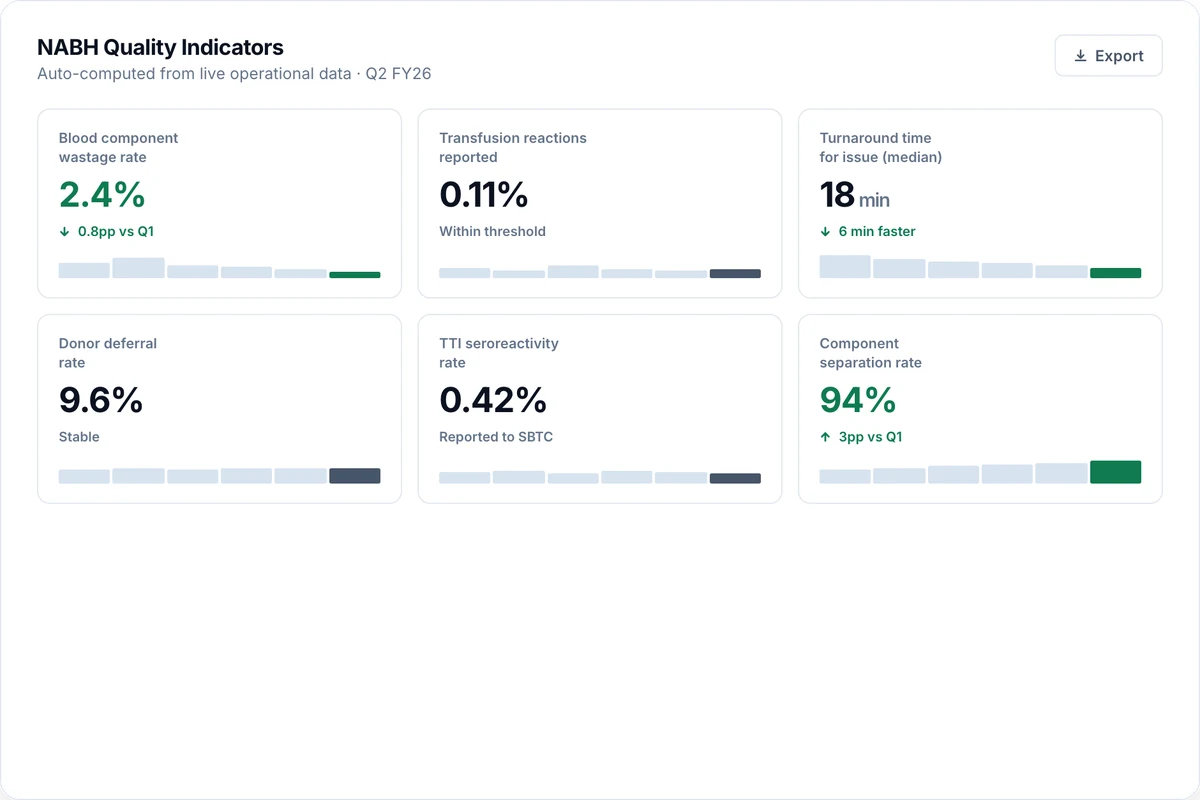
NABH Performance Indicators
TTI reactive rate, adverse transfusion reactions, turnaround time of whole blood and RBC issue, voluntary donation share, deferrals, outdated units and QNS.
The registers by name
Donor Register, TTI Register, Grouping Register, Issue Register, Crossmatch Register, Component Preparation Record, Disposition Register and Discard Register.
eRaktKosh submissions
Scheduled reporting with acknowledgements retained against every record.
Full audit trail
Who changed what and when, on every record, retained and searchable.
Discard reasons, not just totals
Every discard carries a reason and an MO approval, so the wastage figure can be explained rather than only reported.
Drill down from any number
Every indicator traces back to the bags behind it, which is the next thing an assessor asks for.
What an assessor actually opens
Indicators from operational data
Performance Indicators compute TTI %, adverse reactions, TAT, voluntary share, outdated units, deferrals and more from the bags you already entered.
Click through to the units
Each percentage has an AJAX drill-down to the underlying records. That is the difference between a chart and something an assessor can verify.
Registers as views of the floor
Statutory and MIS registers are generated from the same donor, bag and issue models — corrections stay as corrections with an actor.
Compliance questions in Ask RAKT AI
Read-only tools cite NABH BTS, Drugs & Cosmetics Schedule F XII-B and NBTC rules. The AI will not mark a unit released.
Indicators you can open, not charts you screenshot
NABH performance indicators on RAKT are computed from the bags, issues and discards already on the floor. Each percentage has a drill-down to the units behind it.
- TTI %, adverse reactions, TAT, voluntary share, outdated units, deferrals and QNS
- Click through from the percentage to the underlying bag list
- Statutory registers generated from the same models — not typed the week before
- Supports the evidence trail; RAKT is not a NABH certification body
What is actually being asked of you, and by whom
Three different bodies want three different things, and conflating them is why compliance feels heavier than it is. The Drugs & Cosmetics Act, 1940 is the licensing instrument: Schedule F Part XII-B sets out which records a licensed blood centre keeps, for how long, and requires them to be produceable on inspection. NBTC and your State Blood Transfusion Council set standards for collection, testing, component preparation and transfusion practice, and require periodic returns, and the state return format is the single thing that varies most, which is the practical argument for a report builder rather than a fixed list of reports. NABH is voluntary and increasingly what hospitals and insurers look for, and it asks for something different in kind: quality indicators computed over real periods.
That last difference is the one that decides how much work an assessment is. A register is a record of what happened, and you either kept it or you did not. An indicator is arithmetic over the operational record, computed across a defined period: discard rate by cause, component separation rate, turnaround time from request to issue, transfusion reaction rate, donor deferral rate, TTI reactive rate, outdated units, QNS. Assembling those by hand from registers is a week of somebody’s time and produces figures nobody can defend when the assessor asks which bags are behind a number. Derived continuously from the same operational data, they are already there, and every one drills back to the bags behind it.
What software cannot do is worth saying plainly, because the opposite is claimed often. No system makes a centre compliant. It can refuse a non-compliant action, record who attempted it, and produce the evidence on demand; it cannot make a deferral decision, cannot judge whether a donor is fit, and cannot make an entry honest. Every assessment we have supported has turned on whether the register and the return agree and whether a number can be traced to its bags, both of which are what deriving everything from one record buys you, and neither of which is a certificate anyone can sell you.
Questions about compliance made simple
Which statutory registers does RAKT generate?
Over a hundred registers and returns, including the Donor Register, Blood Grouping Register, TTI Register, Component Preparation Record, Stock Register, Crossmatch Register, Issue Register, Patient-Recipient Register, Sample Receiving Register, Discard and Disposition Register and Transfusion Reaction Register, plus a report builder for the format your state council asks for and nobody else does. All of them are generated from the operational record rather than typed a second time.
Does RAKT compute NABH performance indicators?
Yes, continuously rather than on request: TTI reactive rate, adverse transfusion reactions, turnaround time for whole blood and red cell issue, voluntary donation share, donor deferral rate, outdated units and QNS. Each drills back to the bags behind it, which is the next thing an assessor asks for after seeing the number, and the question a hand-assembled indicator usually cannot survive.
Will RAKT make our blood bank NABH accredited?
No, and any vendor who says otherwise is overselling. Accreditation assesses your processes, your staff and your facility; software is evidence, not compliance. What it removes is the data-assembly exercise: indicators computed over real periods, registers produceable on demand, every number traceable to its records, and an audit trail showing who did what. That is the part of an assessment that is usually a week of work, and it is the part that is genuinely automatable.
How long are records retained?
Retention is set by Schedule F obligations rather than by us, and those obligations outlast most software contracts, which has a practical consequence worth acting on: ask every vendor, including us, what a complete export looks like, in what format and at what cost. Records you cannot retrieve after leaving a vendor are a compliance exposure you bought rather than solved. With RAKT export is free and on request.
More of what RAKT does
See this running on your own floor
Tell us how your centre works today and we will show you the parts that would change.