
A blood centre that runs from anywhere
RAKT is delivered as a hosted service. There is no server in your store room, no annual reinstall, and no version drift between your centres — everyone works on the same system, updated continuously.
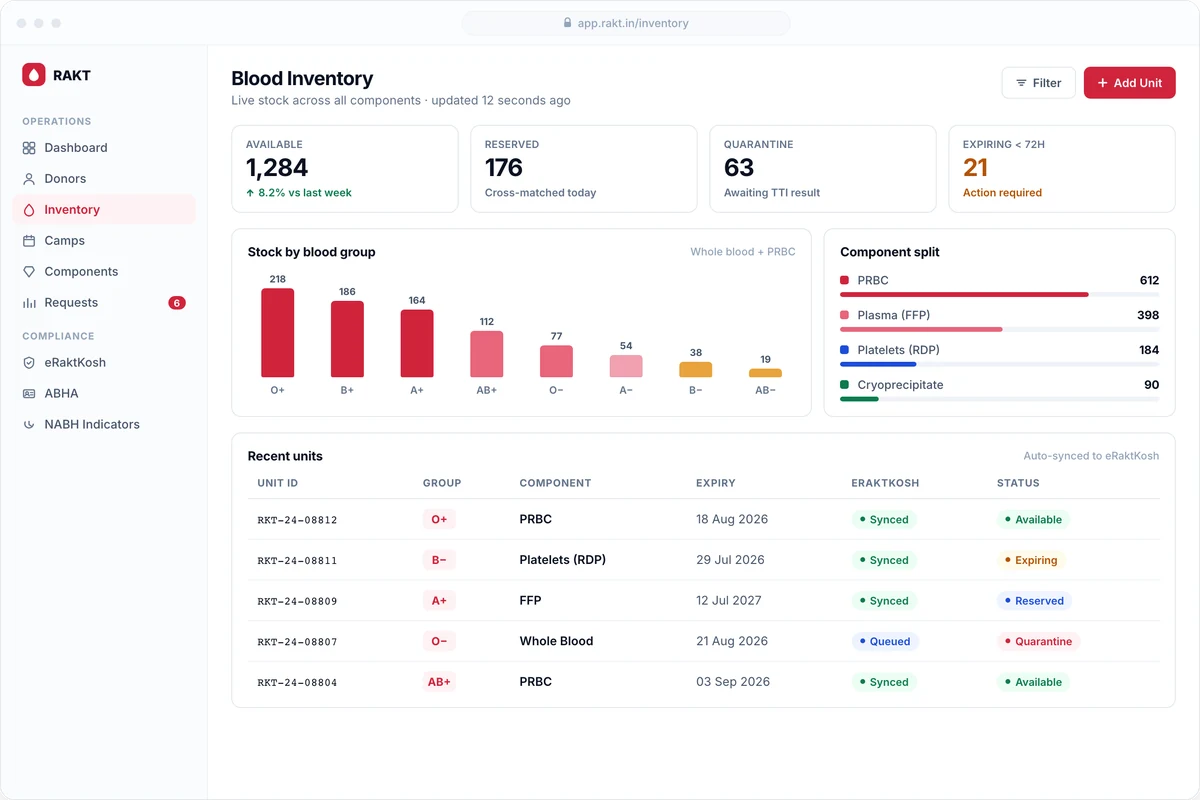
Centres on one hosted build
Version across every licence
Servers to patch at your site
Hosting region
What running on RAKT changes
The operational differences blood centres notice in the first month.
No local server to maintain
Nothing to patch, back up or replace. Hosting, upgrades and backups are handled for you.
Updates without downtime
New capability and statutory changes reach every centre at the same time, without a site visit.
Multi-centre from day one
Run several licences or storage centres under one account, with stock visibility across them.
Works on the devices you have
A responsive web application — desktops at the counter, tablets at camps, phones for quick checks.
Your data stays yours
Export your registers and records whenever you need them, in formats you can actually open.
Support that knows blood banking
Implementation and support handled by people who have set up blood centres, not a generic helpdesk.
How multi-centre actually works
One account, several licences
Each blood centre is its own Organisation. Staff with the right permission switch centre from the top bar without signing out.
Link the banks you trade with
BloodBankConnection records a relationship between centres. Inward stock from a linked bank lands in reception as a first-class workflow, not a spreadsheet paste.
Same build, same formats
Statutory and eRaktKosh template changes reach every centre the week they ship. Support reproduces what you see because you are not on three installed versions.
Leave with your registers
A complete export on request, in formats you can open, at no charge — Schedule F retention outlasts every software contract.
What the sequence looks like
- DAY 1Licence, centre and register formats configured. Users, roles and permissions set up.
- DAY 2Donor records, donation history, deferrals and existing back stock imported and reconciled.
- DAY 3Staff trained on their own workflow across the shifts they work. Go live.
Moving from your current system
Most centres come to RAKT with years of history in spreadsheets or a legacy desktop package. We import what you have so your donor base and stock history come with you.
- Donor records, donation history and deferrals imported before go-live
- Existing unit numbering and register formats preserved where you need continuity
- Staff trained on the workflow they actually run, not a generic demo
What hosting actually changes, and what it costs you
The usual argument for cloud blood bank software is that there is no server to maintain, which is true and is not the important part. The important part is version drift. A blood centre running an installed package is running whatever version was installed, and the statutory formats it produces are the formats that were current at install time. When a state council changes its return template or the eRaktKosh schema moves, an on-premise centre needs a site visit, a paid upgrade, or both, and until that happens it is filing in a format that is no longer accepted. Multiply that across three centres under one trust and they are on three versions producing three slightly different returns.
Hosting collapses that. Every centre is on the same build, format changes reach all of them the same week, and multi-centre stock visibility is a permission rather than a synchronisation project. The second-order effect is the one operators notice: because there is one version, support can reproduce what you are seeing. Half the time a blood bank spends on the phone about an installed system is spent establishing which version is on which machine.
The cost is honest and worth stating. You need working connectivity at the counter, and if yours drops for hours at a time then a hosted system will frustrate your staff at exactly the wrong moment, and an on-premise package is the better recommendation. We will say so on the call rather than after implementation. You are also renting rather than owning, which makes the exit question load bearing: a complete export of your registers, in a format you can open, at no cost and on request. Schedule F retention obligations outlast every software contract, so that has to be a right rather than a favour.
Questions about cloud-based blood bank software
Is cloud-based blood bank software safe for patient and donor data?
The relevant comparison is not cloud versus local, it is managed versus unmanaged. A hosted system gives you encryption in transit and at rest, patched infrastructure, access control by role and centre, and an audit log on every record, all maintained continuously. The most common real-world breach at a blood centre is not an attack on a data centre. It is a shared password on a machine in a corridor, and that risk is identical on-premise. RAKT is hosted in India, and passkey sign-in exists specifically to remove the shared-password problem.
What happens to our work if the internet goes down?
You lose access until it returns, which is the honest answer and the reason we ask about connectivity before quoting. Most centres run a mobile hotspot as a fallback, which is enough for a browser-based system at counter volumes. If your connectivity is unreliable for hours rather than minutes, tell us at the demo, a locally installed package is the right architecture for that site and we would rather say so than implement into frustration.
Can we run several blood centres on one account?
Yes, and this is where hosting pays for itself. Multiple licences or storage centres run under one account with stock visible across them, donors and deferral history shared rather than duplicated, and permissions set per centre so staff see only their own. Retrofitting that onto a single-centre installed system is a migration, not a setting, so it is worth asking about even if the second centre is hypothetical today.
How do we get our data out if we leave?
On request, complete, in formats you can open, at no charge. We treat this as a right rather than a service item because your registers are subject to statutory retention and a vendor who can invoice you for access to your own compliance records has a hold over you no blood centre should accept. It is worth asking every vendor you evaluate the same question and getting the answer into the contract.
More of what RAKT does
See this running on your own floor
Tell us how your centre works today and we will show you the parts that would change.